Projectors
Best Budget Home Theater Projector
We research every product against its spec sheet and independent measurements. When you buy through our links we may earn a commission, at no cost to you. How we score · Disclosure
The best budget home theater projector is the one that spends your money on light, lens and picture quality instead of marketing claims, and for most people in 2026 that is the Optoma UHD38x. It typically sells around the $1,000 mark and is rated at 4,000 lumens, with pixel-shift 4K and 4.2 ms gaming lag. That is more real brightness than many projectors costing twice as much.
This guide is for first-time projector buyers and anyone building a movie room on a tight budget. We split the picks into two tiers, under $500 and around $1,000, and checked every claim against the spec sheet, because the budget end of the market is where inflated lumens and "4K supported" labels hide the most.
Our top picks at a glance


Quick answer
The Optoma UHD38x is the best budget home theater projector: 4,000 lumens and 4K pixel shifting for around $1,000. Under $500, the Epson Home Cinema 880 is the safest buy, with 3,300 lumens from a real brand. Gamers on a budget should get the BenQ TH575 (16.7 ms lag), and if you want built-in streaming at 4K, the Epson Home Cinema 2350 is the pick.
On this page
- 1. Where Budget Projectors Cut Corners
- 2. How to Choose the Best Budget Home Theater Projector
- 3. The Best Budget Home Theater Projector
- 4. Budget Home Theater Projector Side by Side
- 5. How We Ranked These Budget Projectors
- 6. How Big a Screen Can a Budget Projector Fill?
- 7. Spending Less vs Spending a Little More
- 8. Hidden Costs of a Cheap Home Theater Projector
- 9. Who Should Buy a Budget Projector
- 10. Common Mistakes to Avoid
- 11. Frequently Asked Questions
1. Where Budget Projectors Cut Corners
A budget projector can look great, but you need to know where the savings come from:
- Contrast. This is the first thing to go. Budget DLP and 3LCD projectors produce grayish blacks in a dark room. In a room with some light, nobody notices, so cheap projectors are often better suited to living rooms than to blacked-out theaters.
- Lens flexibility. Most budget models have little or no optical zoom and no lens shift. You must place the projector at a specific distance and height, or use keystone correction, which discards pixels.
- Light source. Almost every bright projector under $1,000 uses a lamp. Lamps dim over time and need replacing; laser and LED models avoid that, but in this price range they either cost more, like the laser BenQ TK710, or are built for small, dark rooms, like the Dangbei N2 mini.
- Honest specs. The cheapest no-name projectors quote "lumens" with no standard attached, often five to ten times their real output. Stick to brands that publish ANSI lumens or ISO lumens.
- Resolution claims. "4K supported" usually means the projector accepts a 4K signal and downscales it. True budget 4K projectors use named pixel-shifting systems.
What budget projectors do not give up anymore is brightness. Several picks below out-shine projectors costing several times as much.
2. How to Choose the Best Budget Home Theater Projector
Five questions narrow the field quickly:
- How dark is the room? Dark room: brightness from 2,000 rated lumens is plenty and contrast matters more. Room with light: get 3,000 lumens or more.
- How big is the screen? Divide effective lumens by screen area to get foot-lamberts. A 100-inch screen is 29.7 sq ft; a 120-inch screen is 42.7 sq ft. Aim for at least 16 fL, and 30 fL or more for HDR or ambient light. With budget projectors, assume an accurate mode keeps about half the rated lumens.
- Where will it sit? Measure the distance to the screen and run it through the projector throw calculator. Little zoom means little room for error.
- Do you game? Look for a quoted input lag; the BenQ TH575 and Optoma models are far quicker than most budget projectors.
- Do you need 4K? Only if you sit within about 1.6 times the screen diagonal. Farther back, a good 1080p projector looks nearly identical.
3. The Best Budget Home Theater Projector

1. Optoma UHD38x
$1,000–$1,400 · Best for: Gaming rooms and bright mixed-use spaces
- Resolution
- 4K UHD (DLP with XPR pixel shifting)
- Brightness
- 4,000 ANSI lumens
- Input lag
- About 4.2 ms at 1080p/240 Hz; about 16 ms at 4K/60 (Optoma spec)
- Throw ratio
- About 1.5–1.65 (1.1x zoom)
The UHD38x wins because it does the one thing budget buyers need most, put a big bright picture on the wall, better than anything else at its price. Optoma rates it at 4,000 lumens. Assume an accurate movie mode keeps about half of that and you still have roughly 2,000 lumens, which works out to 47 fL on a 120-inch screen and 67 fL on a 100-inch screen. Either is comfortably above the 16 fL cinema reference, so you can watch with some light in the room.
It is also a genuine 4K projector, using a DLP chip with pixel shifting to put 3840 × 2160 detail on screen, with HDR10 and HLG support. Gamers get 4.2 ms input lag at 1080p/240Hz and about 16 ms at 4K/60Hz, numbers usually reserved for gaming monitors.
Who it suits: a family room, basement or bonus room used for movies, sports and games, especially one that never gets fully dark.
The trade-off: contrast and placement. In a pitch-black room, dark scenes look gray compared with Epson's more expensive UB models, and the narrow zoom range means you need to mount it close to the right distance. Use the projector throw calculator before you buy. Compared with the Epson Home Cinema 2350, the Optoma is brighter and faster for gaming; the Epson adds built-in apps and avoids DLP rainbow artifacts.
Pros
- 4,000 ANSI lumens, very bright for the money
- 1080p/240 Hz mode with about 4.2 ms lag (Optoma spec)
- 4K/60 gaming at about 16 ms (Optoma spec)
- Built-in speaker
Cons
- Only a 1.1x zoom and no lens shift
- Lamp needs periodic replacement
- Average black levels

2. Epson Home Cinema 880
$500–$650 · Best for: Bright family rooms and budget movie nights on a 100–120" screen
- Resolution
- 1080p (native, 3LCD)
- Brightness
- 3,300 ISO lumens (white and color)
- Light source
- Lamp
- HDR
- None
If your budget stops around $500, buy a real projector from a real brand rather than one of the dozens of "9,000 lumen" no-name boxes online. The Epson 880 is the safest choice. Epson rates it at 3,300 lumens for both color and white brightness, and that rating follows the ISO standard, so it means something.
It is native 1080p with Epson's 3LCD design, which avoids the rainbow artifacts some viewers see on single-chip DLP, and it is simple to set up: put it on a table or shelf, square it up and go. On a 100-inch screen, half its rated output is about 1,650 lumens, or roughly 56 fL, so it is bright enough for a living room with the lights dimmed rather than off.
The trade-off: it is a basic lamp projector. Contrast is modest, so dark scenes look grayish in a blacked-out room, there is no 4K, no HDR worth the name and no optical lens shift, so placement relies more on keystone correction (which softens detail). There are no built-in apps, so add a streaming stick.
Alternative: the Optoma HD146X is a similar 1080p lamp projector rated at 3,600 lumens. Pick whichever is cheaper on the day. If you can stretch, the BenQ TH575 below adds brightness and much lower input lag.
Pros
- 3,300 ISO lumens, equal white and color brightness
- Very low cost for that much light
- 3LCD design avoids the rainbow effect some viewers see with single-chip DLP
- Simple to set up on a table or shelf
Cons
- No optical zoom, so throw distance sets screen size
- No 4K or HDR input
- Contrast and black levels are basic
- No built-in streaming

3. BenQ TH575
$550–$700 · Best for: Bright-room sports, gaming and casual movie nights on a tight budget
- Resolution
- 1080p (native, DLP)
- Brightness
- 3,800 ANSI lumens
- Input lag
- 16.7 ms (BenQ spec, game mode)
- Throw ratio
- About 1.5 at wide (1.1x zoom)
The TH575 is a budget 1080p projector built around speed and brightness. BenQ rates it at 3,800 lumens with 16.7 ms input lag at 1080p/60Hz, which makes it one of the most responsive projectors in its price bracket. For a game room or a basement where the projector does double duty as a console screen, that combination is hard to beat.
Brightness maths: at 50% of rated output, you get about 1,900 effective lumens. That is roughly 44 fL on a 120-inch screen and 64 fL on a 100-inch screen, enough to keep colors punchy with some ambient light. If you want to go bigger, it can drive a 135-inch screen at about 35 fL.
It is native 1080p, which suits its job: games and sports look clean, and from more than about 1.6 times the screen diagonal away, 1080p and 4K are hard to tell apart anyway (see the maths in our 4K projector guide).
The trade-off: this is a lamp-based DLP projector aimed at brightness rather than cinema contrast, so black levels in a dark room are only average and a few viewers may notice DLP rainbow effects. Compared with the Epson Home Cinema 880, it is brighter and far faster for gaming; the Epson is cheaper and better for rainbow-sensitive viewers. Compared with the Optoma UHD38x, you give up 4K and 240Hz support to save money.
Pros
- 3,800 ANSI lumens, very bright for the price
- 16.7 ms input lag in game mode (BenQ spec)
- Built-in speaker for casual use
- Low purchase cost
Cons
- Only a 1.1x zoom and no lens shift
- No 4K or HDR support
- Basic contrast and color
- Lamp needs periodic replacement

4. Dangbei N2 mini
$180–$220 · Best for: Bedrooms, dorms and kids' rooms with a 60–80-inch image in the dark
- Resolution
- 1080p (native)
- Image size
- 60–120 in.
- Smart platform
- Linux OS with licensed Netflix, YouTube, Prime Video
- Setup
- Auto focus, auto keystone, screen fit, obstacle avoidance; 190° gimbal
The Dangbei N2 mini is a different kind of budget projector: tiny and app-ready rather than big and bright. It is the successor to the Dangbei N2 and projects native 1080p from an LED light source, sits on a built-in 190° tilt gimbal so you can aim it at a wall, a screen or the ceiling, and runs officially licensed Netflix, YouTube and Prime Video. Setup is automatic too, with auto focus, auto keystone, screen fit and obstacle avoidance, and Dangbei rates it at under 27 dB.
Know what you are buying. The listing quotes no brightness figure, and image area grows with the square of the diagonal: going from 60 inches (about 10.7 sq ft) to its 120-inch maximum (about 42.7 sq ft) spreads the same light over four times the area, so the picture is a quarter as bright. That makes the N2 mini a bedroom, dorm or kids'-room projector for 60 to 80 inches with the lights off, not a living-room TV replacement.
Who it suits: a simple movie-night setup with no streaming stick, no ceiling mount and a single cable.
The trade-off: brightness. In a room with daylight or lamps on, the image will wash out quickly, and leaning on auto keystone softens detail. If you can spend more for a bigger, brighter picture, get the Epson Home Cinema 880 and add a streaming stick; for a smart projector with real home theater brightness, the Epson Home Cinema 2350 is the step up. See more from Dangbei.
Pros
- Native 1080p with licensed Netflix built in
- 190° gimbal aims at walls or ceilings
- Auto focus, keystone, screen fit and obstacle avoidance
- Quiet: rated under 27 dB
- One cable, no external power brick
Cons
- No brightness figure on the listing; dark rooms only
- Not a home theater centerpiece
- Linux app store is smaller than Google TV's

5. Epson Home Cinema 2350
$1,000–$1,300 · Best for: Living rooms and first home theaters that want 4K-class detail and built-in streaming
- Resolution
- 4K PRO-UHD (1080p 3LCD with pixel shifting)
- Brightness
- 2,800 ISO lumens (white and color)
- Throw ratio
- 1.32–2.15 (1.6x optical zoom)
- Smart platform
- Android TV
The 2350 is the all-in-one budget 4K pick. It combines Epson's 4K PRO-UHD pixel shifting with a built-in Android TV platform, so you get streaming apps and a 4K picture from a single box with no external dongle. Epson rates it at 2,800 lumens for both color and white brightness, and quotes input lag under 20 ms for gaming.
Brightness maths: at about 50% of rated output in a movie mode, that is 1,400 effective lumens, or roughly 33 fL on a 120-inch screen. That is double the cinema reference and enough for HDR to look lively in a dark or dim room.
3LCD has two practical benefits at this price: there is no color wheel, so no rainbow artifacts, and color brightness equals white brightness, so saturated colors do not look dim next to whites. It is a good fit for a family room where some viewers are bothered by DLP.
The trade-off: versus the Optoma UHD38x, the Epson is less bright (2,800 vs 4,000 lumens) and slower for competitive gaming, and it is a lamp projector, so plan on replacing lamps over its life. It typically costs a little more than the Optoma, so you are paying for the smart platform and 3LCD. If you want Epson's step-up model with lens shift and more brightness, see the Epson Home Cinema 3800 or our full Epson projector review.
Pros
- 2,800 ISO lumens of equal white and color brightness
- 1.6x zoom gives a wide 11.5–18.7 ft throw range at 120"
- Android TV built in, so no streaming stick needed
- Low input lag for a lamp projector
Cons
- No optical lens shift, so placement is fussy
- Lamp needs replacing over time
- Black levels are only average in a dark room

6. Optoma UHD35STx
$1,000–$1,400 · Best for: Gaming setups in small or shallow rooms
- Resolution
- 4K UHD (DLP with XPR pixel shifting)
- Brightness
- 3,600 ANSI lumens
- Throw ratio
- About 0.5 (short throw, fixed)
- Input lag
- About 4.2 ms at 1080p/240 Hz; about 16 ms at 4K/60 (Optoma spec)
Budget projectors usually need a long room. The UHD35STx is the exception. Its 0.5:1 throw ratio fills a 100-inch screen from about 3.6 feet and a 120-inch screen from about 4.4 feet (throw ratio × screen width: 0.5 × 104.6 inches = 52.3 inches). That makes a big picture possible in a spare bedroom, a narrow basement or an apartment living room where the projector can sit on a low table in front of the seats.
Optoma rates it at 3,600 lumens, with 4K via DLP pixel shifting, HDR10 and HLG, and the same 4.2 ms at 1080p/240Hz gaming lag as the UHD38x. Short-throw placement also keeps the beam out of people's eyes and away from heads, which is handy with kids around.
Brightness maths: at 50% of rating, about 1,800 lumens gives roughly 42 fL on a 120-inch screen, plenty for a dim room.
The trade-off: it usually costs a bit more than the UHD38x, it is a lamp design with modest contrast, and short-throw lenses magnify any wrinkles or waves in the screen, so use a fixed-frame screen rather than a wall or pull-down. Compared with an ultra short throw such as the Hisense PX3-Pro, it sits farther from the screen but costs a fraction of the price. For laser short-throw options, see our laser projector guide.
Pros
- Short throw: 100" from about 3.6 ft
- 3,600 ANSI lumens for dim rooms
- 1080p/240 Hz mode with about 4.2 ms lag (Optoma spec)
- Good value for a 4K short throw
Cons
- No optical zoom
- Lamp needs periodic replacement
- Average black levels
- Viewers close to the screen can cast shadows
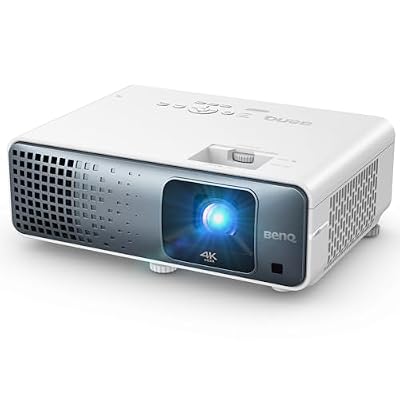
7. BenQ TK710
$1,700–$1,900 · Best for: Mixed-use rooms and gamers who want a bright, lamp-free 4K projector with lens shift
- Resolution
- 4K UHD (DLP with XPR pixel shifting)
- Brightness
- 3,200 ANSI lumens
- Light source
- Laser
- Input lag
- 16 ms (4K/60), 4 ms (1080p/240 Hz)
The TK710 sits above the budget range, but it is the projector to stretch for if you want to leave lamps behind for good. It is the successor to the 1080p BenQ HT2060 on our list and moves up a class: 4K UHD via DLP pixel shifting, HDR10 and HLG, and a laser light source rated at 3,200 ANSI lumens, so there are no lamps to buy and no slow dimming to manage. BenQ also claims 95% Rec.709 color.
It has features most budget projectors skip: a 1.3x zoom and lens shift, so you can ceiling-mount or shelf-mount without keystone, plus eARC to pass sound to a soundbar or receiver. Gamers get 16 ms at 4K/60 and 4 ms at 1080p/240Hz on BenQ's spec.
Brightness maths: at about 50% of its rating in an accurate mode, roughly 1,600 lumens gives about 54 fL on a 100-inch screen and 37 fL on a 120-inch screen, in the same league as the brighter lamp projectors here.
The trade-off: price. It costs well over the around-$1,000 tier, and the Amazon listing does not state its throw ratio, so check BenQ's figure in the projector throw calculator before you drill. Compared with the Optoma UHD38x, you pay more for laser longevity and lens shift, not for more light. Compared with the Epson Home Cinema 3800, it trades a lamp for a laser in a similar price band. See how it ranks against everything else in our best projector for home theater guide.
Pros
- 3,200 ANSI lumens from a long-life laser
- 1.3x zoom and lens shift for flexible placement
- 16 ms at 4K/60 and 4 ms at 1080p/240 Hz for gaming
- HDR10 and HLG with 95% Rec.709 color claimed
- eARC support and a 3-year warranty
Cons
- Pixel-shifting 4K, not native
- DLP blacks trail the best dark-room projectors
- Throw ratio not stated on the Amazon listing
4. Budget Home Theater Projector Side by Side
| Product | Score | Price | Resolution | Brightness | Light source | Throw ratio | Input lag | Buy |
|---|---|---|---|---|---|---|---|---|
| Optoma UHD38x Best Overall Budget | 80 | $1,000–$1,400 | 4K UHD (DLP with XPR pixel shifting) | 4,000 ANSI lumens | Lamp | About 1.5–1.65 (1.1x zoom) | About 4.2 ms at 1080p/240 Hz; about 16 ms at 4K/60 (Optoma spec) | Amazon → |
| Epson Home Cinema 880 Best Under $500 | 74 | $500–$650 | 1080p (native, 3LCD) | 3,300 ISO lumens (white and color) | Lamp | Fixed lens (digital zoom only) | — | Amazon → |
| BenQ TH575 Best Budget for Gaming | 75 | $550–$700 | 1080p (native, DLP) | 3,800 ANSI lumens | Lamp | About 1.5 at wide (1.1x zoom) | 16.7 ms (BenQ spec, game mode) | Amazon → |
| Dangbei N2 mini Best Smart Projector Under $500 | 64 | $180–$220 | 1080p (native) | — | LED | — | — | Amazon → |
| Epson Home Cinema 2350 Best Budget 4K Smart Projector | 80 | $1,000–$1,300 | 4K PRO-UHD (1080p 3LCD with pixel shifting) | 2,800 ISO lumens (white and color) | Lamp | 1.32–2.15 (1.6x optical zoom) | 20 ms (Epson spec) | Amazon → |
| Optoma UHD35STx Best Budget Short Throw | 78 | $1,000–$1,400 | 4K UHD (DLP with XPR pixel shifting) | 3,600 ANSI lumens | Lamp | About 0.5 (short throw, fixed) | About 4.2 ms at 1080p/240 Hz; about 16 ms at 4K/60 (Optoma spec) | Amazon → |
| BenQ TK710 Best Step-Up Laser | 82 | $1,700–$1,900 | 4K UHD (DLP with XPR pixel shifting) | 3,200 ANSI lumens | Laser | — | 16 ms (4K/60), 4 ms (1080p/240 Hz) | Amazon → |
5. How We Ranked These Budget Projectors
We started with every projector in our catalog that typically sells around $1,000 or less, then ranked them on:
- Verified brightness: only standardized ANSI or ISO lumens count. Unrated "lumens" disqualify a projector outright.
- Picture per dollar: usable foot-lamberts on a 100- and 120-inch screen, plus resolution and HDR handling.
- Placement: throw ratio, zoom and lens shift for real rooms.
- Cost of ownership: lamp replacement versus solid-state light sources.
- Owner-reported reliability from long-term user reviews and forums.
We have not bench-tested these projectors in a lab; rankings come from spec research, room maths and owner experience. If we could not confirm a figure, we left it out rather than guess. We also added one step-up laser above the around-$1,000 tier for buyers who can stretch.
6. How Big a Screen Can a Budget Projector Fill?
Here is the screen-size maths for the picks, assuming an accurate picture mode keeps about 50% of the rated lumens on a 1.0-gain screen. The target is at least 16 fL for a dark room and 30 fL or more for HDR or ambient light.
| Projector | Rated lumens | fL at 100 in | fL at 120 in |
|---|---|---|---|
| Optoma UHD38x | 4,000 | 67 | 47 |
| BenQ TH575 | 3,800 | 64 | 44 |
| Optoma UHD35STx | 3,600 | 61 | 42 |
| Epson Home Cinema 880 | 3,300 | 56 | 39 |
| BenQ TK710 | 3,200 | 54 | 37 |
| Epson Home Cinema 2350 | 2,800 | 47 | 33 |
Every model here can fill a 120-inch screen in a dark room. For a living room with lamps on, stick to the top half of the table, or pair a mid-table projector with an ALR screen. The Dangbei N2 mini is left out because its listing quotes no brightness figure and it is designed for much smaller, darker setups.
Not sure what size suits your seats? At 12 feet, a 120-inch screen is immersive and 100 inches is relaxed; the viewing distance calculator does the rest.
7. Spending Less vs Spending a Little More
Under $500, you are buying a bright 1080p lamp projector (Epson Home Cinema 880, Optoma HD146X) or a compact smart LED projector (Dangbei N2 mini). Expect good brightness or good convenience, but not both, plus basic contrast and no lens shift. This tier is perfect for a first projector, a bedroom or a backyard movie night.
Around $1,000, you get pixel-shift 4K, HDR support and, in some cases, built-in streaming or gaming-grade input lag: the Optoma UHD38x, Epson Home Cinema 2350 and Optoma UHD35STx. This is where a projector starts to look like a real home theater upgrade rather than a novelty.
Just above, the Epson Home Cinema 3800 adds 3,000 lumens, lens shift and a 1.62x zoom; if you can save for a few more months, it is the projector we rank first in our best projector for home theater guide. The laser BenQ TK710 sits in the same tier and drops lamps altogether, with 3,200 lumens, a 1.3x zoom and lens shift.
8. Hidden Costs of a Cheap Home Theater Projector
The projector is only part of the bill. Plan for:
- A screen. A fixed-frame screen gives a flatter, more uniform image than a wall, and budget 100- to 120-inch screens cost a fraction of the projector. See our projector screen guide for options that start in budget territory.
- Replacement lamps. Lamp life varies by model and mode; at 20 hours of viewing a week, a lamp rated around 4,000 hours lasts about four years. Check the replacement lamp price before you buy.
- Mounting and cables. A ceiling mount and a long HDMI cable (fiber HDMI for runs over about 25 feet) add up.
- Sound. Projector speakers are weak. Even a budget soundbar is a big upgrade; a 5.1 setup is better. Our budget home theater system guide covers affordable options.
- Streaming. Projectors without apps need a streaming stick.
A realistic first home theater budget covers the projector plus a screen and sound, so it can pay to buy a slightly cheaper projector and put the difference into audio.
9. Who Should Buy a Budget Projector
A budget projector makes sense if: you want a 100-inch-plus picture for movie nights, sports and games, your room is dim in the evening, and you would rather spend on screen size than perfect black levels. It is also the smart first step if you are not sure a projector will suit your household.
Spend more if: you are building a dedicated, light-controlled theater where contrast will be obvious, you want laser longevity, or you need flexible ceiling placement. Our 4K projector and laser projector guides cover that tier.
Skip projectors altogether if: you mostly watch in daylight. A big TV is better there; see the best TV for home theater.
10. Common Mistakes to Avoid
Believing inflated lumen numbers
A no-name projector claiming 9,000 or 15,000 "lumens" for under $200 usually delivers a few hundred real ANSI lumens. Only trust standardized ANSI or ISO ratings from established brands.
Buying "4K supported" thinking it is 4K
"4K supported" or "4K compatible" means the projector accepts a 4K signal, then downscales it. Real budget 4K projectors list a 3840 × 2160 output via pixel shifting.
Projecting onto a textured wall
Wall texture and off-white paint reduce sharpness and shift color. A budget fixed-frame screen often makes a bigger visible difference than stepping up a projector tier.
Ignoring throw distance
Budget projectors often have little or no zoom, so the throw distance is nearly fixed. Measure your room and confirm the image size with a throw calculator before you buy.
Forgetting the cost of sound
Projector speakers cannot carry a movie. Budget for at least a soundbar, and ideally a receiver with speakers, so the sound matches a 100-inch picture.
11. Frequently Asked Questions
What is the best home theater projector under $500?
The Epson Home Cinema 880 is the best home theater projector under $500 for most people: it is rated at 3,300 lumens, uses 3LCD to avoid rainbow artifacts and comes from an established brand. The Optoma HD146X is a close alternative, and the Dangbei N2 mini suits small, dark rooms if you want built-in Netflix.
What is the best home theater projector under $1,000?
The Optoma UHD38x is the best home theater projector around $1,000. It is rated at 4,000 lumens, uses pixel shifting for 4K detail and has 4.2 ms input lag at 1080p/240Hz. The Epson Home Cinema 2350 is the pick if you prefer built-in Android TV and 3LCD color.
Are cheap projectors worth it for a home theater?
Yes, if you buy from an established brand and match brightness to your screen. A 3,000-plus lumen budget projector can fill a 100- to 120-inch screen convincingly. What you give up is contrast in a dark room and placement flexibility. Avoid unbranded projectors with inflated lumen claims.
How many lumens does a budget home theater projector need?
For a dark room and a 100-inch screen, about 2,000 rated lumens is enough. For a 120-inch screen or a room with some ambient light, choose 3,000 lumens or more. Assume a budget projector keeps about half its rated lumens in an accurate picture mode when you do the maths.
Can you get a good 4K projector on a budget?
Yes. Pixel-shift 4K projectors such as the Optoma UHD38x and Epson Home Cinema 2350 cost around $1,000 and put 3840 × 2160 detail on screen. Below that, most "4K" projectors only accept a 4K signal and downscale it, so a good native 1080p projector is the better buy.
Is 1080p good enough for a home theater projector?
Yes, if you sit at least 1.6 times the screen diagonal away; for a 100-inch screen, that is about 13 feet. At that distance, 1080p and 4K look nearly identical. Closer to a large screen, 4K is visibly sharper and worth the extra money.
Do I need a screen for a budget projector?
You can start with a smooth, matte white wall, but a screen improves sharpness, color and uniformity. Budget fixed-frame screens cost a fraction of the projector and are often the single most visible upgrade, especially for short-throw projectors that magnify wall texture.
How long do budget projector lamps last?
It varies by model and lamp mode, but several thousand hours is typical, and eco modes extend life. At 20 hours of viewing a week, a lamp rated around 4,000 hours lasts roughly four years. Laser and LED projectors, such as the BenQ TK710 and Dangbei N2 mini, avoid lamp replacements entirely.
Related Guides
Projectors
Best Projector for Home Theater
The best projector for home theater in 2026, matched to your room: 8 picks from budget 4K to laser, native 4K and UST, with lumens and throw maths for each.
Projectors
Best 4K Projector for Home Theater
The best 4K projector for home theater in 2026: 7 picks from around $1,000 to native 4K laser, plus a plain-English guide to native 4K vs pixel shifting.
Home Theater Systems
Best Budget Home Theater System
The best budget home theater system for 2026: six cheap, affordable picks from 5.1.2 Atmos soundbars to a receiver bundle, ranked on channels per dollar.
The Bottom Line
The best budget home theater projector is the Optoma UHD38x: 4,000 lumens and pixel-shift 4K for around $1,000. Under $500, the Epson Home Cinema 880 is the safe, bright 1080p choice, and the Dangbei N2 mini is the compact smart option for small dark rooms. Gamers should look at the BenQ TH575, streamers at the Epson Home Cinema 2350, and short rooms at the Optoma UHD35STx, which throws 120 inches from about 4.4 feet. If you can stretch past the budget tier, the laser BenQ TK710 ends lamp replacements for good. Spend what is left on a screen and sound.