Home Theater Systems
Best Home Theater Systems
We research every product against its spec sheet and independent measurements. When you buy through our links we may earn a commission, at no cost to you. How we score · Disclosure
The best home theater systems give you real surround sound, deep bass and clear dialogue without a weekend of guesswork. For most living rooms our top pick is the Samsung HW-Q990F: a complete 11.1.4 Dolby Atmos system (soundbar, wireless subwoofer and two wireless rear speakers with their own up-firing drivers) in one box, set up through one HDMI cable.
This guide is for anyone choosing between the three ways to build a system in 2026: an all-in-one soundbar kit, a "home theater in a box" with its own receiver, or a passive speaker package you pair with an AV receiver. We ranked eight systems on spec sheets, room maths and owner-reported reliability, and we explain what 5.1, 7.1 and 5.1.2 really mean before you spend a dollar.
Our top picks at a glance




Quick answer
The best home theater system for most people is the Samsung HW-Q990F, an 11.1.4 soundbar system with wireless sub and rears that needs no receiver. If you want the best sound and will add a receiver, the Klipsch Reference R-625FA 5.1.2 package is the stronger performer. On a tight budget, the VIZIO 5.1.2 Elevate SE gives you rotating height speakers, a wireless sub and Atmos in the $350–$450 band.
On this page
- 1. What a Home Theater System Actually Includes
- 2. Channel Numbers Decoded: Surround, Height and Bass
- 3. The Best Home Theater Systems
- 4. Home Theater Systems Side by Side
- 5. How We Ranked the Best Home Theater Systems
- 6. Home Theater in a Box vs Separates
- 7. How Much Speaker and Power Your Room Needs
- 8. Pairing a Speaker Package With a Receiver
- 9. What Each Budget Tier Gets You
- 10. Can One System Handle Music and Movies?
- 11. Who Should Buy a Home Theater System, and Who Can Skip It
- 12. Common Mistakes to Avoid
- 13. Frequently Asked Questions
1. What a Home Theater System Actually Includes
"Home theater system" covers four quite different products. Knowing which one you are shopping for narrows the field fast.
| System type | What is in the box | Needs a receiver? | Best for |
|---|---|---|---|
| Soundbar system | Bar, wireless sub, often rear speakers | No | Living rooms, simple setup |
| Home theater in a box | AV receiver, five or more speakers, sub | No (included) | First system, small rooms |
| Speaker package | Passive speakers and powered sub | Yes | Best sound, upgradability |
| Wireless speaker system | Powered speakers and a hub or bar | No | No cable runs, clean look |
Soundbar systems decode audio inside the bar and send it wirelessly to the sub and rears. They are the easiest to live with. Our best soundbar for home theater guide covers bars on their own.
Home theater in a box bundles an AV receiver with matched speakers. You get proper HDMI switching and room correction, but the included speakers are usually small.
Speaker packages are passive. They make no sound until you connect them to an AV receiver, which decodes the soundtrack, switches video and powers each speaker. This is the route to the best sound and the only one where every piece is replaceable.
Wireless systems put an amplifier in each speaker and send audio over a radio link. "Wireless" means no speaker wire, not no cables: every speaker still needs power.
2. Channel Numbers Decoded: Surround, Height and Bass
The numbers on a home theater system describe its speaker layout. The first number is ear-level speakers, the second is subwoofers, and the optional third is height speakers for Dolby Atmos or DTS:X.
| Layout | Ear-level | Subs | Height | Total speakers |
|---|---|---|---|---|
| 2.1 | Left, right | 1 | 0 | 3 |
| 5.1 | Left, center, right, two surrounds | 1 | 0 | 6 |
| 7.1 | 5.1 plus two rear surrounds | 1 | 0 | 8 |
| 5.1.2 | 5.1 | 1 | 2 | 8 |
| 7.1.4 | 7.1 | 1 | 4 | 12 |
5.1 vs 7.1: 7.1 adds two rear surrounds behind the seats. They help only if your seating sits well forward of the back wall, with roughly 3 feet or more behind the sofa. Against a back wall, 7.1 adds cost without adding much.
7.1 vs 5.1.2: both need seven amplified channels plus a subwoofer, but 5.1.2 spends the extra two on height instead of rear surrounds. For most living rooms, height adds more than rear surrounds: rain, flyovers and room ambience above you are more noticeable than an extra pair of side-back speakers. That is why we favor 5.1.2 over 7.1 in typical rooms.
The ".1" is the LFE channel, the dedicated low-frequency effects track, plus any bass redirected from smaller speakers. It is the channel that makes explosions physical.
Be skeptical of soundbar channel counts. A bar labeled 9.1.4 may produce some of those channels virtually or by bouncing sound off walls. Dedicated speakers behind and above you are always more convincing than reflections.
3. The Best Home Theater Systems

1. Samsung HW-Q990F 11.1.4 Soundbar
$1,500–$2,000 · Best for: Living rooms that want the fullest all-in-one Atmos system, especially with a Samsung TV
- Channels
- 11.1.4
- Atmos/DTS:X
- Dolby Atmos and DTS:X
- Subwoofer
- Wireless subwoofer included
- Inputs
- HDMI in, HDMI eARC, Wi-Fi, Bluetooth
The Q990F wins because it is the only one-box system here that delivers every layer of a proper Atmos layout: front, center, surrounds, four height channels and a subwoofer, from a single purchase with a single remote. Samsung rates it 11.1.4. The bar handles the front stage plus side- and up-firing duties, the two wireless rear speakers carry their own up-firing drivers, and the wireless sub covers the ".1".
That rear placement is the point. Single-bar systems fake surround by bouncing sound off your side walls, which works in a narrow, symmetrical room and fails in an open-plan one. Here, rear effects come from actual speakers behind you.
On paper the feature list covers what a living room needs: Dolby Atmos and DTS:X decoding, HDMI eARC, SpaceFit Sound Pro room calibration using the bar's microphone, and Q-Symphony, which blends the bar with the speakers in recent Samsung TVs. Compatible Samsung TVs can also send Atmos to it wirelessly.
The trade-off: you cannot upgrade one piece later, as you can with separates, and the rears and sub still need wall power. Compared with the Klipsch package below, the Q990F is simpler and costs less once you add a receiver to the Klipsch bill, but the Klipsch towers will outclass it for dynamics and music in a medium or large room. In the $1,500–$2,000 band it is the most complete single-box system you can buy. See our Samsung home theater review for the rest of the lineup.
Pros
- Full 11.1.4 layout with rear height drivers in the box
- Decodes Dolby Atmos and DTS:X
- SpaceFit Sound Pro room calibration
- HDMI input plus eARC, and wireless Atmos with Samsung TVs
Cons
- Expensive for a soundbar system
- Best features need a Samsung TV
- Rear levels often need manual tweaking

2. Klipsch Reference R-625FA 5.1.2 Dolby Atmos System
$1,200–$1,400 · Best for: Living rooms that want real Atmos height effects without ceiling speakers
- Channels
- 5.1.2
- Subwoofer
- Klipsch R-100SW, 10-inch, 300 W amplifier
- Surrounds
- Included (2x R-41M bookshelf)
- Amplification
- Passive speakers; needs a 7-channel AV receiver
If you want the best home theater sound system rather than the most convenient one, buy speakers and a receiver. This Klipsch Reference package is a complete 5.1.2 set: two R-625FA towers with Dolby Atmos elevation drivers built into their tops, an R-52C center, two R-41M bookshelf surrounds and an R-100SW subwoofer with a 10-inch driver and a 300 W amplifier. The main speakers share Klipsch's 1-inch aluminum LTS tweeter on a Tractrix horn and spun-copper IMG woofers, so effects keep the same character as they pan around the room.
The spec that matters is sensitivity. Horn-loaded Reference speakers are high-sensitivity designs, and every 3 dB of extra sensitivity halves the amplifier power you need for the same volume, so a mid-range receiver drives these loud with ease. The maths is in the power section below.
You need a receiver with at least seven amplified channels (five ear-level, two heights; the sub has its own amp). A 7.2-channel model such as the Denon AVR-X1800H or Denon AVR-S770H is the natural partner. A 5.2 receiver will not power the height drivers.
The trade-offs are brightness and bass. Horn tweeters sound forward in rooms with bare walls and hard floors, so a rug and curtains help, and one 10-inch sub runs short in rooms much over 2,700 cubic feet. Against the Q990F above, this package plus a receiver costs more and takes a Saturday to wire, but every piece can be upgraded on its own. More in our Klipsch home theater review and on the Klipsch brand page.
Pros
- Built-in elevation drivers give a genuine 5.1.2 layout from one bundle
- Matched Tractrix horn tweeters and IMG woofers across the main speakers
- High sensitivity means a mid-range receiver drives it loudly
- 10-inch, 300 W R-100SW sub included
- 5-year warranty
Cons
- Needs a 7-channel receiver, sold separately
- Up-firing effect depends on a flat, reflective ceiling
- 10-inch sub limits deep bass in larger rooms
- Forward treble can sound bright in hard, echoey rooms

3. Sonos Arc Ultra
$900–$1,000 · Best for: Living rooms that want a premium single-bar Atmos setup with room to grow
- Channels
- 9.1.4 (14 drivers)
- Atmos/DTS:X
- Dolby Atmos (no DTS:X)
- Subwoofer
- Built-in Sound Motion woofer; optional Sonos Sub 4
- Inputs
- HDMI eARC (optical via adapter), Bluetooth
The Arc Ultra is the best starting point if you want to build a system in stages. On its own it is a 9.1.4-rated Atmos soundbar with 14 drivers, including Sonos's Sound Motion woofer, which gives a single bar unusually solid low end. Later you can add a Sonos Sub 4 and a pair of Era 300 speakers as rears; each Era 300 has its own up-firing driver, so rear height effects come from behind you.
The link between them is a dedicated wireless connection from the bar, not your router, so a busy home network does not drag down the surrounds. Trueplay tuning uses the bar's microphone to adjust for your room, and the bar handles AirPlay 2, Wi-Fi streaming and Bluetooth for music.
Two trade-offs. First, there is no DTS:X decoding, so a 4K Blu-ray player sending a DTS:X track gets a non-height version; Atmos from streaming apps and discs is fully supported. Second, there is no HDMI input: everything goes through your TV's eARC port.
Compared with the Q990F, the bar alone is the better music speaker and the app is simpler, but a full Sonos kit with Sub 4 and two Era 300s costs well above the Samsung's band. Buy it if you value a staged path and multi-room streaming. Our Sonos home theater review and the Sonos brand page cover the ecosystem.
Pros
- Deeper bass than any slim bar of its size, thanks to Sound Motion
- Clear dialogue and strong Atmos height for a single bar
- Trueplay room tuning, including a mic-based quick tune
- Best-in-class multiroom app; adds Sub 4 and rears wirelessly
Cons
- No DTS:X decoding
- Single HDMI eARC port, no passthrough inputs
- Full Sonos surround system gets expensive
4. Polk Audio T-Series 5.1 Home Theater System
$750–$900 · Best for: First-time buyers who want a complete receiver-based 5.1 system for a small to mid-size room
- Channels
- 5.1
- Fronts
- 2x T50 towers: 6.5-inch driver, 1-inch tweeter, two 6.5-inch passive radiators
- Subwoofer
- Polk PSW10, 10-inch powered, up to 100 W
- Surrounds
- Included (2x T15 bookshelf: 5.25-inch driver, 0.75-inch tweeter)
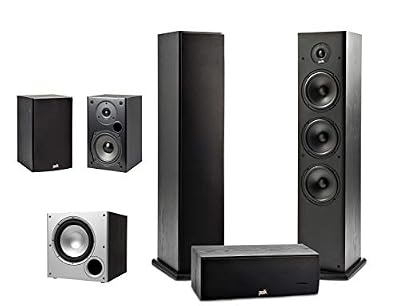
Polk's T-Series 5.1, the successor to the Monitor XT 5.1 on this list, is the cheapest complete passive package here, typically in the $750–$900 band. One bundle covers every channel: two T50 towers (a 6.5-inch driver, a 1-inch tweeter and two 6.5-inch passive bass radiators each), a T30 center with two 5.25-inch drivers and a 1-inch tweeter, two T15 bookshelf surrounds (5.25-inch driver, 0.75-inch tweeter) and a Polk PSW10 10-inch powered subwoofer rated up to 100 W.
The towers are the value. Each 6.5-inch driver plus two 6.5-inch radiators gives about three times the radiating area of the driver alone, so the fronts reach lower than bookshelf speakers and the package sounds bigger than its band suggests.
Budget the receiver into the total. A 5.2 model like the Sony STR-DH590 or Yamaha RX-V4A is enough for 5.1; Polk says the set can grow to 7.1 or more if your receiver has the channels. There are no height speakers, so Atmos means adding separate modules and a seven-channel receiver later.
The trade-off is the subwoofer. A 10-inch sub rated up to 100 W suits small to mid-size rooms; a 12 x 16 x 8 ft room is about 1,540 cubic feet. If yours is bigger than about 2,500 cubic feet, plan to upgrade to something like the SVS SB-1000 Pro. Against the Klipsch above, the Polk set has no heights and a smaller sub, but it costs much less. See our Polk Audio review or the Polk Audio brand page.
Pros
- Complete 5.1 set: towers, center, surrounds and powered sub in one bundle
- Towers add two 6.5-inch passive radiators each for fuller bass
- Compatible with most home theater receivers
- Can grow to 7.1 or more later
Cons
- 10-inch, up-to-100 W sub runs out of steam in large rooms
- No height speakers for Atmos
- Needs a separate AV receiver

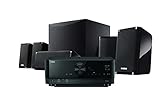
5. Yamaha YHT-5960U Home Theater System
$550–$700 · Best for: Small to mid-size rooms that want a calibrated 5.1 system with minimal effort
- Channels
- 5.1
- Subwoofer
- Powered subwoofer included
- Surrounds
- Included (compact satellites)
- Amplification
- Yamaha receiver included
A home theater in a box is the old-school complete system: an AV receiver, five speakers and a subwoofer, all matched and sold together. The YHT-5960U is the best home theater in a box still widely sold because the receiver at its core is a genuine Yamaha AVR rather than a stripped-down control unit.
That means YPAO room correction (a microphone measures your room and sets levels, distances and EQ), proper HDMI switching with 4K HDR pass-through (including Dolby Vision) for your streaming box and game console, and Bluetooth for phones. There is no Wi-Fi streaming or 4K120 pass-through. You also learn the same receiver workflow you would use with separates, which pays off if you upgrade the speakers later.
Compared with a soundbar kit, the advantage is flexibility: the receiver can drive better speakers down the line, and HDMI devices plug into it rather than into the TV. Compared with the Polk T-Series above, everything is included, so there is no separate receiver to shop for.
The trade-off is the speakers. Satellites this small have limited bass and output, so the sub does a lot of work, and the system is 5.1 with no height channels. In a small to medium room (up to roughly 2,000 cubic feet) it sounds full and coherent. If you want Atmos or a big room, look at the Klipsch or Samsung picks instead. Our Yamaha home theater review covers Yamaha's receivers in depth.
Pros
- YPAO auto-calibration takes the guesswork out of setup
- 4K HDR pass-through including Dolby Vision
- Matched speakers and powered sub in one box
- Yamaha receivers have a good reliability reputation
Cons
- 5.1 only, so no Atmos upgrade path
- Compact satellites limit dynamics in big rooms
- No 4K120 pass-through for current consoles

6. Sony Bravia Theater Quad
$2,000–$2,500 · Best for: Design-led living rooms that want Atmos surround without a bar or speaker cable runs
- Channels
- Four wireless speakers with virtual surround and height
- Atmos/DTS:X
- Dolby Atmos, DTS:X and IMAX Enhanced
- Subwoofer
- Optional (Sony SA-SW3 or SA-SW5)
- Inputs
- HDMI eARC on control box
The Theater Quad does something no other pick here does: it drops the soundbar entirely. You get four wireless speakers (two for the front, two for the rear) plus a compact control box that connects to your TV over HDMI eARC. With no bar under the screen, it suits wall-mounted TVs and minimalist rooms.
Sony packs the four speakers with 16 drivers in total, and the system decodes Dolby Atmos and DTS:X. Its 360 Spatial Sound Mapping creates virtual speakers around the room from the four physical ones, and Sound Field Optimization measures the room to adjust the output. Because front sound comes from two speakers spread to either side of the screen, the stereo image is wider than any single bar can produce.
"Wireless" still means power cords: each speaker needs an outlet, so check your rear wall before ordering. Our wireless home theater guide explains latency and power planning in detail.
The trade-off is bass. No subwoofer comes in the box, and four compact speakers cannot reproduce the bottom octave of an action film. Sony sells matching wireless subs, and adding one is close to essential for movies. With a sub, the total climbs past the Q990F, which already includes one. Buy the Quad for the cleanest look and the widest soundstage; buy the Samsung for the most complete package. Our Sony home theater review compares Sony's full range.
Pros
- No soundbar under the screen; slim, wall-mountable speakers
- Room calibration places virtual speakers around you
- Decodes Dolby Atmos, DTS:X and IMAX Enhanced
- Good Wi-Fi streaming support
Cons
- No subwoofer included, and it really needs one
- Phantom center relies on careful front placement
- Expensive for the output you get

7. VIZIO 5.1.2 Elevate SE Soundbar (SL512X-08)
$350–$450 · Best for: Budget buyers who want Atmos and DTS:X with real height drivers in a small to mid-size room
- Channels
- 5.1.2
- Atmos/DTS:X
- Dolby Atmos and DTS:X; height speakers rotate up automatically
- Subwoofer
- Wireless subwoofer included
- Inputs
- HDMI eARC, Bluetooth
The VIZIO 5.1.2 Elevate SE (SL512X-08), successor to the M-Series 5.1.2 here, is the budget pick because it brings a 5.1.2 Atmos layout with a wireless subwoofer into the $350–$450 band. Spread across eight listed channels, that is roughly $44–$56 per channel, the best channels-per-dollar figure on this list.
Its signature feature is a pair of height speakers that rotate upward automatically when Dolby Atmos or DTS:X content is detected, so they bounce sound off the ceiling only when a soundtrack has height information. It decodes both Dolby Atmos and DTS:X, connects to your TV over HDMI eARC so your TV remote controls it, and adds Bluetooth for music.
Why not rank it higher? Output, refinement and a few gaps. A compact system fills a bedroom or modest living room (up to around 1,500–2,000 cubic feet) convincingly, but not a big open space. The rotating heights depend on a flat ceiling of normal height. The soundbar remote is sold separately, Wi-Fi streaming is not listed, and the Amazon listing does not detail the surround speakers, so check the box contents if real rear speakers matter; the Q990F and Yamaha both include them.
Against the Q990F, you lose two height channels, room calibration and a lot of headroom, but you pay a fraction of the price. Against the Yamaha box above, you trade a receiver's flexibility and calibration for Atmos and a much simpler setup. For more options at this level see our best budget home theater system guide.
Pros
- Height speakers rotate up automatically for Atmos and DTS:X
- Wireless subwoofer included
- HDMI eARC lets your TV remote control it
- QuickFit mounting for select Vizio TVs and a distinctive Elevate design
Cons
- Soundbar remote sold separately
- Surround speakers not detailed on the listing
- No Wi-Fi streaming listed

8. SVS Prime Satellite 5.1 System
$330–$380 per pair · Best for: Rooms where speakers must stay small but bass still needs to be tight and full
- Channels
- 5.1 (two satellite pairs + Prime Center + sub)
- Satellite drivers
- 1-inch aluminum dome tweeter, 4.5-inch woofer, SoundMatch 2-way crossover
- Subwoofer
- Not included; SVS SB-1000 Pro (12-inch sealed) suggested, sold separately
- Amplification
- Passive speakers; needs an AV receiver
The SVS Prime Satellite 5.1 is a build-it-yourself system, so read the listing first: the Amazon link is one pair of Prime Satellites (typically $330–$380 per pair). The full 5.1 takes two satellite pairs for fronts and surrounds, an SVS Prime Center and a subwoofer such as the SVS SB-1000 Pro, each bought separately. The total is several times the pair price, but you can buy it in stages.
Each satellite pairs a 1-inch aluminum dome tweeter with a 4.5-inch woofer through SVS's SoundMatch 2-way crossover, and the Prime Center uses the same tweeter family with a dedicated 4.5-inch midrange, so voices keep their character as effects pan around the room.
Small satellites only work with a good subwoofer, and this is where SVS earns its place. A 4.5-inch woofer has about 2.25 times the cone area of a 3-inch lifestyle driver, so set the receiver's crossover to 80–100 Hz and the sealed 12-inch SB-1000 Pro, with its 325 W RMS amp, blends tightly below that. That makes this the best home theater music system on the list for clean, fast bass rather than sheer boom.
Pair it with a receiver that has five channels and a sub pre-out; our receiver guide has options.
The trade-off is scale. Satellites with 4.5-inch woofers cannot match the Klipsch towers for dynamics in a big room, and there are no height channels. In a room under about 2,000 cubic feet, though, this is the most refined system here. More on the SVS page.
Pros
- Compact satellites wall- or ceiling-mount easily
- 1-inch aluminum tweeter and 4.5-inch woofer cross over cleanly at 80–100 Hz
- Prime-series voicing keeps the center and satellites matched
- Pairs with a 12-inch sealed SB-1000 Pro for tight bass
- Easy to build in stages, one pair at a time
Cons
- Amazon link is one pair: the 5.1 needs two pairs, a center and a sub bought separately
- Needs a separate AV receiver
- No height speakers
4. Home Theater Systems Side by Side
| Product | Score | Price | Channels | Atmos/DTS:X | Subwoofer | Surrounds | Wireless | Buy |
|---|---|---|---|---|---|---|---|---|
| Samsung HW-Q990F 11.1.4 Soundbar Best Overall | 87 | $1,500–$2,000 | 11.1.4 | Dolby Atmos and DTS:X | Wireless subwoofer included | Included, with up-firing drivers | Wireless sub and rears; wireless Atmos with Samsung TVs | Amazon → |
| Klipsch Reference R-625FA 5.1.2 Dolby Atmos System Best Speaker Package | 84 | $1,200–$1,400 | 5.1.2 | Via your receiver; elevation drivers built into the towers | Klipsch R-100SW, 10-inch, 300 W amplifier | Included (2x R-41M bookshelf) | No | Amazon → |
| Sonos Arc Ultra Best Soundbar-Based System | 88 | $900–$1,000 | 9.1.4 (14 drivers) | Dolby Atmos (no DTS:X) | Built-in Sound Motion woofer; optional Sonos Sub 4 | Optional (pair of Era 100 or Era 300) | Wireless sub and rear expansion | Amazon → |
| Polk Audio T-Series 5.1 Home Theater System Best Value Speaker Package | 74 | $750–$900 | 5.1 | Via your receiver (no height speakers included) | Polk PSW10, 10-inch powered, up to 100 W | Included (2x T15 bookshelf: 5.25-inch driver, 0.75-inch tweeter) | No | Amazon → |
| Yamaha YHT-5960U Home Theater System Best Home Theater in a Box | 71 | $550–$700 | 5.1 | No | Powered subwoofer included | Included (compact satellites) | No (wired speakers) | Amazon → |
| Sony Bravia Theater Quad Best Wireless System | 83 | $2,000–$2,500 | Four wireless speakers with virtual surround and height | Dolby Atmos, DTS:X and IMAX Enhanced | Optional (Sony SA-SW3 or SA-SW5) | Included (rear pair) | Wireless speakers (each needs power) | Amazon → |
| VIZIO 5.1.2 Elevate SE Soundbar (SL512X-08) Best Budget | 76 | $350–$450 | 5.1.2 | Dolby Atmos and DTS:X; height speakers rotate up automatically | Wireless subwoofer included | Not detailed on the Amazon listing | Wireless sub, Bluetooth | Amazon → |
| SVS Prime Satellite 5.1 System Best for Small Rooms and Music | 83 | $330–$380 per pair | 5.1 (two satellite pairs + Prime Center + sub) | Via your receiver (no height speakers included) | Not included; SVS SB-1000 Pro (12-inch sealed) suggested, sold separately | Second Prime Satellite pair (sold separately) | No | Amazon → |
5. How We Ranked the Best Home Theater Systems
We have not bench-tested these systems in a lab. Our method is spec research, room maths and owner-reported reliability. For this list we weighted five things:
- Real channels. Discrete speakers in the right positions beat virtual processing. A system with real rear speakers scored higher than a bar that relies on wall reflections.
- Completeness. What else do you have to buy? Speaker packages lose points for needing a receiver, and systems without a subwoofer lose points for movies.
- Headroom for the room. Sensitivity, driver size and sub size against a typical 2,000–3,000 cubic foot living room.
- Decoding and connections. Dolby Atmos, DTS:X, HDMI eARC, HDMI inputs and room calibration.
- Upgrade path. Can you add a better sub, heights or rears later without starting over?
The Samsung HW-Q990F took the top spot because it scores well on all five in one box. The Klipsch package scores higher on sound and upgrades but loses on completeness. The budget and small-room picks win their categories on value per channel and on how well they suit smaller spaces.
6. Home Theater in a Box vs Separates
"Separates" means buying the receiver and speakers individually, or as a speaker package plus a receiver. A home theater in a box (HTIB) sells them together.
Why an HTIB still makes sense: everything is matched, included and cheap. The receiver handles HDMI switching and calibration, and the speaker wire is often color-coded. For a first system in a small room, the Yamaha YHT-5960U gets you true 5.1 with automatic calibration and little effort.
Why separates win long term: the speakers in an HTIB are the weakest part, and they are the part you hear. With separates, you spend where it counts (speakers first, then subwoofer, then receiver) and can replace any one piece. A speaker package like the Polk T-Series 5.1 plus a seven-channel receiver will outlast two generations of soundbars.
A simple rule: if your all-in budget is in the $500–$700 band or lower and the room is small, an HTIB or soundbar system gives more for the money. Above that, separates start to pull ahead, especially if you also care about music. Our home theater setup guide walks through wiring a separates system step by step.
7. How Much Speaker and Power Your Room Needs
This is where spec sheets earn their keep. Two numbers decide whether a system fills your room: speaker sensitivity and amplifier power.
Sensitivity is how loud a speaker plays with 1 watt at 1 meter. Volume falls about 6 dB each time distance doubles, so at a 10-foot (3-meter) seat you lose about 9.5 dB.
Say you want 105 dB peaks at your seat, the level film soundtracks are mixed to:
- Speaker rated 96 dB (a high-sensitivity horn design): 96 − 9.5 = 86.5 dB at your seat from 1 watt. You need +18.5 dB more, which is 10^1.85 ≈ 70 watts.
- Speaker rated 88 dB (a typical bookshelf): 88 − 9.5 = 78.5 dB. You need +26.5 dB, which is 10^2.65 ≈ 450 watts.
That 8 dB sensitivity gap means about six times the amplifier power for the same peak. In practice most people listen well below reference, and the subwoofer handles the bass, which lowers the demand on each speaker. But the maths explains why high-sensitivity speakers sound effortless on a mid-range receiver and why low-sensitivity ones can sound strained.
Subwoofer size vs room volume. Multiply length × width × height:
- Under 1,500 cu ft (bedroom, small den): an 8- or 10-inch sub is plenty.
- 1,500–3,000 cu ft (typical living room): a 10- or 12-inch sub.
- Over 3,000 cu ft or open-plan: a 12-inch or larger sub, or two subs.
Our best subwoofer for home theater guide goes deeper on sizing. Soundbar systems do not publish sensitivity, so for those we lean on driver count, sub size and owner reports of how loud they play cleanly.
8. Pairing a Speaker Package With a Receiver
If you buy a passive package, the receiver decides what layouts you can run. Count amplified channels, not the marketing number.
- 5.1 package: a 5.2 receiver (five amplified channels) is enough. The Sony STR-DH590 and Yamaha RX-V4A are common budget pairings.
- 5.1.2 package: you need seven amplified channels. A 7.2 receiver such as the Denon AVR-X1800H covers it.
- 5.1.4 or 7.1.2: nine amplified channels, which means a model like the Denon AVR-X3800H.
Check three more things. First, impedance: most packages are rated 6–8 ohms, which any mainstream receiver handles; see impedance if a speaker is rated 4 ohms. Second, room correction: Audyssey on Denon and Marantz, YPAO on Yamaha and Dirac on some Onkyo models make a bigger difference than most upgrades, as explained in room correction. Third, HDMI: if you game, look for 4K/120 HDMI 2.1 passthrough.
Wire matters less than people think. For runs under 50 feet, 16-gauge is fine and 14-gauge covers anything longer; see our speaker wire guide.
9. What Each Budget Tier Gets You
Prices move, so here are street-price bands rather than exact figures.
| Total budget | What it buys | Example |
|---|---|---|
| Under $500 | 5.1 or 5.1.2 soundbar kit | VIZIO 5.1.2 Elevate SE, Sony HT-S40R |
| $500–$1,000 | HTIB with a receiver, or a small speaker package with a budget receiver | Yamaha YHT-5960U, Klipsch Reference Theater Pack plus a 5.2 receiver |
| $1,000–$2,000 | Flagship soundbar system, or entry separates | Samsung HW-Q990F, Polk T-Series 5.1 plus a 5.2 receiver |
| $2,000 and up | Atmos separates, refined separates or premium wireless | Klipsch R-625FA 5.1.2 plus a 7.2 receiver, SVS Prime Satellite 5.1 built from two pairs, center, sub and receiver, Sony Bravia Theater Quad with sub |
Two budget rules hold at every tier. Spend the most on the speakers you hear most, which are the front three. And do not skimp on the subwoofer: a weak sub makes even great speakers sound thin in movies.
10. Can One System Handle Music and Movies?
Yes, but the two pull in slightly different directions. Movies reward channel count, dialogue clarity and deep bass. Music rewards a strong stereo pair, smooth treble and tight bass that blends without boom.
Best for both: separates with good front speakers. Towers or quality bookshelves on the front left and right carry music, while the center and surrounds take over for films. The SVS and Klipsch picks are the strongest music performers here.
Soundbar systems have improved, and the Sonos Arc Ultra handles music better than most, but a single bar cannot match the stereo width of two speakers spaced six to eight feet apart. If music is half of what you play, split speakers win.
11. Who Should Buy a Home Theater System, and Who Can Skip It
Buy a full system if you watch films or play games in a dedicated space, your TV speakers make dialogue hard to follow, or you want bass you can feel. A 5.1 or 5.1.2 system is a bigger upgrade than moving from a good TV to a great one.
Choose a soundbar system if you want one remote, minimal wiring and a clean look in a shared living room.
Choose separates if you care about music as well as movies, have room for proper speakers, and want to upgrade piece by piece.
You can skip a full system if you mostly watch news and sitcoms, live in an apartment with strict noise limits, or your seating is pushed against a wall with nowhere to put rear speakers. A good soundbar on its own, like the Sonos Beam (Gen 2), fixes dialogue without the extra boxes. Our soundbar vs home theater guide helps you decide.
12. Common Mistakes to Avoid
Buying a passive speaker package with no receiver
Speaker packages from Klipsch, Polk and SVS make no sound on their own. Budget for an AV receiver with enough amplified channels: five for 5.1, seven for 5.1.2.
Choosing more channels than the room can place
A 7.1 system needs space behind the seats for rear surrounds. If your sofa is against the back wall, a 5.1 or 5.1.2 layout sounds better and costs less.
Treating the subwoofer as an afterthought
The sub carries the LFE channel and all bass below the crossover. A small sub in a large room makes the whole system sound thin. Match driver size to room volume.
Skipping room calibration
Run YPAO, Audyssey, Trueplay or SpaceFit after setup and again if you move furniture. Calibration corrects levels, distances and room boom in minutes, and it is free.
Assuming wireless means no cables
Wireless rears and subs still need power outlets. Check where your sockets are before buying, especially for rear speakers.
13. Frequently Asked Questions
What is the best home theater system?
The best home theater system for most people is the Samsung HW-Q990F, an 11.1.4 soundbar system with a wireless sub and wireless rear speakers that needs no receiver. If you prioritize sound quality and will buy a receiver, the Klipsch Reference R-625FA 5.1.2 speaker package is the better performer. Tight budget: the VIZIO 5.1.2 Elevate SE.
Is 5.1 or 7.1 better for a home theater?
5.1 is better for most rooms. 7.1 adds two rear surrounds that only help when there are roughly 3 feet or more between your seats and the back wall. In a typical living room, spending those two extra channels on height speakers (5.1.2) adds more than rear surrounds do.
What does 5.1.2 mean in a home theater system?
5.1.2 means five ear-level speakers (left, center, right and two surrounds), one subwoofer and two height speakers for Dolby Atmos or DTS:X. The height speakers can be in the ceiling, on top of the front speakers as up-firing modules, or built into a soundbar.
Is a home theater in a box worth it?
Yes, for a first system in a small to medium room. A home theater in a box gives you a real receiver, matched speakers and a subwoofer for less than buying them separately. The included speakers are the weak link, so if you have a large room or care about music, a speaker package plus a receiver is the better long-term buy.
Is a soundbar as good as a home theater system?
Not quite. A premium soundbar with a wireless sub and rear speakers gets close in a normal living room, but separate speakers produce a wider front stage, more convincing surround placement and more headroom. A soundbar wins on simplicity and space. See our soundbar vs home theater guide for the full comparison.
Do I need a receiver for a home theater system?
Only for passive speaker packages. Soundbar systems, wireless systems and home theater in a box kits include their own amplification and decoding. Passive packages from Klipsch, Polk, SVS or Fluance need an AV receiver with at least one amplified channel per speaker, not counting the powered subwoofer.
How big a subwoofer do I need for home theater?
Match the sub to room volume. Under 1,500 cubic feet, an 8- or 10-inch sub is enough. From 1,500 to 3,000 cubic feet, a 10- or 12-inch sub. Larger or open-plan rooms benefit from a 12-inch or bigger sub, or two subs, which also smooth out bass across seats.
What is the best home theater system for music?
A separates system with good front speakers is best for music, because a real stereo pair spaced six to eight feet apart creates a wider image than any soundbar. The SVS Prime Satellite 5.1 is the most refined music performer on this list, and the Klipsch R-625FA package plays loudest.
Related Guides
Home Theater Systems
Best Dolby Atmos Home Theater System
The best Dolby Atmos home theater system for 2026, from 5.1.2 speaker packages to 11.1.4 soundbar kits. Seven picks ranked by real height channels, not hype.
AV Receivers
Best Home Theater Receiver
The best home theater receiver for 5.1, 7.2 and Dolby Atmos rooms, ranked on real channel counts, rated power, 4K/120 HDMI and room correction.
Guides
Soundbar vs Home Theater
Soundbar vs home theater: which is best? We compare sound, cost, space and setup, explain 5.1 vs 7.1 and amplifier vs receiver, and match each path to a room.
The Bottom Line
The best home theater system for most living rooms is the Samsung HW-Q990F, a complete 11.1.4 Atmos kit with real rear speakers in one box. If you want the best sound and can add a receiver, the Klipsch R-625FA 5.1.2 package plays louder and upgrades piece by piece. Build in stages with the Sonos Arc Ultra, save with the Polk T-Series 5.1 package, get everything in one box with the Yamaha YHT-5960U, go cable-free with the Sony Bravia Theater Quad, spend less with the VIZIO 5.1.2 Elevate SE, or build the SVS Prime Satellite 5.1 pair by pair for small rooms and music.
More in Home Theater Systems
Home Theater Systems
Best Budget Home Theater System
The best budget home theater system for 2026: six cheap, affordable picks from 5.1.2 Atmos soundbars to a receiver bundle, ranked on channels per dollar.
Home Theater Systems
Best Wireless Home Theater System
The best wireless home theater system for 2026: six picks ranked on placement, latency and wireless link, and why wireless speakers still need power.