Subwoofers
Best Subwoofer for Home Theater
We research every product against its spec sheet and independent measurements. When you buy through our links we may earn a commission, at no cost to you. How we score · Disclosure
The best subwoofer for home theater in most living rooms is the SVS SB-2000 Pro: a sealed 12-inch sub with a 550 W RMS amplifier, extension rated into the high teens (±3 dB), and app-based EQ, all in a cabinet compact enough to place where the bass sounds best rather than where it fits. This guide is for anyone adding a sub to a receiver-based system, upgrading a soundbar's bass, or planning a dedicated theater.
The right sub depends more on your room than on any brand. We match each pick to a room size and job, show the driver-size and room-volume maths, and explain sealed vs ported, placement and why two subs often beat one bigger one. For big or open-plan rooms, the ported SVS PB-2000 Pro is the step up; on a budget, the Klipsch R-120SW is the pick.
Our top picks at a glance


Quick answer
The SVS SB-2000 Pro is the best subwoofer for home theater for most rooms: a sealed 12-inch driver, 550 W RMS and app-controlled EQ in a compact cabinet. Choose the ported SVS PB-2000 Pro for large or open-plan rooms, the SVS SB-1000 Pro for small rooms, and the Klipsch R-120SW on a tight budget. Two subs smooth bass across seats better than one bigger sub.
On this page
- 1. What Makes a Great Home Theater Subwoofer
- 2. Choosing the Best Subwoofer for Home Theater by Room Size
- 3. The best home theater subwoofers
- 4. Subwoofer for Home Theater Side by Side
- 5. How We Ranked These Subwoofers
- 6. Sealed vs Ported Subwoofers
- 7. Where Should You Put Your Subwoofer?
- 8. Do You Need Two Subwoofers?
- 9. Wireless Subwoofers and Soundbar Systems
- 10. Connecting and Setting Up a Home Theater Sub
- 11. Who Needs a Subwoofer, and Who Can Wait
- 12. Common Mistakes to Avoid
- 13. Frequently Asked Questions
1. What Makes a Great Home Theater Subwoofer
A subwoofer has one job: reproduce the bottom few octaves (roughly 20–80 Hz) cleanly, at the level your room needs. Four specs tell you whether a sub can do that:
- Low-frequency extension at ±3 dB. The frequency where output has dropped 3 dB. A "20 Hz" sub at ±3 dB is genuinely deep; a figure without a tolerance means little.
- Driver size and amplifier power. Together these set maximum output. Cone area rises with the square of diameter, so a 12-inch driver moves far more air than a 10-inch at the same excursion.
- Enclosure type. Sealed or ported (or passive radiator). This shapes both depth and how the sub sounds in your room.
- Control and EQ. An app with parametric EQ, phase and crossover settings makes integration easier, especially with two subs.
What doesn't matter much: peak watts (ignore them), cabinet finish and marketing names. And remember the LFE channel in movies goes down to around 20 Hz; music rarely goes below 30–40 Hz.
2. Choosing the Best Subwoofer for Home Theater by Room Size
Room volume matters more than any other variable. Multiply length × width × height in feet to get cubic feet, then use this rule of thumb (ours, based on typical output specs, not a manufacturer rating):
| Room volume | Example room | What to look for | Picks |
|---|---|---|---|
| Under 1,500 cu ft | 12 × 14 × 8 ft (1,344) | 8–12 in sealed | REL T/5x, SVS SB-1000 Pro |
| 1,500–3,000 cu ft | 15 × 20 × 8 ft (2,400) | 12 in sealed with 400 W+ or 12 in ported | SVS SB-2000 Pro, Monolith M-10 V2 (up to 2,000 cu ft), Klipsch R-120SW |
| 3,000+ cu ft or open plan | 20 × 25 × 9 ft (4,500) | 12 in+ ported, or two subs | SVS PB-2000 Pro, or two SVS SB-2000 Pro subs |
Why driver size matters: approximate effective cone area is about 200 cm² for an 8-inch driver, 330 cm² for a 10-inch and 480 cm² for a 12-inch. A 12-inch has roughly 1.45 times the area of a 10-inch, and doubling the air a sub moves (area × excursion) gains about 6 dB. That's why we recommend 12-inch subs for most living rooms, and why two subs beat one in bigger spaces.
An open doorway or open-plan kitchen counts as part of the room for bass. Measure the whole connected space.
3. The best home theater subwoofers

1. SVS SB-2000 Pro
$950–$1,200 · Best for: Living rooms and dedicated rooms up to about 3,000 cubic feet that need a compact cabinet
- Driver
- 12-inch
- Amplifier
- 550 W RMS / 1,500 W peak (Class D)
- Frequency response
- 19–260 Hz ±3 dB
- Enclosure
- Sealed, front-firing
The SB-2000 Pro hits the point where output, depth and size balance best for the typical living room. It pairs a 12-inch driver with a 550 W RMS Sledge amplifier in a sealed cabinet, and SVS rates it down to about 19 Hz (±3 dB). That's deep enough to reproduce the low-frequency effects on most action soundtracks with real weight rather than just boom.
Sealed matters here. A sealed sub rolls off gradually (about 12 dB per octave), and in a typical room, room gain below roughly 30–40 Hz lifts that response back up. The result is tight, well-controlled bass that blends easily with speakers and is forgiving of placement. The cabinet is compact for a 12-inch sub, roughly a 15-inch cube, which makes corner, side-wall or behind-the-sofa placement realistic.
The SVS app (Bluetooth) gives you volume, phase, crossover, a three-band parametric EQ and room-gain compensation from your phone, which is far easier than reaching behind a sub mid-calibration.
The trade-off: in very large or open-plan rooms, a sealed 12-inch sub runs out of output before a ported one does. That's when the SVS PB-2000 Pro wins. Compared with the smaller SVS SB-1000 Pro, you get 225 W more amplifier power and noticeably more headroom for a modest size increase. It's the best home theater subwoofer for most people.
Pros
- 550 W RMS amp, 2.3 dB more headroom than the SB-1000 Pro
- Sealed cabinet extends to 19 Hz (±3 dB)
- SVS app with parametric EQ and room gain compensation
- Blends well with music
Cons
- Less deep-bass output than the ported PB-2000 Pro
- Heavy for its size

2. SVS PB-2000 Pro
$1,100–$1,400 · Best for: Dedicated movie rooms up to about 4,000 cubic feet
- Driver
- 12-inch
- Amplifier
- 550 W RMS / 1,500 W peak (Class D)
- Frequency response
- 16–260 Hz ±3 dB
- Enclosure
- Ported, front-firing; three tuning modes
The PB-2000 Pro takes the same 12-inch driver and 550 W RMS amp as the SB-2000 Pro and puts them in a much larger ported cabinet. SVS rates it to about 16 Hz (±3 dB) in its standard mode. The port adds output in the lowest octave, exactly where a sealed sub runs out of excursion, which makes it the better choice for rooms over roughly 3,000 cubic feet or open-plan spaces.
Its port plugs give you three tuning modes: standard, extended (deeper, slightly less output at the top end) and sealed (tighter, lower group delay, for smaller rooms or music). That's a useful hedge if you move house or rearrange the room.
The maths of why ported helps: to play an octave lower at the same level, a driver needs four times the excursion. A port supplies that lowest-octave output instead of the cone. Below its tuning frequency, though, a ported sub drops off steeply (around 24 dB per octave), so the rated extension figure is where the bass actually ends.
The trade-off is size and weight. The cabinet is large and heavy, so plan the location before you buy. In a small room with a nearby wall, the SVS SB-2000 Pro is easier to place and benefits more from room gain. For a big room, the PB-2000 Pro is the best home theater bass speaker for the money.
Pros
- Ported cabinet reaches 16 Hz (±3 dB)
- 550 W RMS amplifier
- Three port tuning modes via the app
- Huge deep-bass output for the price
Cons
- Very large, heavy cabinet
- Overkill for small rooms
- Ports need clearance from walls

3. SVS SB-1000 Pro
$650–$800 · Best for: Living rooms up to about 2,000 cubic feet
- Driver
- 12-inch
- Amplifier
- 325 W RMS / 820 W peak (Class D)
- Frequency response
- 20–270 Hz ±3 dB
- Enclosure
- Sealed, front-firing
The SB-1000 Pro is a sealed 12-inch sub in a cabinet only about 13 inches on each side, with a 325 W RMS amplifier and a rated response of 20–270 Hz (±3 dB). That combination makes it the best compact subwoofer for home theater in bedrooms, dens and apartments under about 1,500 cubic feet.
A small room is where a sealed sub shines. In a 12 × 14 × 8-foot room (1,344 cubic feet), room gain starts lifting the bass at a higher frequency than in a big room, so a sealed sub's gentle roll-off is partially cancelled. You get deep, controlled bass without the boominess a port can add when it's close to a wall. The same SVS app as the bigger models handles EQ, phase and crossover.
The SB-1000 Pro is also an excellent second sub. Two of them in a medium room usually outperform one SB-2000 Pro, because the pair smooths seat-to-seat variation (more on that below).
The trade-off: 325 W in a sealed 12-inch box has a hard limit, and in a room over 2,000 cubic feet or at high volume on effects-heavy films, you'll hit it. That's when to step up to the SVS SB-2000 Pro. Against the 8-inch REL T/5x, it has more output and depth; the REL is smaller and more music-focused.
Pros
- Compact sealed cabinet fits most living rooms
- 325 W RMS amp drives a 12-inch driver
- SVS app with parametric EQ, phase and room gain compensation
- Tight, even bass that suits music as well as movies
Cons
- Less deep-bass output than the ported PB-1000 Pro
- One sub is not enough for large rooms
- Costs more than budget 12-inch subs

4. SVS SB-3000
$1,300–$1,700 · Best for: Large living rooms that want sealed-sub tightness with high output
- Driver
- 13-inch
- Amplifier
- 800 W RMS / 2,500 W peak (Class D)
- Frequency response
- 18–270 Hz ±3 dB
- Enclosure
- Sealed, front-firing
The SB-3000 is SVS's flagship sealed sub in this group, with a 13-inch driver and an 800 W RMS amplifier. SVS rates it to around 18 Hz (±3 dB). The bigger driver and amp mean more output at every frequency, but the real benefit is headroom: at the same listening level, the SB-3000 is working far less hard than an SB-2000 Pro, so distortion stays lower during the loudest scenes.
The maths: a 13-inch driver has roughly 15% more cone area than a 12-inch, and 800 W versus 550 W is about 1.6 dB more amplifier headroom. Neither number sounds dramatic alone, but together with a longer-throw motor, the result is a sub that can play reference-level effects in medium rooms without strain.
The cabinet is still sealed and reasonably compact for its class, so it's easier to place than a large ported sub of similar output. The SVS app with parametric EQ and room-gain compensation is included.
The trade-off: price. For many rooms, two SVS SB-1000 Pro subs cost similar money and will give smoother bass across more seats. Choose the SB-3000 if you can only fit one sub and want the best single sealed sub short of high-end models. Compared with the ported SVS PB-2000 Pro, it's tighter and smaller; the PB-2000 Pro goes a little deeper in big rooms.
Pros
- 13-inch driver and 800 W RMS amp
- Sealed cabinet extends to 18 Hz (±3 dB)
- Balanced XLR and RCA inputs and outputs
- SVS app with parametric EQ and room gain compensation
Cons
- Costs more than the ported PB-2000 Pro
- Heavy for its footprint

5. Monolith M-10 V2 Subwoofer
$650–$750 · Best for: Rooms up to about 2,000 cubic feet that want THX-level output from a compact box
- Driver
- 10-inch
- Amplifier
- 500 W RMS / 900 W peak, Class D with TI 48-bit DSP
- Enclosure
- Vented HDF cabinet with internal bracing; foam plug for sealed mode
- Inputs
- Balanced XLR and RCA
The Monolith M-10 V2 is a THX Certified Select subwoofer, which means it's designed to reach THX reference level in rooms up to about 2,000 cubic feet at a 10 to 12 ft viewing distance. Monoprice pairs a 10-inch driver with a 500 W RMS (900 W peak) Class D amplifier in a braced, vented HDF cabinet. A 15 × 16 ft room with an 8 ft ceiling (1,920 cubic feet) sits right on that target.
The standout feature is its port plug. With the port open, you get maximum output in the deepest octave. Fit the foam plug and it becomes a sealed sub with a gentler roll-off, useful when the sub sits near a corner and room gain lifts the low end, or for music.
The maths against the SVS SB-1000 Pro: 500 W versus 325 W is 10 × log10(500 ÷ 325) = 1.9 dB more amplifier headroom, but the 10-inch cone has only about 0.69 times the area of a 12-inch, roughly 1.6 dB less output at the same excursion. The big amp and THX tuning are there to close that gap. You also get balanced XLR as well as RCA inputs, handy for long cable runs.
The trade-off: there's no app or built-in EQ, so you rely on your receiver's room correction. THX certification also means it was designed to blend cleanly at the 80 Hz crossover every AV receiver uses. For certified reference output in a medium room without a huge cabinet, it's a strong value.
Pros
- THX Certified Select for rooms up to 2,000 cu ft
- 500 W RMS / 900 W peak amplifier
- Port plug lets you run it ported or sealed
- Balanced XLR and RCA inputs
Cons
- No app or built-in room EQ
- 10-inch driver has less cone area than 12-inch rivals
- Plainer finish than SVS or REL

6. REL T/5x
$700–$900 · Best for: Music-first systems in small rooms that also play movies
- Driver
- 8-inch active (front-firing) + 8-inch passive radiator (down-firing)
- Amplifier
- 125 W
- Enclosure
- Passive radiator (no port)
- Inputs
- High-level (Neutrik Speakon), LFE and line-level RCA
The REL T/5x is a different kind of subwoofer. It uses an 8-inch front-firing active driver with an 8-inch down-firing passive radiator, driven by a 125 W Class AB amplifier, in a cabinet small enough to sit beside a bookshelf speaker stand.
REL's key feature is its high-level (speaker-level) input. Instead of only taking the receiver's LFE/sub output, the sub connects to the same amplifier terminals as your main speakers. That means it receives the same signal character as the speakers and blends with them very smoothly, which is why owners with stereo systems rate RELs highly for music. In a home theater, you can use both: the high-level input for the main speakers and the LFE input for the .1 channel.
The passive radiator works like a port without port noise, extending bass from a small box. An 8-inch driver's cone area is less than half a 12-inch's, though, so it can't move the same air.
The trade-off: limited output for large rooms or loud action movies. In a room over about 1,500 cubic feet, or if you watch at high volume, an SVS SB-1000 Pro has more headroom. As the best small subwoofer for home theater systems that also play a lot of music, the T/5x is the one to pick. Pairs especially well with an integrated amp like the Yamaha A-S501.
Pros
- High-level Speakon input for seamless music blending
- Compact cabinet with premium finish
- Passive radiator aids deep extension without port noise
- LFE input for home theater
Cons
- 8-inch driver limits output in larger rooms
- Expensive for its output
- No app or built-in room EQ

7. Sonos Sub 4
$750–$900 · Best for: Sonos soundbar owners who want wireless bass
- Driver
- Two opposing force-canceling woofers
- Frequency response
- Down to 25 Hz (manufacturer)
- Inputs
- Wi-Fi (Sonos products only), Ethernet
- App/EQ
- Sonos app; Trueplay tuning
If your system is a soundbar rather than a receiver, your choice of subwoofer is usually locked to the soundbar's brand. For Sonos owners, the Sonos Sub 4 is the upgrade that makes the biggest difference. It uses two opposing, force-cancelling woofers, which cancels cabinet vibration so the sub doesn't rattle furniture, and connects wirelessly over your Wi-Fi.
Pair it with a Sonos Arc Ultra or Sonos Beam (Gen 2) and the soundbar hands off its deepest bass to the sub, which also frees the soundbar to play mids and dialogue more cleanly. Trueplay tuning (with a compatible phone or the Arc Ultra's built-in mic) adjusts the sub for your room. The cabinet can stand upright or lie flat under a sofa.
The trade-off: it only works with Sonos products, has no wired LFE input for a receiver, and costs more than wired subs with much more output. A wired 12-inch sub like the SVS SB-2000 Pro will dig deeper and play louder for similar money, but it won't connect to a Sonos soundbar.
For Bose soundbars, the equivalent is the Bose Bass Module 700. If you're still choosing a soundbar, our soundbar guide compares systems including their subwoofer options.
Pros
- Wireless pairing with Sonos soundbars
- Force-canceling drivers keep cabinet vibration low
- Trueplay tuning and app setup
- Slim cabinet can stand or lie flat
Cons
- Works only with Sonos products
- Costs more than wired subs with more output
- Sonos does not publish driver size or amp power

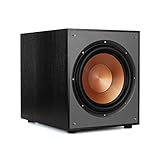
8. Klipsch R-120SW
$300–$400 · Best for: Medium living rooms on a budget
- Driver
- 12-inch copper-spun
- Amplifier
- 200 W RMS / 400 W peak
- Frequency response
- 29–120 Hz ±3 dB
- Enclosure
- Front-firing, ported
The Klipsch R-120SW is the pick when the budget is tight but you still want a proper 12-inch sub. It has a front-firing, ported cabinet and a 200 W RMS / 400 W peak amplifier, with a rated response of 29–120 Hz (±3 dB).
That 29 Hz figure is the honest limit. It means the R-120SW handles the punch of explosions, kick drums and bass lines well, but it won't reproduce the deepest rumble below the high 20s that the SVS subs above can. For a medium living room with action movies at normal levels, it delivers a lot of impact per dollar, and its front-firing driver makes placement near the front wall straightforward.
Klipsch's sub matches its Reference speakers visually, so it's a natural pairing with the Klipsch Reference Theater Pack or the Klipsch R-600F towers.
The trade-off: no app or EQ, so you rely on your receiver's room correction to tame room peaks; and output in big rooms is limited. If you can stretch, the SVS SB-1000 Pro is tighter and deeper. If you need to spend less, see our dedicated budget subwoofer guide, which ranks more options under $300 and $500.
Pros
- 12-inch driver for the price of many 10-inch subs
- 200 W RMS amp with plenty of mid-bass punch
- Simple setup with LFE input
Cons
- Rolls off below 29 Hz
- No app or built-in room EQ
- Less refined than sealed rivals with music
4. Subwoofer for Home Theater Side by Side
| Product | Score | Price | Driver | Amplifier | Frequency response | Enclosure | App/EQ | Buy |
|---|---|---|---|---|---|---|---|---|
| SVS SB-2000 Pro Best Overall | 87 | $950–$1,200 | 12-inch | 550 W RMS / 1,500 W peak (Class D) | 19–260 Hz ±3 dB | Sealed, front-firing | SVS app (Bluetooth): parametric EQ, phase, crossover, room gain compensation | Amazon → |
| SVS PB-2000 Pro Best for Large Rooms | 88 | $1,100–$1,400 | 12-inch | 550 W RMS / 1,500 W peak (Class D) | 16–260 Hz ±3 dB | Ported, front-firing; three tuning modes | SVS app (Bluetooth): parametric EQ, phase, crossover, port tuning modes | Amazon → |
| SVS SB-1000 Pro Best for Small Rooms | 84 | $650–$800 | 12-inch | 325 W RMS / 820 W peak (Class D) | 20–270 Hz ±3 dB | Sealed, front-firing | SVS app (Bluetooth): parametric EQ, phase, crossover, room gain compensation | Amazon → |
| SVS SB-3000 Best Upgrade | 89 | $1,300–$1,700 | 13-inch | 800 W RMS / 2,500 W peak (Class D) | 18–270 Hz ±3 dB | Sealed, front-firing | SVS app (Bluetooth): parametric EQ, phase, crossover, room gain compensation | Amazon → |
| Monolith M-10 V2 Subwoofer Best THX-Certified Subwoofer | 80 | $650–$750 | 10-inch | 500 W RMS / 900 W peak, Class D with TI 48-bit DSP | — | Vented HDF cabinet with internal bracing; foam plug for sealed mode | None (use your receiver's room correction) | Amazon → |
| REL T/5x Best Small Sub for Music and Movies | 79 | $700–$900 | 8-inch active (front-firing) + 8-inch passive radiator (down-firing) | 125 W | — | Passive radiator (no port) | — | Amazon → |
| Sonos Sub 4 Best Wireless Sub for Soundbars | 76 | $750–$900 | Two opposing force-canceling woofers | Two Class D amplifiers | Down to 25 Hz (manufacturer) | — | Sonos app; Trueplay tuning | Amazon → |
| Klipsch R-120SW Best Budget Subwoofer | 78 | $300–$400 | 12-inch copper-spun | 200 W RMS / 400 W peak | 29–120 Hz ±3 dB | Front-firing, ported | — | Amazon → |
5. How We Ranked These Subwoofers
These rankings are built on the spec sheet, room maths, widely published independent measurements and owner-reported reliability. We haven't run our own lab tests.
- Extension at a stated tolerance. Subs with ±3 dB ratings into the low 20s or below ranked higher than those quoting unqualified ranges.
- Output for room size. Driver area, amplifier power and enclosure type were matched to the room size each pick suits.
- Ease of integration. App control, parametric EQ, phase adjustment and room-gain compensation make subs easier to blend, especially in pairs.
- Placement flexibility. Compact sealed cabinets and front-firing ports scored higher for living rooms.
- Value and reliability. Long warranties, good owner reports and consistent quality control.
The SVS SB-2000 Pro won because it covers the most common room size with deep extension, enough output and easy app control in a cabinet that fits real homes.
6. Sealed vs Ported Subwoofers
Sealed subwoofers use an airtight box. Bass rolls off gradually (about 12 dB per octave) below the system's resonance. They're compact, tight and accurate, and they benefit most from room gain, the natural bass boost that small rooms give below about 30–40 Hz. The SVS SB-2000 Pro and SB-1000 Pro are sealed.
Ported subwoofers add a tuned port that reinforces output near its tuning frequency. You get more output in the lowest octave from the same driver and amp, but a bigger cabinet and a steeper roll-off (about 24 dB per octave) below tuning. The SVS PB-2000 Pro and Klipsch R-120SW are ported.
Passive radiators (like the REL T/5x) behave like a port without port noise and in a smaller box.
Which is best for home theater? In small and medium rooms, sealed subs usually sound tighter and are easier to place. In large rooms, ported subs deliver more output where movies need it. If you can't decide, a sub with port plugs (PB-2000 Pro, Monolith M-10 V2) lets you try both.
7. Where Should You Put Your Subwoofer?
Placement can change bass at your seat by 10 dB or more at some frequencies, more than the difference between most subs. Room dimensions create standing waves: peaks and nulls that depend on where the sub is and where you sit.
The subwoofer crawl is the easiest way to find a good spot:
- Put the sub temporarily at your main seat.
- Play a bass-heavy track or a bass sweep on repeat.
- Crawl around the floor along the walls where the sub could go.
- Where the bass sounds smoothest and most even (not just loudest), that's where the sub goes.
General rules:
- Corners give the most output (corner loading can add several dB) but often excite more room modes, so bass can sound boomy.
- Front-wall placement (between or beside the front speakers) is a good starting point for one sub.
- Midpoint of a wall often cancels some room modes for a smoother response.
- Keep ports clear by at least a few inches from walls for rear-ported subs.
After placing it, run your receiver's room correction, then fine-tune phase so the sub and speakers add together at the crossover.
8. Do You Need Two Subwoofers?
For many rooms, two subwoofers are the single best bass upgrade, often better than one bigger sub. The reason isn't loudness, though you do get that: two identical subs in the same spot give about 6 dB more output. The real benefit is smoother bass across seats.
Each sub creates its own pattern of peaks and nulls. With two subs in different positions (classic choices: opposite walls at their midpoints, or front corners), those patterns partly cancel. Seat-to-seat variation drops, so the person at the end of the sofa hears roughly what you hear in the middle.
When two subs make sense:
- You have more than one row of seats or a wide sofa.
- Your room is over about 2,500 cubic feet.
- One sub sounds boomy in some seats and thin in others even after calibration.
How to do it: most AV receivers have two subwoofer outputs; the Denon AVR-X3800H has four independent outputs with separate EQ. Two SVS SB-1000 Pro subs are an excellent alternative to one SVS SB-3000.
9. Wireless Subwoofers and Soundbar Systems
Soundbar subs are almost always brand-locked. The Sonos Sub 4 only works with Sonos speakers, and the Bose Bass Module 700 only works with Bose smart soundbars. Check compatibility before buying, and if you're still choosing a soundbar, factor the sub into the decision. Our soundbar vs home theater guide covers the trade-offs.
Wireless kits for receiver subs let you place a regular sub anywhere without running a cable. SVS and other brands sell plug-in transmitter and receiver kits that carry the LFE signal from your receiver. They add a small amount of latency, which room correction compensates for during calibration.
Wired is still best when possible. A single shielded RCA cable is cheap, reliable and adds no delay.
10. Connecting and Setting Up a Home Theater Sub
Cable. The best subwoofer cable for home theater is simply a well-shielded mono RCA cable long enough to reach your chosen spot without strain. Expensive cables don't change bass; shielding helps if you hear hum near power cords.
Connection. Run the receiver's "SUB" or "LFE" output to the sub's LFE input. Set the sub's own low-pass filter to its highest setting or "LFE/bypass" so the receiver handles crossover.
Crossover. Set your speakers to "Small" and the crossover to 80 Hz as a starting point (the THX standard). Small bookshelf speakers may need 100–120 Hz; big towers may work at 60 Hz. See our crossover explainer.
Level and phase. Set the sub's gain around the middle before running calibration. After calibration, try the phase switch (0 or 180 degrees) at your seat and keep whichever sounds fuller around 80 Hz.
Ground loop hum. If a sub hums, try plugging it into the same outlet strip as the receiver, or into a surge protector with ground-loop isolation.
11. Who Needs a Subwoofer, and Who Can Wait
Buy a sub if: you watch action films, your main speakers are bookshelves or smaller towers, or your receiver's bass management is crossing over at 80 Hz anyway. Almost every home theater benefits from a sub because it lets the main speakers play cleaner by handing off their hardest job.
You can wait if: you have large full-range towers in a small room and mostly watch dialogue-heavy content, or you're on a strict budget and need to finish your speaker setup first. Even then, a sub is usually the first upgrade worth making afterward.
Spend more on a sub than on a receiver? In budget systems, often yes. Bass quality shapes how big a system sounds more than any other component.
12. Common Mistakes to Avoid
Buying for peak watts
Peak or "dynamic" wattage is a marketing number. Compare RMS power, driver size and frequency response at a stated tolerance (±3 dB).
Hiding the sub where it fits
A sub behind a cabinet door or in a random corner can lose 10 dB at key frequencies at your seat. Do the subwoofer crawl first, then hide it if you can.
Running the sub too hot
Many people turn the sub up after calibration for more "impact." A few dB is fine; much more and bass swamps dialogue and sounds boomy.
Leaving the sub low-pass filter on
With a receiver, set the sub's own crossover to bypass or its highest setting. Two filters stacked can create a hole in the response around 80 Hz.
Forgetting the open-plan space
An open kitchen or hallway is part of the room acoustically. Size the sub for the whole connected volume.
13. Frequently Asked Questions
What size subwoofer do I need for my home theater?
For most living rooms between 1,500 and 3,000 cubic feet, a 12-inch subwoofer with 300–550 W RMS is the right size. Rooms under 1,500 cubic feet work well with an 8- to 12-inch sealed sub. Large or open-plan rooms over 3,000 cubic feet need a ported 12-inch or larger, or two subs.
Where should I put my subwoofer?
Start at the front of the room, then use the subwoofer crawl: put the sub at your seat, play bass, and crawl along the walls to find where bass sounds smoothest. Put the sub there. Corners give the most output but can sound boomy; midpoints of walls often sound smoother. Then run room correction.
Do I need two subwoofers?
Not always, but two subs usually give smoother bass across multiple seats than one bigger sub, because their peaks and nulls partly cancel. They also add about 6 dB of output. Two subs are worth it for wide seating, rooms over 2,500 cubic feet, or bass that varies a lot between seats.
Is a sealed or ported subwoofer better for home theater?
Sealed subs are better for small and medium rooms: tighter, more compact and easier to place, with room gain filling in the deepest bass. Ported subs are better for large rooms because they deliver more output in the lowest octave. Subs with port plugs let you choose either.
What is the best home theater bass speaker?
The best home theater bass speaker is a powered subwoofer matched to your room. The SVS SB-2000 Pro is the best for most living rooms, the SVS PB-2000 Pro for large rooms, and the Klipsch R-120SW on a budget. For soundbars, use the brand's own wireless sub, such as the Sonos Sub 4.
Is a 10-inch or 12-inch subwoofer better?
A 12-inch subwoofer is better for most home theaters. It has roughly 45% more cone area than a 10-inch, so it moves more air and plays deeper bass louder with less strain. A 10-inch is fine for small rooms, bedrooms or music-focused systems where size matters more than maximum output.
What crossover should I set for my subwoofer?
Start at 80 Hz with your speakers set to "Small"; it's the THX standard and works for most systems. Small satellite or bookshelf speakers may need 100–120 Hz. Large towers can go down to 60 Hz. Set the sub's own low-pass filter to bypass or maximum so only the receiver's crossover applies.
Can I use a wireless subwoofer with any soundbar?
Usually not. Soundbar subwoofers are almost always locked to the same brand: the Sonos Sub 4 works only with Sonos, and the Bose Bass Module 700 only with Bose smart soundbars. Some soundbars have a wired sub output, but most don't. Check compatibility before buying.
Related Guides
Subwoofers
Best Budget Subwoofer for Home Theater
The best budget subwoofer for home theater at every price tier, ranked by honest RMS power and ±3 dB extension, with placement tips for cheap subs.
AV Receivers
Best Home Theater Receiver
The best home theater receiver for 5.1, 7.2 and Dolby Atmos rooms, ranked on real channel counts, rated power, 4K/120 HDMI and room correction.
Bookshelf Speakers
Best Home Theater Speakers
The best home theater speakers for 2026: 8 packages, towers, bookshelf and center picks, plus the sensitivity and amp-power maths to build a matched 5.1.
The Bottom Line
The SVS SB-2000 Pro is the best subwoofer for home theater in most living rooms, thanks to its sealed 12-inch driver, 550 W RMS amp and app EQ in a placeable cabinet. Step up to the ported SVS PB-2000 Pro for big rooms, or the SVS SB-3000 for the most headroom from one sealed sub. The SVS SB-1000 Pro suits small rooms and makes a great pair, the Monolith M-10 V2 brings THX Select certification and port-plug flexibility to medium rooms, and the REL T/5x is the small sub for music lovers. Soundbar owners should pick the Sonos Sub 4 (or Bose's equivalent), and the Klipsch R-120SW is the budget 12-inch to buy.