Bookshelf Speakers
Best Home Theater Speakers
We research every product against its spec sheet and independent measurements. When you buy through our links we may earn a commission, at no cost to you. How we score · Disclosure
The best home theater speakers are the ones that sound like a single, seamless system: three matched speakers across the front, surrounds that share the same tweeter, and enough sensitivity that your receiver never runs out of headroom. Our top pick for most rooms is the Klipsch Reference R-625FA 5.1.2 Dolby Atmos System, a complete matched set with height channels built into the towers, so you get Atmos without cutting holes in the ceiling.
This guide is for anyone building or upgrading a surround setup around an AV receiver, from a first 5.1 in a living room to a dedicated room with towers. We mix complete speaker packages with individual towers, bookshelf and center speakers, and we show the maths that decides which ones suit your amplifier and your room.
Our top picks at a glance


Quick answer
For most people the best home theater speakers are a matched package such as the Klipsch Reference R-625FA 5.1.2 system, because every speaker shares one voicing and the high sensitivity suits mid-price receivers. If you prefer to build piece by piece, the SVS Prime Tower with the matching Prime center and bookshelf speakers is the smoothest-sounding route. On a tighter budget, the Polk T-Series 5.1 system gets you a full matched set with towers and a 10-inch powered sub.
On this page
- 1. How to Choose the Best Home Theater Speakers
- 2. The Best Home Theater Speakers Right Now
- 3. Home Theater Speakers Side by Side
- 4. How We Ranked These Speakers
- 5. Building a Matched Surround System From Separate Speakers
- 6. Timbre Matching and Why Speakers Should Share a Family
- 7. Speaker Sensitivity Versus Amplifier Power
- 8. Speaker Packages Versus Building Your Own
- 9. Best Home Theater Speaker Brands
- 10. Surround, Height and Wall-Mounted Speakers
- 11. Who Should Buy Separate Speakers and Who Can Skip Them
- 12. Common Mistakes to Avoid
- 13. Frequently Asked Questions
1. How to Choose the Best Home Theater Speakers
Most speaker spec sheets look alike, but four numbers and one design decision separate the best home theater speakers from the rest.
- Sensitivity tells you how loud a speaker plays from 1 watt (or 2.83 volts) at 1 meter. Every 3 dB of extra sensitivity halves the amplifier power you need. It is the single most useful number when matching speakers to a receiver. See our speaker sensitivity glossary entry.
- Impedance is the electrical load. Most receivers are happiest with 8-ohm speakers; 4-ohm speakers draw more current and can make a budget receiver run hot. More in our impedance explainer.
- Frequency response only means something with a tolerance attached. "35 Hz to 25 kHz ±3 dB" is a real promise; "35 Hz to 25 kHz" with no tolerance is marketing.
- Recommended power is a range, not a target. A speaker rated for 20 to 150 watts will be fine on a 75-watt receiver at normal listening levels.
The design decision is matching. A surround system works because sound moves between speakers. If the left, center and right speakers use different tweeters, a voice panning across the screen changes character as it moves. That is why we weight matched speaker families so heavily in this list, and why two of our eight picks are complete packages and a third is a matched satellite system you build from one family.
Finally, think about dispersion: how evenly a speaker spreads sound to the sides. In a living room where people sit across a wide sofa, a speaker with even off-axis output (KEF's coaxial Uni-Q, or a 3-way center with a vertical midrange) serves more seats well than one that only sounds right in the middle.
2. The Best Home Theater Speakers Right Now

1. Klipsch Reference R-625FA 5.1.2 Dolby Atmos System
$1,200–$1,400 · Best for: Living rooms that want real Atmos height effects without ceiling speakers
- Channels
- 5.1.2
- Subwoofer
- Klipsch R-100SW, 10-inch, 300 W amplifier
- Surrounds
- Included (2x R-41M bookshelf)
- Amplification
- Passive speakers; needs a 7-channel AV receiver
This is the easiest way to get a properly matched Dolby Atmos speaker system without hiring an installer. The bundle pairs two R-625FA towers, each with dual 6.5-inch spun-copper woofers, a horn-loaded 1-inch aluminum tweeter and a built-in up-firing Atmos elevation module, with an R-52C center, two R-41M bookshelf surrounds and an R-100SW 10-inch subwoofer with a 300 W amp. The main speakers share the same Tractrix horn tweeter design, so a car that pans from left to center to right keeps the same tonal character the whole way across.
The second reason it wins is sensitivity. Klipsch's horn-loaded Reference designs are high-sensitivity, so a seven-channel receiver such as the Denon AVR-X1800H can drive a 5.1.2 layout to loud levels without strain. Count before you buy: five ear-level speakers plus two heights is seven amplified channels, so a 5.2 receiver won't do.
The trade-off is the up-firing elevation channel. It works by bouncing sound off the ceiling, so it needs a flat, hard ceiling of ordinary height, and it will never place a helicopter overhead as precisely as true in-ceiling speakers. Horn treble can also sound forward in a room full of hard surfaces, and in a large room the 10-inch sub is the first thing to upgrade. If you want a softer, more neutral sound and do not mind assembling the system yourself, the SVS Prime family below is the alternative.
Pros
- Built-in elevation drivers give a genuine 5.1.2 layout from one bundle
- Matched Tractrix horn tweeters and IMG woofers across the main speakers
- High sensitivity means a mid-range receiver drives it loudly
- 10-inch, 300 W R-100SW sub included
- 5-year warranty
Cons
- Needs a 7-channel receiver, sold separately
- Up-firing effect depends on a flat, reflective ceiling
- 10-inch sub limits deep bass in larger rooms
- Forward treble can sound bright in hard, echoey rooms

2. SVS Prime Tower
$1,000–$1,300 per pair · Best for: Accurate, balanced systems built around a quality subwoofer
- Drivers
- 1-inch aluminum dome tweeter; 4.5-inch polypropylene midrange; dual 6.5-inch polypropylene woofers
- Sensitivity
- 87 dB
- Frequency response
- 35 Hz–25 kHz ±3 dB
- Impedance
- 8 ohms
If you would rather build your system one speaker at a time, start here. The Prime Tower is a genuine 3-way design: a 1-inch aluminum dome tweeter, a dedicated 4.5-inch midrange and dual 6.5-inch woofers. SVS rates it at 35 Hz to 25 kHz (±3 dB), 87 dB sensitivity and 8 ohms. A separate midrange driver matters for movies because dialogue and most effects live between about 300 Hz and 3 kHz, and here that band is handled by a small cone that never has to move much air for bass.
That 35 Hz rating also means the towers can comfortably cross over to a subwoofer at 60 to 80 Hz, which leaves your sub with less work and smoother integration. The Prime family is complete: the Prime Center, Prime Bookshelf and Prime Satellite all share the same aluminum tweeter, so timbre matching is solved for you.
The trade-off is efficiency. At 87 dB, the Prime Tower is 9 dB less sensitive than the most efficient Klipsch towers, which on paper means it needs about eight times the amplifier power to reach the same volume. In a medium room with a mid-price receiver that is fine. In a big, open-plan space, budget for a stronger receiver or an external amplifier.
Pros
- True 3-way with dedicated 4.5-inch midrange
- 35 Hz rated with a real ±3 dB tolerance
- Neutral voicing for clear dialogue
- Matches the Prime Center and Prime Bookshelf
Cons
- 87 dB sensitivity needs real power for reference peaks
- Can sound lean in bright, hard rooms
- Pricier than budget towers

3. KEF Q6 Meta Center Channel Speaker
$500–$700 each · Best for: KEF Q Meta systems and wide seating rows
- Type
- Center channel, coaxial
- Drivers
- Uni-Q with MAT (1-inch vented aluminum dome tweeter in aluminum midrange); aluminum bass drivers
- Impedance
- 8 ohms
- Sold as
- Each
The center speaker carries nearly all of the dialogue, and the KEF Q6 Meta is the center we would pick when clarity across a wide sofa matters most. Its party trick is KEF's Uni-Q driver, which places the tweeter at the acoustic center of the midrange cone. Because the high and mid frequencies come from one point, the speaker avoids most of the off-axis cancellation that afflicts conventional horizontal centers with a tweeter between two woofers.
This generation adds KEF's Metamaterial Absorption Technology (MAT), a maze-like disc behind the tweeter designed to absorb the rearward sound that would otherwise color the treble. In practical terms, people sitting at the ends of the couch hear voices with much the same tonal balance as the person in the middle.
It matches the Q3 Meta bookshelf and Q7 Meta tower, and it is a close tonal partner for the compact KEF Q1 Meta used as surrounds. The trade-off is size: this is a large center, so measure the depth and width of your TV stand before you order, and make sure the front edge of the speaker sits flush with the front of the shelf. For a full comparison of center designs, see our center channel speaker guide.
Pros
- Uni-Q point source avoids the dual-woofer off-axis dip
- Identical tonal balance with Q Meta fronts
- MAT absorber for clean treble
- Easy 8-ohm load
Cons
- Costs more than most budget fronts
- Less efficient than horn-loaded centers
- Wide cabinet for some stands

4. KEF Q1 Meta Bookshelf Speakers
$350–$450 per pair · Best for: Small and medium rooms that want even, coaxial sound from a compact speaker
- Drivers
- Uni-Q with MAT: tweeter at the center of a 5.25-inch bass/midrange driver
- Impedance
- 8 ohms
- Bass loading
- Bass reflex
- Sold as
- Pair
Surround speakers are often heard from an angle, because they sit beside or behind you, and the KEF Q1 Meta handles that better than almost anything near its price. The successor to the Q150, it uses KEF's Uni-Q driver, with the tweeter at the center of a 5.25-inch bass/midrange cone, plus Metamaterial Absorption Technology (MAT) behind the tweeter. Its sound stays consistent as you move off-axis, and the 2-way bass reflex cabinet is only 302 mm (11.9 in) tall, rated at 8 ohms.
That compact size tells you how to set it up: run it as a "small" speaker with an 80 to 100 Hz crossover and let the subwoofer handle everything below. For surrounds, that is exactly how it should be configured anyway. A coaxial driver also disperses the same way in any orientation, so it can lie on its side on a short shelf.
It shares Uni-Q drivers with the Q6 Meta center above, which keeps timbre matched as effects pan from front to back, and the small cabinet suits shelves and wall brackets. The trade-off is information: our spec sheet lists no sensitivity figure, so if your receiver is modest, the 96 dB Klipsch RP-600M II below is the safer bet for efficiency. As surrounds, which rarely play at full level, that rarely matters. As main speakers in a large room, the 5.25-inch woofer runs out of output before a 6.5-inch would.
Pros
- Uni-Q coaxial driver gives even off-axis sound
- Metamaterial Absorption Technology behind the tweeter
- Compact 302 mm tall cabinet
- Matches the Q Meta center and towers
Cons
- 5.25-inch woofer needs a subwoofer for movie bass
- Passive, so you need an amplifier or receiver
- About 3.7 dB less output than the Q3 Meta

5. Klipsch RP-600M II Bookshelf Speakers
$500–$650 per pair · Best for: Medium rooms where you want loud, dynamic movie sound from a mid-priced receiver
- Drivers
- 1-inch titanium LTS tweeter on 90x90 Hybrid Tractrix horn; 6.5-inch Cerametallic woofer
- Sensitivity
- 96 dB (2.83 V / 1 m)
- Frequency response
- 45 Hz–25 kHz ±3 dB
- Impedance
- 8 ohms
If your receiver is an entry-level model, efficiency is free volume, and the RP-600M II is one of the most efficient bookshelf speakers you can buy. Klipsch rates it at 96 dB sensitivity (2.83 V at 1 meter), 8 ohms and 45 Hz to 25 kHz (±3 dB), from a 6.5-inch cerametallic woofer and a 1-inch titanium tweeter loaded by a 90 x 90 degree Hybrid Tractrix horn.
Here is what 96 dB means in practice. To reach a 105 dB movie peak at a 10-foot seat, a 96 dB speaker needs on the order of 70 watts, while an 86 dB speaker would need about 700 watts for the same peak. Even an affordable receiver like the Yamaha RX-V6A has plenty in hand.
Use a pair as fronts in a small to medium room with the matching RP-504C II center, or as surrounds behind RP-8000F II towers for a fully matched Klipsch system. The trade-off is voicing: the horn gives a lively, forward presentation that some listeners find bright in rooms with bare floors and walls. A rug and curtains help, as does the room correction built into most receivers. The rear port also needs a few inches of space from the wall.
Pros
- 96 dB sensitivity: about 22 W reaches 100 dB peaks at 10 ft
- 6.5-inch woofer rated to 45 Hz (±3 dB)
- Dynamic, punchy delivery that suits action films
- Matches the RP-504C II center and RP towers
Cons
- Treble can sound bright in hard-surfaced rooms
- Large for a bookshelf; needs deep shelves or stands
- Horn dispersion rewards careful toe-in
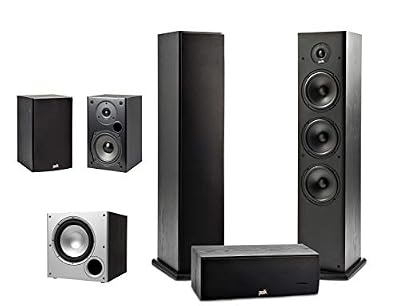
6. Polk Audio T-Series 5.1 Home Theater System
$750–$900 · Best for: First-time buyers who want a complete receiver-based 5.1 system for a small to mid-size room
- Channels
- 5.1
- Fronts
- 2x T50 towers: 6.5-inch driver, 1-inch tweeter, two 6.5-inch passive radiators
- Subwoofer
- Polk PSW10, 10-inch powered, up to 100 W
- Surrounds
- Included (2x T15 bookshelf: 5.25-inch driver, 0.75-inch tweeter)
The Polk T-Series 5.1 system is the best speaker set for home theater on a tighter budget because it covers every channel in one box. You get two T50 towers (a 6.5-inch driver, a 1-inch tweeter and two 6.5-inch passive bass radiators each), a T30 center with two 5.25-inch drivers and a 1-inch tweeter, two T15 bookshelf surrounds and a Polk PSW10 10-inch powered subwoofer rated up to 100 W.
The towers do more than their price suggests: one 6.5-inch driver plus two 6.5-inch radiators gives about three times the radiating area of the driver alone, so they reach lower than bookshelf speakers and ease the load on the sub. Polk notes the set can grow to 7.1 or more if your receiver has the channels.
Compared with the Klipsch R-625FA system above, the Polk has no height speakers and a smaller sub, but it costs a good deal less. The trade-off is headroom: a 10-inch, up-to-100 W sub suits small to mid-size rooms, and in a large room watching action movies at high volume it will reach its limits first. Upgrading the sub later, to something like the SVS SB-1000 Pro with its 12-inch sealed driver and 325 W RMS amp, is the obvious next step. For a small to medium living room at sensible volume, it is hard to beat for the money. Our budget home theater speakers guide covers cheaper alternatives.
Pros
- Complete 5.1 set: towers, center, surrounds and powered sub in one bundle
- Towers add two 6.5-inch passive radiators each for fuller bass
- Compatible with most home theater receivers
- Can grow to 7.1 or more later
Cons
- 10-inch, up-to-100 W sub runs out of steam in large rooms
- No height speakers for Atmos
- Needs a separate AV receiver

7. SVS Prime Satellite 5.1 System
$330–$380 per pair · Best for: Rooms where speakers must stay small but bass still needs to be tight and full
- Channels
- 5.1 (two satellite pairs + Prime Center + sub)
- Satellite drivers
- 1-inch aluminum dome tweeter, 4.5-inch woofer, SoundMatch 2-way crossover
- Subwoofer
- Not included; SVS SB-1000 Pro (12-inch sealed) suggested, sold separately
- Amplification
- Passive speakers; needs an AV receiver
For apartments, bedrooms and any space where five full-size speakers would dominate the room, the SVS Prime Satellite 5.1 is the compact system we would build. Read the listing first: the Amazon link is one pair of Prime Satellites. The full 5.1 takes two satellite pairs (fronts and surrounds), the SVS Prime Center and a subwoofer such as the SVS SB-1000 Pro, each bought separately, so the complete system costs several times the price band shown.
Each satellite pairs a 4.5-inch woofer with the same 1-inch aluminum dome tweeter family used across the larger Prime speakers, joined by SVS's SoundMatch 2-way crossover. The logic of a satellite system is simple: the small speakers handle everything above roughly 80 to 100 Hz, and the sub handles the rest. Because bass below that point is hard to locate, a well-placed sub makes small satellites sound like much bigger speakers, and the SB-1000 Pro's 12-inch sealed driver and 325 W RMS amp have plenty in reserve for a small room.
Compared with the KEF Q1 Meta as a surround, the Prime Satellite is smaller and plays with less authority, but it keeps the Prime family's tweeter matched front to back. The trade-off is scale: without towers or large bookshelf speakers, the front stage is narrower and the system cannot fill a large room at high volume. Set the receiver crossover to 100 Hz rather than 80 Hz if dialogue sounds thin, and spend time on subwoofer placement.
Pros
- Compact satellites wall- or ceiling-mount easily
- 1-inch aluminum tweeter and 4.5-inch woofer cross over cleanly at 80–100 Hz
- Prime-series voicing keeps the center and satellites matched
- Pairs with a 12-inch sealed SB-1000 Pro for tight bass
- Easy to build in stages, one pair at a time
Cons
- Amazon link is one pair: the 5.1 needs two pairs, a center and a sub bought separately
- Needs a separate AV receiver
- No height speakers

8. KEF R7 Meta Floorstanding Speakers
$4,500–$5,500 per pair · Best for: Large rooms and dedicated theaters with serious amplification
- Drivers
- Uni-Q with MAT: 1-inch vented aluminum dome tweeter in 5-inch aluminum midrange; dual 6.5-inch hybrid aluminum bass drivers
- Sensitivity
- 87 dB (2.83 V / 1 m)
- Impedance
- 4 ohms
- Type
- 3-way floorstanding, coaxial
If you already know what a good system sounds like and want the next step, the KEF R7 Meta is where mid-price speakers stop and genuine high-end performance starts. It is a 3-way tower with KEF's 12th-generation Uni-Q driver with MAT, which combines a 1-inch aluminum tweeter and a 5-inch midrange in one coaxial unit, plus dual 6.5-inch bass drivers. KEF rates sensitivity at 87 dB with a 4-ohm nominal impedance.
What you pay for is precision. With the tweeter and midrange sharing one center point, effects stay anchored to the screen and voices stay clear even for listeners well off the center line. KEF offers matching R Meta center and Atmos models, so you can build a complete high-end surround system with one voicing.
The trade-off is amplification. A 4-ohm load at 87 dB asks a lot of a receiver, so check that yours is rated for 4-ohm speakers, or plan to add an external power amplifier for the front channels. Compared with the SVS Prime Tower, the R7 Meta resolves more detail and images more precisely, but it costs several times more per pair. See our high-end home theater speakers guide for alternatives at this level.
Pros
- Uni-Q with MAT gives precise, stable imaging
- Dual 6.5-inch bass drivers for full-range scale
- Dedicated 5-inch midrange for clean dialogue
- Exceptional build and finish
Cons
- 4-ohm load: about 84 dB per watt
- Needs a high-current external amplifier for loud peaks
- Expensive
3. Home Theater Speakers Side by Side
| Product | Score | Price | Type | Drivers | Impedance | Bass loading | Buy |
|---|---|---|---|---|---|---|---|
| Klipsch Reference R-625FA 5.1.2 Dolby Atmos System Best Overall | 84 | $1,200–$1,400 | — | — | — | — | Amazon → |
| SVS Prime Tower Best Tower Speakers | 85 | $1,000–$1,300 per pair | 3-way floorstanding | 1-inch aluminum dome tweeter; 4.5-inch polypropylene midrange; dual 6.5-inch polypropylene woofers | 8 ohms | Rear ported | Amazon → |
| KEF Q6 Meta Center Channel Speaker Best Center Channel | 88 | $500–$700 each | Center channel, coaxial | Uni-Q with MAT (1-inch vented aluminum dome tweeter in aluminum midrange); aluminum bass drivers | 8 ohms | — | Amazon → |
| KEF Q1 Meta Bookshelf Speakers Best Surround Speakers | 84 | $350–$450 per pair | 2-way bookshelf, coaxial | Uni-Q with MAT: tweeter at the center of a 5.25-inch bass/midrange driver | 8 ohms | Bass reflex | Amazon → |
| Klipsch RP-600M II Bookshelf Speakers Best for Low-Power Receivers | 86 | $500–$650 per pair | 2-way bookshelf, horn-loaded | 1-inch titanium LTS tweeter on 90x90 Hybrid Tractrix horn; 6.5-inch Cerametallic woofer | 8 ohms | Rear Tractrix port | Amazon → |
| Polk Audio T-Series 5.1 Home Theater System Best Value Speaker Package | 74 | $750–$900 | — | — | — | — | Amazon → |
| SVS Prime Satellite 5.1 System Best for Small Rooms | 83 | $330–$380 per pair | — | — | — | — | Amazon → |
| KEF R7 Meta Floorstanding Speakers Best Upgrade | 92 | $4,500–$5,500 per pair | 3-way floorstanding, coaxial | Uni-Q with MAT: 1-inch vented aluminum dome tweeter in 5-inch aluminum midrange; dual 6.5-inch hybrid aluminum bass drivers | 4 ohms | Rear ports | Amazon → |
4. How We Ranked These Speakers
These rankings are built on the spec sheet, not lab measurements: spec research, room maths and owner-reported reliability, weighted like this:
- Family completeness and timbre matching. Can you buy a matching center, surrounds and Atmos speakers? Packages and complete families score higher.
- Sensitivity against typical receiver power. We calculate how much power each speaker needs to reach reference peaks at a 10-foot seat, then compare that with what mid-price receivers actually deliver.
- Published frequency response with tolerance, and whether the bass extension lets you use a sensible 60 to 80 Hz crossover.
- Dispersion and design. Coaxial drivers, dedicated midranges and well-documented off-axis behavior earn credit, especially for center and surround roles.
- Owner feedback on reliability, finish and long-term satisfaction, where it is widely reported.
That is why the Klipsch package wins overall and the KEF R7 Meta is an upgrade rather than a default.
5. Building a Matched Surround System From Separate Speakers
A 5.1 system has six channels with distinct jobs, and they are not equally important.
| Channel | Job | Where to spend |
|---|---|---|
| Center | Almost all dialogue, on-screen effects | Spend the most here |
| Front left and right | Music, wide effects, the front soundstage | Second priority |
| Subwoofer (LFE) | Bass below about 80 Hz, explosions | Third priority |
| Surround left and right | Ambience, fly-bys, rain, crowd noise | Can be smaller |
The rule is to buy the front three from the same series, ideally the same tweeter, and the surrounds from the same family if you can. The subwoofer can come from any brand, because bass below 80 Hz carries almost no tonal signature you can identify. That is why mixing a KEF front stage with an SVS subwoofer works perfectly well.
A sensible build order on a budget:
- Start with left, right and center from one family plus a subwoofer (a 3.1 system).
- Add surrounds from the same family when budget allows.
- Add height speakers (Atmos modules or ceiling speakers) last, once you have a receiver that can power them.
Once everything is connected, set every speaker to "small" in the receiver, set the crossover to 80 Hz (THX's long-standing default), and run the receiver's auto-calibration. That one step fixes more problems than any speaker upgrade. Our home theater setup guide walks through it.
6. Timbre Matching and Why Speakers Should Share a Family
Timbre is the tonal character of a sound: why a violin and a trumpet playing the same note sound different. Speakers have timbre too, and it is mostly set by the tweeter material and the crossover point. An aluminum dome, a silk dome, a titanium dome in a horn and a coaxial driver all spread and color treble differently.
In a home theater, the problem shows up when sound pans. A car crossing the screen from left to right passes through the center speaker. If your left and right speakers have bright metal tweeters and your center has a soft silk dome, the car audibly changes character mid-pan. The same applies to dialogue when a character walks off screen.
How to avoid it:
- Buy the front three as one series. This matters more than any other choice.
- Match tweeter type for surrounds. Different sizes are fine; different tweeter technologies are where mismatches appear.
- Do not worry about the subwoofer brand. Below 80 Hz there is no timbre to match.
- Use room correction afterwards. Systems like Audyssey, YPAO and Dirac can trim level and broad tonal differences, but they cannot make a silk dome disperse like a horn.
7. Speaker Sensitivity Versus Amplifier Power
This is where most buyers go wrong, so here is the maths. The sound pressure level at your seat from one speaker is roughly:
SPL = sensitivity + 10 × log10(watts) − 20 × log10(distance in meters)
Dolby's reference level calls for peaks of 105 dB per channel at the seat. Take a 10-foot (3-meter) seat, which costs about 9.5 dB of level compared with the 1-meter rating.
| Speaker sensitivity | Power for 105 dB peaks at 3 m | Power at 10 dB below reference |
|---|---|---|
| 86 dB (typical compact bookshelf) | about 700 W | about 70 W |
| 87 dB (SVS Prime Tower) | about 560 W | about 56 W |
| 96 dB (Klipsch RP-600M II) | about 70 W | about 7 W |
Three conclusions follow:
- Almost nobody listens at full reference level in a living room. Ten dB below reference is already loud, and at that level every speaker on this list works with any decent receiver.
- For dedicated rooms and loud listeners, efficiency wins. A 96 dB speaker on a 100-watt receiver has more headroom than an 86 dB speaker on a 300-watt amplifier.
- Watch the 2.83-volt trick. Sensitivity is often quoted at 2.83 volts, which equals 1 watt only into 8 ohms. Into a 4-ohm speaker, 2.83 volts is 2 watts, so a 4-ohm speaker's sensitivity figure is flattered by about 3 dB.
Room reflections and multiple speakers playing together add a few dB in real rooms, so these numbers are a conservative worst case. They still explain why a high-current receiver or separate amplifier becomes worthwhile with low-sensitivity, 4-ohm speakers.
8. Speaker Packages Versus Building Your Own
A speaker package (sometimes sold as a home theater speaker system) bundles matched speakers and usually a subwoofer. A build-your-own system means buying fronts, center, surrounds and sub separately.
Packages make sense when:
- You want guaranteed timbre matching with no research.
- Your budget is fixed and you want a full 5.1 or 5.1.2 in one purchase.
- The package uses speakers sold individually too, like the Klipsch Reference set, whose R-625FA towers are also sold on their own, so you can upgrade one piece later.
Building your own makes sense when:
- You want towers up front but smaller surrounds.
- You care more about the front three than the surrounds and want to spend unevenly.
- You already own good front speakers and only need a center, surrounds or a better sub. If you want an all-in-one solution with a receiver included, see our best home theater systems guide. If you are weighing speakers against a soundbar, read soundbar vs home theater first.
9. Best Home Theater Speaker Brands
A few brands keep appearing in best-rated home theater speaker lists because they offer complete, matched families at several price points.
- Klipsch: horn-loaded tweeters and very high sensitivity. Lively, dynamic and easy to drive; can sound forward in bright rooms. See our Klipsch home theater review.
- SVS: best known for subwoofers, with a neutral, well-integrated Prime speaker family that shares one tweeter across every model.
- KEF: coaxial Uni-Q drivers for even dispersion, which makes KEF centers and surrounds unusually good for wide seating.
- Polk Audio: strong value, with Monitor XT and Signature Elite families that include Atmos modules. See our Polk Audio review.
- ELAC: Andrew Jones-designed Debut speakers, including a 3-way center that punches above its price.
- Sony: the SS-CS series is one of the cheapest ways into a matched 3-way system.
10. Surround, Height and Wall-Mounted Speakers
Surround speakers should sit just above ear height when seated, about 1 to 2 feet higher than your ears, and at roughly 110 to 120 degrees from the center line for a 5.1 layout, per Dolby's guidance. In a 7.1 system, the side surrounds move to 90 to 110 degrees and rear surrounds go at 135 to 150 degrees. Compact bookshelf speakers like the KEF Q1 Meta or the SVS Prime Bookshelf are ideal. Our bookshelf speakers for home theater guide covers surround options in depth.
Height speakers for Dolby Atmos come in three forms: up-firing modules like the Klipsch R-41SA and Polk Monitor XT90, towers with built-in elevation drivers like the Klipsch R-625FA, and true in-ceiling speakers. In-ceiling speakers are the most precise; up-firing modules are the easiest.
Wall-mounted speakers work best when they are sealed or front-ported, because rear-ported designs pressed against a wall produce boomy bass. If you want speakers flush with the wall, see our in-wall and in-ceiling speakers guide. If running wire is the problem, our wireless speakers for home theater guide explains what wireless systems can and cannot do.
11. Who Should Buy Separate Speakers and Who Can Skip Them
Buy a separate speaker system if:
- You want real surround sound with speakers physically behind you, not virtualized.
- You want to upgrade piece by piece over years rather than replace everything at once.
- Your room is medium to large, where soundbars run out of width and output.
You can skip separates if:
- You have no space or no way to run wire to the rear of the room. A Dolby Atmos soundbar or a wireless home theater system is the realistic choice.
- You do not want an AV receiver. Passive speakers need one, and budgeting for it is part of the cost.
12. Common Mistakes to Avoid
Mixing brands across the front three
A center from one brand between left and right speakers from another is the most common cause of dialogue that sounds different from the music and effects around it. Buy left, center and right from the same series, even if the surrounds come from somewhere else.
Pairing low-sensitivity speakers with a weak receiver
An 86 dB, 4-ohm speaker on an entry-level receiver will clip at loud volume, and clipping is what actually damages tweeters. Check sensitivity and impedance before buying, and pick efficient speakers if your receiver is modest.
Leaving every speaker set to Large
Unless your towers are rated flat to the mid-30s Hz, set every speaker to Small with an 80 Hz crossover and let the subwoofer do the bass. This reduces strain on the receiver and usually gives smoother, deeper bass across the room.
Putting surrounds at the wrong height
Surrounds mounted near the ceiling or sitting on the floor pull effects up or down. Aim for 1 to 2 feet above seated ear height, beside or slightly behind the main seat, and angle them toward the listening area.
Skipping calibration
Even perfectly matched speakers need distance, level and crossover settings. Run the receiver's auto-calibration with the microphone at ear height in the main seat. It takes 15 minutes and fixes more problems than a speaker upgrade.
13. Frequently Asked Questions
What are the best rated home theater speakers?
The best rated home theater speakers for most rooms are matched families: Klipsch Reference for efficiency and dynamics, SVS Prime for neutral sound and a complete range, and KEF Q Meta for even dispersion across wide seating. As a single purchase, the Klipsch Reference R-625FA 5.1.2 system is our top pick because it delivers matched Atmos sound from one box.
Is 5.1 or 7.1 better for a home theater?
A 5.1 system is better for most living rooms; 7.1 only helps when your seating is far enough from the back wall to place rear surrounds behind you. In small and medium rooms, a 5.1.2 layout, which adds two height channels for Dolby Atmos, usually gives a bigger improvement than two extra rear speakers.
Do home theater speakers have to be the same brand?
Your front left, center and right speakers should be the same brand and series, because sound pans between them and mismatched tweeters change the tone mid-pan. Surrounds should ideally match too, but small differences matter less there. The subwoofer can be any brand, because bass below 80 Hz has no recognizable timbre.
How many watts do I need for home theater speakers?
For most living rooms, 50 to 100 watts per channel is plenty with speakers rated at 87 dB sensitivity or higher. The maths: an 87 dB speaker needs about 56 watts for loud peaks 10 dB below reference at a 10-foot seat. Highly efficient speakers like Klipsch's need far less; low-sensitivity 4-ohm speakers need more.
Are tower speakers better than bookshelf speakers for home theater?
Tower speakers are better for medium and large rooms because their extra woofers give more output and deeper bass, which eases the load on the subwoofer. Bookshelf speakers are better for small rooms, for surrounds and for anyone using a subwoofer with an 80 Hz crossover, where the tower's extra bass is handed off anyway.
Do I need a subwoofer if I have tower speakers?
Yes, for movies you still need a subwoofer. Film soundtracks carry a dedicated low-frequency effects (LFE) channel, and only a subwoofer reproduces it properly. Towers reduce how hard the sub has to work above 60 to 80 Hz, but they cannot replace it for explosions and deep rumble.
Can I use bookshelf speakers as surround speakers?
Yes, bookshelf speakers make excellent surround speakers, and they are what most experts recommend. Pick ones from the same family as your fronts, mount them 1 to 2 feet above seated ear height, and set them to Small with an 80 Hz crossover. Sealed or front-ported models are easiest to place near a wall.
What is the most important speaker in a home theater?
The center channel is the most important speaker in a home theater, because it carries almost all dialogue and most on-screen effects. If your budget is limited, spend more on the center than on the surrounds, and make sure it matches the tweeter type of your front left and right speakers.
Related Guides
AV Receivers
Best Home Theater Receiver
The best home theater receiver for 5.1, 7.2 and Dolby Atmos rooms, ranked on real channel counts, rated power, 4K/120 HDMI and room correction.
Subwoofers
Best Subwoofer for Home Theater
The best subwoofer for home theater, matched to your room: sealed vs ported, driver size vs room volume, placement and when two subs beat one.
Home Theater Systems
Best Dolby Atmos Home Theater System
The best Dolby Atmos home theater system for 2026, from 5.1.2 speaker packages to 11.1.4 soundbar kits. Seven picks ranked by real height channels, not hype.
The Bottom Line
For most rooms the best home theater speakers are the Klipsch Reference R-625FA 5.1.2 system: a complete, matched Atmos set with a 10-inch sub, efficient enough for any mid-price seven-channel receiver. If you prefer to build around a neutral tower, the SVS Prime Tower and its matching family is the smoothest route, with the KEF Q6 Meta as our pick for a center and the KEF Q1 Meta for surrounds. Owners of modest receivers should look at the 96 dB Klipsch RP-600M II, value buyers at the Polk T-Series 5.1 system, small rooms at an SVS Prime Satellite 5.1 build, and anyone ready for the high end at the KEF R7 Meta. Whatever you choose, match the front three, set an 80 Hz crossover and calibrate.
More in Bookshelf Speakers
Bookshelf Speakers
Best Bookshelf Speakers for Home Theater
The best bookshelf speakers for home theater in 2026: 8 picks for front, surround and rear duty, with Dolby placement angles and crossover settings explained.
Bookshelf Speakers
Best Budget Home Theater Speakers
The best budget home theater speakers for 2026: 7 cheap packages and pairs, with a spend plan for 5.1 setups and the maths to match them to a budget AVR.