Projectors
Best Projector for Home Theater
We research every product against its spec sheet and independent measurements. When you buy through our links we may earn a commission, at no cost to you. How we score · Disclosure
The best projector for home theater is the one that puts enough light on your screen, from a spot you can actually mount it, at a sharpness your seats can resolve. For most dedicated rooms and darkened living rooms in 2026, that projector is the Epson Home Cinema 3800: 3,000 lumens, a 1.62x zoom with generous lens shift, and 4K pixel-shift detail for a fraction of what a laser projector costs.
This guide is for anyone building a movie room or moving up from a TV. We ranked eight projectors across four types (4K lamp, 4K laser, ultra short throw and smart all-in-one) using the spec sheet, room maths and owner-reported reliability. Each pick names the room it suits and the one trade-off you should know before buying.
Our top picks at a glance


Quick answer
The Epson Home Cinema 3800 is the best projector for home theater for most people: bright enough for a 120-inch screen, flexible enough to ceiling-mount almost anywhere, and sharp enough for 4K Blu-ray. For 4K around $1,000, get the Optoma UHD38x; for a bright, lamp-free laser that also games well, the BenQ TK710. Dedicated dark room? Step up to the Epson 5050UB or the laser Epson LS11000. No ceiling mount? Get the Hisense PX3-Pro ultra short throw.
On this page
- 1. What Actually Matters in a Home Theater Projector
- 2. How Many Lumens Do You Need?
- 3. The Best Projector for Home Theater
- 4. Projector for Home Theater Side by Side
- 5. How We Chose the Best Home Theater Projectors
- 6. Lamp vs LED vs Laser: Which Light Source Is Best?
- 7. Projector or TV for a Home Theater?
- 8. Screen Size, Throw Distance and Seating
- 9. Ceiling Mount, Rear Shelf or Ultra Short Throw?
- 10. What Your Budget Buys in a Projector
- 11. Who Should Buy a Projector, and Who Can Skip One
- 12. Common Mistakes to Avoid
- 13. Frequently Asked Questions
1. What Actually Matters in a Home Theater Projector
Spec sheets list dozens of numbers. Six of them decide whether a projector works in your room.
- Brightness (ANSI lumens). The rating is measured in the brightest mode, which usually looks green or blue. Accurate movie modes often keep 50–70% of it. Treat the rated number as a ceiling, not what you will see. Some brands quote "ISO lumens," a similar standardized method; be wary of vague "LED lumens" figures with no standard attached.
- Throw ratio. Throw ratio × image width = distance from lens to screen. A 1.5:1 lens needs about 13 feet for a 120-inch, 16:9 image (104.6 in wide × 1.5 = 157 in). Zoom range and lens shift decide how much freedom you have.
- Native contrast and black level. In a dark room, this separates good from great. 3LCD and LCoS designs with irises generally beat single-chip DLP here; in a bright room, contrast matters far less than brightness.
- Resolution: native 4K vs pixel shift. Nearly every 4K projector below the price of the Sony VPL-XW5000ES reaches 4K with pixel shifting. From typical seating distances the difference is subtle; on very large screens it becomes visible.
- HDR tone mapping. Projectors cannot reach TV-level highlight brightness, so how a projector compresses HDR matters more than the logos on the box.
- Light source. Lamps are cheapest up front but dim over time and need replacing. LED and laser are solid-state, typically rated for 20,000 hours or more, and turn on instantly.
Everything else (built-in apps, speakers, 3D) is a tiebreaker.
2. How Many Lumens Do You Need?
Brightness on screen is measured in foot-lamberts (fL), and the formula is simple:
fL = effective lumens × screen gain ÷ screen area in square feet
The cinema reference for SDR in a dark room is about 16 fL. For HDR, or a living room with some ambient light, aim for 30 fL or more. Here is what that means in effective (real, calibrated) lumens on a 1.0-gain, 16:9 screen:
| Screen size | Area | Lumens for 16 fL | Lumens for 30 fL |
|---|---|---|---|
| 100 in | 29.7 sq ft | 475 | 891 |
| 120 in | 42.7 sq ft | 683 | 1,281 |
| 135 in | 54.1 sq ft | 866 | 1,623 |
| 150 in | 66.8 sq ft | 1,069 | 2,004 |
Those are effective lumens. If a calibrated mode keeps about 60% of the rating, divide by 0.6: a 120-inch screen at 30 fL needs roughly 2,135 rated lumens. That is why we treat 2,000–3,000 rated lumens as the sweet spot for 100–135 inch screens in a dark or dim room, and 3,000-plus (or an ALR screen) when there is ambient light.
Lamps also lose output with age, so buy a little more brightness than the bare minimum.
3. The Best Projector for Home Theater

1. Epson Home Cinema 3800
$1,700–$2,000 · Best for: Mixed-use rooms and rear-shelf installs that need lens shift and real brightness
- Resolution
- 4K PRO-UHD (1080p 3LCD with pixel shifting)
- Brightness
- 3,000 ISO lumens (white and color)
- Throw ratio
- 1.32–2.15 (1.6x optical zoom)
- Input lag
- 20 ms (Epson spec)
The 3800 wins because it gets the three hard things right at once: light output, placement flexibility and a picture that holds up on a big screen. Epson rates it at 3,000 lumens for both white and color brightness, a 3LCD trait that also means no "rainbow" artifacts for viewers sensitive to single-chip DLP. On a 120-inch, 1.0-gain screen (about 42.7 sq ft), even if an accurate movie mode keeps only half the rated output, you get roughly 35 foot-lamberts, more than double the 16 fL cinema reference. That headroom is what keeps HDR from looking dim.
Placement is the underrated part. The 1.62x zoom (throw ratio of roughly 1.32 to 2.15) fills a 120-inch screen from about 11.5 to 18.7 feet away, and ±60% vertical and ±24% horizontal lens shift lets you mount it off-center without digital keystone, which softens detail. Check your room in the projector throw calculator.
Resolution is 4K via pixel shifting, and from a normal seat it looks close to native 4K. Side by side with the native-4K Sony VPL-XW5000ES, the Sony is crisper, at roughly three times the money.
The trade-off: it is a lamp projector, so budget for a replacement lamp every few years of regular use, and black levels are good rather than great. If your room is fully light-controlled, the Epson 5050UB below goes deeper.
Pros
- 3,000 ISO lumens of white and color brightness
- Lens shift of about ±60% vertical makes placement easy
- 1.6x zoom covers a 11.5–18.7 ft range at 120"
- Low input lag (Epson quotes about 20 ms)
- Built-in dual speakers for casual use
Cons
- Lamp light source needs periodic replacement
- No built-in streaming apps
- Blacks are good, not great, in a dark room

2. Optoma UHD38x
$1,000–$1,400 · Best for: Gaming rooms and bright mixed-use spaces
- Resolution
- 4K UHD (DLP with XPR pixel shifting)
- Brightness
- 4,000 ANSI lumens
- Input lag
- About 4.2 ms at 1080p/240 Hz; about 16 ms at 4K/60 (Optoma spec)
- Throw ratio
- About 1.5–1.65 (1.1x zoom)
The UHD38x is the most light per dollar on this list. Optoma rates it at 4,000 lumens, and it typically sells around the $1,000 mark, so you pay roughly 25 cents per rated lumen versus well over a dollar per lumen for the Epson and Sony laser picks further down. In a family room with some light leaking in, that brightness is the difference between a watchable picture and a washed-out one.
It is also the gamer's choice: Optoma quotes 4.2 ms input lag at 1080p/240Hz and around 16 ms at 4K/60Hz, numbers that rival dedicated gaming monitors.
The 4K image comes from a DLP chip with pixel shifting. Sharpness is good, but contrast is the weak spot: in a dark room, black levels look gray next to the Epson 3800 or 5050UB. HDR10 and HLG are supported, though at this price HDR looks brighter rather than deeper.
Placement is the other compromise. Its zoom range is narrow, so the throw distance is fairly fixed. Measure your room before you buy and confirm the numbers in the projector throw calculator.
Who it suits: a multipurpose room used for movies, sports and gaming, especially with daylight around. Who should skip it: anyone with a blackout-capable theater room, where the money is better spent on contrast. For more 4K options, see our 4K projector guide.
Pros
- 4,000 ANSI lumens, very bright for the money
- 1080p/240 Hz mode with about 4.2 ms lag (Optoma spec)
- 4K/60 gaming at about 16 ms (Optoma spec)
- Built-in speaker
Cons
- Only a 1.1x zoom and no lens shift
- Lamp needs periodic replacement
- Average black levels
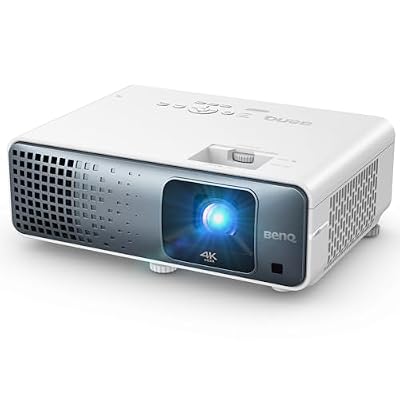
3. BenQ TK710
$1,700–$1,900 · Best for: Mixed-use rooms and gamers who want a bright, lamp-free 4K projector with lens shift
- Resolution
- 4K UHD (DLP with XPR pixel shifting)
- Brightness
- 3,200 ANSI lumens
- Light source
- Laser
- Input lag
- 16 ms (4K/60), 4 ms (1080p/240 Hz)
The TK710 is the pick for a room that does everything: films, sports and console games. It is the successor to the 1080p BenQ HT2060 on our list and moves the formula up a class, to 4K UHD via DLP pixel shifting with a laser light source rated at 3,200 ANSI lumens, so there is no lamp to replace and no slow dimming to manage. BenQ claims 95% Rec.709 color and supports HDR10 and HLG.
Run the numbers for a 120-inch screen (42.7 sq ft): if a calibrated mode keeps about half the rating (1,600 lumens), you get roughly 37 fL, enough to keep the picture watchable with a lamp on. At 100 inches (29.7 sq ft) it is about 54 fL.
Placement is easier than on most projectors at this price thanks to a 1.3x zoom with lens shift, so you can shelf-mount or ceiling-mount without keystone. Gamers get 16 ms at 4K/60 and 4 ms at 1080p/240Hz on BenQ's spec, and eARC passes sound to a soundbar or receiver.
The trade-off: single-chip DLP contrast trails Epson's 3LCD models in a dark room, a small number of viewers notice rainbow flashes, and the Amazon listing does not state the throw ratio, so check BenQ's figure in the projector throw calculator. Against the lamp-based Epson Home Cinema 3800 in a similar price band, you give up some black level and the 3800's longer zoom for a laser and much lower input lag. If you only need cheap light, the Optoma UHD38x above is brighter for less.
Pros
- 3,200 ANSI lumens from a long-life laser
- 1.3x zoom and lens shift for flexible placement
- 16 ms at 4K/60 and 4 ms at 1080p/240 Hz for gaming
- HDR10 and HLG with 95% Rec.709 color claimed
- eARC support and a 3-year warranty
Cons
- Pixel-shifting 4K, not native
- DLP blacks trail the best dark-room projectors
- Throw ratio not stated on the Amazon listing

4. Epson Home Cinema 5050UB
$2,500–$3,000 · Best for: Dedicated dark home theaters that prioritize black levels and install flexibility
- Resolution
- 4K PRO-UHD (1080p 3LCD with pixel shifting)
- Brightness
- 2,600 ISO lumens (white and color)
- Contrast
- 1,000,000:1 (dynamic, Epson spec)
- Throw ratio
- 1.35–2.84 (2.1x motorized zoom)
If you have a dedicated room with dark walls and blackout curtains, contrast becomes the spec that matters most, and the 5050UB is built around it. "UB" stands for UltraBlack: Epson pairs its 3LCD panels with a dynamic iris and extra polarizing filters to push black levels well below the 3800's. Independent reviews have consistently ranked it among the best black-level performers below laser money.
It is still bright at 2,600 lumens, and the lens is properly theater-grade: a motorized 2.1x zoom (throw ratio of roughly 1.35 to 2.84) with ±96.3% vertical and ±47.1% horizontal lens shift. That fills a 120-inch screen from about 11.8 to 24.8 feet away, so a rear-shelf or back-of-room ceiling mount is easy. Resolution is 4K PRO-UHD pixel shifting, the same approach as the 3800.
On a 120-inch screen, 2,600 lumens at around 60% in a calibrated mode is about 1,560 lumens, or 36 fL. That is enough to give HDR real punch in a dark room.
The trade-off: it is a lamp design from 2019, so there is no HDMI 2.1, no 4K/120 for gaming and no built-in apps. Its 18 Gbps HDMI inputs handle 4K/60 HDR, which is all a 4K Blu-ray player needs. Versus the Epson LS11000, you give up the instant-on laser and 4K/120 but keep deeper blacks, which is why many enthusiasts still prefer the 5050UB for pure movie watching.
Pros
- Excellent black levels for the price (1,000,000:1 dynamic rating)
- Motorized 2.1x zoom covers 11.8–24.8 ft at 120"
- Huge lens shift, about ±96% vertical and ±47% horizontal
- 2,600 ISO lumens is plenty for a dark room
Cons
- Lamp light source needs replacing
- No 4K/120 input and higher lag than newer models
- Large, heavy chassis

5. Epson Pro Cinema LS11000
$3,500–$4,000 · Best for: Dark dedicated rooms that want laser longevity and a flexible lens without flagship pricing
- Resolution
- 4K PRO-UHD (1080p 3LCD with pixel shifting)
- Brightness
- 2,500 ISO lumens (white and color)
- Light source
- Laser
- Throw ratio
- 1.35–2.84 (2.1x motorized zoom)
The LS11000 is what most people mean by "set it and forget it." Its laser light source is rated for 20,000 hours, roughly 13 years at four hours a day, with no lamp swaps and no gradual dimming to manage. It turns on and off in seconds, which matters more than it sounds in a shared living space.
It is rated at 2,500 lumens, uses Epson's pixel-shift 4K, and was among the first home theater projectors with HDMI 2.1 inputs that accept 4K/120Hz, so it suits a PS5 or Xbox Series X as well as movies. Pair it with a receiver that passes HDMI 2.1 (see our receiver guide). The motorized 2.1x zoom and wide lens shift match the 5050UB, and lens memory lets you switch between 16:9 and 2.35:1 framing on a scope screen at the press of a button.
Brightness maths: on a 120-inch screen, 2,500 rated lumens at around 60% in a calibrated mode is about 1,500 lumens, or 35 fL. That is on par with the 3800, not brighter, so you are paying for longevity, gaming support and convenience rather than extra punch.
The trade-off: native contrast trails the 5050UB, so in a pitch-black room dark scenes look a touch grayer. Epson's Pro Cinema LS9000 sits in the same price band with a powered lens, but its listing quotes no lumen or contrast figures, so the LS11000 is the safer buy on paper.
Pros
- Laser light source, no lamp replacements
- Accepts 4K/120 over HDMI 2.1
- Motorized 2.1x zoom with large lens shift
- Strong contrast for a 3LCD design
Cons
- 2,500 ISO lumens is modest for big screens or HDR
- Black levels are good, not flagship-class
- No built-in speakers or streaming

6. Sony VPL-XW5000ES
$5,000–$6,000 · Best for: Dark dedicated theaters where native 4K detail and processing matter most
- Resolution
- Native 4K (4096 x 2160, 3 x 0.61-inch SXRD)
- Brightness
- 2,000 lumens (Sony spec)
- Light source
- Laser
- Throw ratio
- 1.38–2.21 (1.6x zoom)
If you want true 4K rather than pixel-shifted 4K, this is the most affordable way into it from an established home theater brand. The XW5000ES uses three native 4K (3840 × 2160) SXRD panels, Sony's version of LCoS, so every pixel on screen is a physical pixel. Combine that with a laser light source rated at 2,000 lumens and Sony's X1 Ultimate processor (the same chip family Sony uses in its TVs) and you get a crisp, natural image with widely praised HDR tone mapping.
Why does native matter? Pixel shifting overlaps sub-frames to approximate 4K. It is very good, but fine textures and small text are cleaner on a native panel, especially on screens of 120 inches and up or when you sit close. This is the best high-end home theater projector here for viewers who notice that difference.
Brightness maths: 2,000 lumens is the lowest rating on this list. On a 120-inch, 1.0-gain screen, at about 70% in a calibrated mode, that works out to roughly 33 fL, fine in a dark room. Avoid pairing it with a 150-inch screen or a low-gain ALR screen.
The trade-off: there is no mechanical iris, so native black level is good but not class-leading, and lumens per dollar are the lowest here. Compared with the Epson LS11000, you pay more and get less light, but a sharper, more refined picture. More on Sony.
Pros
- Native 4K SXRD panels, no pixel shifting
- Laser light source with long life
- Sony processing with strong HDR tone mapping
- 1.6x zoom covers 12.0–19.3 ft at 120"
Cons
- 2,000-lumen rating limits big screens and HDR punch
- Expensive
- No speakers or streaming built in

7. Hisense PX3-Pro
$3,000–$3,500 · Best for: Living rooms that want a 100–120" TV replacement on a low cabinet
- Resolution
- 4K UHD (DLP with XPR pixel shifting)
- Brightness
- 3,000 ANSI lumens (Hisense spec)
- Light source
- RGB triple laser
- HDR
- Dolby Vision, HDR10, HLG
An ultra short throw (UST) projector sits on a low console a few inches from the wall and fires a 100- to 150-inch picture upward, so there is no ceiling mount, no long cable run and no heads casting shadows. The PX3-Pro is our pick for that kind of living-room theater. It uses a triple-laser (RGB) light source for a very wide color gamut, supports Dolby Vision alongside HDR10, and Hisense rates it at 3,000 lumens. A full smart-TV platform is built in, so it behaves much like a giant TV.
Pair it with the right screen. A UST's steep upward angle is exactly what ceiling-light-rejecting screens like the Elite Screens Aeon CLR 3 are designed for: they bounce the projector's light toward you and send overhead light down to the floor. A white wall or a standard ALR screen made for ceiling-mounted projectors will look far more washed out. See our projector screen guide.
Brightness maths: on a 100-inch screen (29.7 sq ft), even 1,800 effective lumens is about 60 fL before screen losses, which is why a good UST can be watched with some lights on.
The trade-off: USTs are unforgiving of wall and screen flatness, since any ripple shows as distortion, and RGB lasers can produce visible speckle for some viewers. Compared with the Epson LS800, the Hisense offers a wider color gamut and Dolby Vision; the Epson is brighter at 4,000 lumens and uses 3LCD, so there is no rainbow effect.
Pros
- 3,000 ANSI lumens from an RGB triple laser
- Dolby Vision support
- Very wide color gamut
- Ultra short throw placement inches from the wall
Cons
- Needs a flat fixed-frame UST screen for best results
- Some viewers notice laser speckle
- Black levels lag OLED and Mini LED TVs

8. Valerion VisionMaster Pro2
$2,500–$3,000 · Best for: Movie and gaming rooms that want laser color and zoom flexibility at a mid-range price
- Resolution
- 4K UHD (DLP with XPR pixel shifting)
- Brightness
- 3,000 ISO lumens
- Light source
- RGB triple laser
- Throw ratio
- 0.9–1.5 (optical zoom)
Lifestyle projectors used to mean dim, small portable boxes. The VisionMaster Pro2 is the category grown up: a compact 4K projector with an RGB triple-laser light source, built-in streaming, and specs aimed squarely at home theater fans. Valerion rates it at 3,000 ISO lumens, it supports Dolby Vision, and its standout feature is a dynamic iris (Valerion calls it Enhanced Black Level) that closes down in dark scenes. That tackles the gray, washed-out blacks most smart laser projectors suffer from.
Who it suits: a living room, bedroom or bonus room where you want a big image without a separate streaming box, an AV rack or a permanent install. Put it on a shelf or table, aim it at a screen, and you are watching. It is also a good fit for renters, because it moves with you.
The trade-off: you do not get the long motorized zoom and wide lens shift of the Epsons, so plan placement carefully; digital keystone and digital zoom reduce effective resolution. The built-in speakers are fine for casual viewing, but for a real theater send audio to a soundbar or an AV receiver.
Versus the Hisense PX3-Pro: the Valerion is a standard-throw design, so it needs more distance from the screen, but it is far easier to move between rooms. The Hisense is a permanent console installation that wins on convenience once it is set up. For more laser choices, see our laser projector guide.
Pros
- 3,000 ISO lumens from an RGB triple laser
- Optical zoom: 7.8–13.1 ft for a 120" screen
- Dolby Vision and HDR10+ support
- Google TV built in
Cons
- Some viewers notice laser speckle
- DLP native contrast trails top Epson and Sony models
- Newer brand with a shorter service track record
4. Projector for Home Theater Side by Side
| Product | Score | Price | Resolution | Brightness | Light source | Throw ratio | HDR | Buy |
|---|---|---|---|---|---|---|---|---|
| Epson Home Cinema 3800 Best Overall | 83 | $1,700–$2,000 | 4K PRO-UHD (1080p 3LCD with pixel shifting) | 3,000 ISO lumens (white and color) | Lamp | 1.32–2.15 (1.6x optical zoom) | HDR10, HLG | Amazon → |
| Optoma UHD38x Best Budget 4K | 80 | $1,000–$1,400 | 4K UHD (DLP with XPR pixel shifting) | 4,000 ANSI lumens | Lamp | About 1.5–1.65 (1.1x zoom) | HDR10, HLG | Amazon → |
| BenQ TK710 Best for Mixed-Use Rooms | 82 | $1,700–$1,900 | 4K UHD (DLP with XPR pixel shifting) | 3,200 ANSI lumens | Laser | — | HDR10, HLG | Amazon → |
| Epson Home Cinema 5050UB Best for Dark Rooms | 84 | $2,500–$3,000 | 4K PRO-UHD (1080p 3LCD with pixel shifting) | 2,600 ISO lumens (white and color) | Lamp | 1.35–2.84 (2.1x motorized zoom) | HDR10, HLG | Amazon → |
| Epson Pro Cinema LS11000 Best Laser Upgrade | 86 | $3,500–$4,000 | 4K PRO-UHD (1080p 3LCD with pixel shifting) | 2,500 ISO lumens (white and color) | Laser | 1.35–2.84 (2.1x motorized zoom) | HDR10, HLG | Amazon → |
| Sony VPL-XW5000ES Best Native 4K | 88 | $5,000–$6,000 | Native 4K (4096 x 2160, 3 x 0.61-inch SXRD) | 2,000 lumens (Sony spec) | Laser | 1.38–2.21 (1.6x zoom) | HDR10, HLG | Amazon → |
| Hisense PX3-Pro Best Ultra Short Throw | 84 | $3,000–$3,500 | 4K UHD (DLP with XPR pixel shifting) | 3,000 ANSI lumens (Hisense spec) | RGB triple laser | Ultra short throw | Dolby Vision, HDR10, HLG | Amazon → |
| Valerion VisionMaster Pro2 Best Smart All-in-One | 86 | $2,500–$3,000 | 4K UHD (DLP with XPR pixel shifting) | 3,000 ISO lumens | RGB triple laser | 0.9–1.5 (optical zoom) | Dolby Vision, HDR10+, HDR10, HLG | Amazon → |
5. How We Chose the Best Home Theater Projectors
We started with the 29 projectors in our catalog and narrowed them to eight using four filters:
- Brightness against screen size. Every pick has to reach at least 16 fL on a 120-inch, 1.0-gain screen in a realistic movie mode, assuming 50–70% of its rated lumens.
- Placement flexibility. We weighted optical zoom and lens shift heavily, because digital keystone and digital zoom throw away resolution.
- Picture fundamentals over features. Contrast, HDR handling and color accuracy, judged from manufacturer specs and widely published independent measurements, count for more than app stores and speakers.
- Cost of ownership and reliability. Lamp replacement cost, laser and LED lifespan, and owner-reported failures from forums and retailer reviews.
We have not bench-tested these projectors in a lab. Rankings come from spec research, room maths and owner-reported experience, and where we could not confirm a spec we left it out.
6. Lamp vs LED vs Laser: Which Light Source Is Best?
| Light source | Typical rated life | Strengths | Weaknesses |
|---|---|---|---|
| Lamp (UHP) | A few thousand hours, varies by mode | Most lumens per dollar | Dims with age, replacement lamps, warm-up time |
| LED | 20,000+ hours | No maintenance, good color, quiet | Less brightness for the money |
| Laser (blue + phosphor) | 20,000 hours or more | Instant on, stable output | Costs more up front |
| RGB triple laser | 20,000 hours or more | Widest color gamut | Speckle visible to some viewers |
Ownership maths: if a lamp lasts around 4,000 hours in a normal mode and you watch 20 hours a week, that is roughly four years per lamp. For a movie room used a few nights a week, a lamp model like the Epson Home Cinema 3800 is still the best value. If the projector will be your everyday TV, laser (the Epson LS11000 or Hisense PX3-Pro) is worth the premium.
7. Projector or TV for a Home Theater?
This is the first decision, so it is worth doing the maths. A 120-inch projected image has about twice the area of an 85-inch TV ((120 ÷ 85)² ≈ 2.0), and a 150-inch image has more than three times the area. Big TVs get expensive fast past 85 inches; projectors scale cheaply, because the main extra cost is a bigger screen.
A TV wins when:
- You watch mostly in daylight or in a room you cannot darken.
- You want the best HDR: OLED and Mini LED TVs reach highlight brightness no home projector can match, and OLED blacks are perfect.
- The screen size you want is 85 inches or less.
A projector wins when:
- You want 100 inches or more, especially for a dedicated room or basement.
- You can control light at least in the evening.
- You want a cinema feel, with the image filling more of your field of view.
Many people end up with both. If a TV makes more sense for your room, see our guide to the best TV for home theater.
8. Screen Size, Throw Distance and Seating
Work backwards from your seats. A common target for a home theater is a screen that fills about 30 to 40 degrees of your field of view (the SMPTE and THX recommendations). For a 16:9 screen, that means:
- 40° (immersive): viewing distance ≈ 1.2 × screen diagonal
- 30° (relaxed): viewing distance ≈ 1.6 × screen diagonal
So at 12 feet (144 inches), a 120-inch screen is immersive and roughly 90 to 100 inches is relaxed. Native 1080p starts to look soft if you sit closer than about 1.5 times the diagonal; 4K holds up closer. Try your own numbers in the viewing distance calculator.
Then check throw. The distance from lens to screen = throw ratio × screen width. For a 120-inch screen (104.6 inches wide):
- Epson Home Cinema 3800 (about 1.32–2.15): roughly 11.5 to 18.7 feet
- Epson 5050UB and LS11000 (about 1.35–2.84): roughly 11.8 to 24.8 feet
- Epson LS800 UST (0.16): about 17 inches from lens to screen
If your mounting spot falls outside a projector's range, it is the wrong projector for your room, however good the reviews are. The projector throw calculator does this in seconds, and our screen guide covers screen sizes and materials.
9. Ceiling Mount, Rear Shelf or Ultra Short Throw?
Where the projector lives decides which type to buy.
- Ceiling mount. The classic dedicated-room setup. The best ceiling mount projectors for home theater have lens shift, so they need not sit perfectly centered. The Epson 3800, 5050UB and LS11000 all offer it, as does the BenQ TK710; many budget DLP models do not, which forces keystone. Run power and HDMI (fiber HDMI for long runs) before you finish the ceiling.
- Rear shelf. If the back wall of the room is 15 to 25 feet from the screen, a long-zoom projector such as the 5050UB or LS11000 can sit on a shelf behind the seats. It is easier to install and service, but people standing up will cast shadows.
- Ultra short throw. A UST like the Hisense PX3-Pro or Epson LS800 sits on a console under the screen: no ceiling work, no shadows. Budget for a ceiling-light-rejecting screen, and expect tight installation tolerances.
- Table or portable. A smart all-in-one like the Valerion VisionMaster Pro2 can sit on a coffee table or bookshelf and move between rooms.
10. What Your Budget Buys in a Projector
- Under $500: native 1080p lamp projectors such as the Epson Home Cinema 880 (3,300 lumens) and Optoma HD146X. Bright and simple, but basic contrast and no lens shift.
- Around $1,000: entry 4K, such as the Optoma UHD38x and Epson Home Cinema 2350. See our budget home theater projector guide.
- Around $1,500 to $3,000: the sweet spot for dedicated rooms: the Epson 3800 and 5050UB, plus smart lasers like the Valerion VisionMaster Pro2.
- $3,000 and up: laser home theater projectors (Epson LS11000, LS9000) and premium USTs.
- $5,000 and up: native 4K, starting with the Sony VPL-XW5000ES.
Whatever you spend, keep money for a screen and sound: a home theater system does more for movie night than a few hundred extra lumens.
11. Who Should Buy a Projector, and Who Can Skip One
Buy a projector if: you want a picture of 100 inches or more, you have (or can create) a room that gets dark in the evening, and you are happy to spend an afternoon on setup. A projector is also the best home theater option for basements and bonus rooms, where a huge TV would dominate the space.
Skip it, or buy a TV, if: you mostly watch during the day in a bright room, you care most about HDR highlights and perfect blacks, or you need something that works with zero setup. A 77- or 85-inch OLED or Mini LED TV from our TV guide will look better in those conditions.
Consider an ultra short throw if: you want a huge living-room picture but cannot ceiling-mount or run cables.
12. Common Mistakes to Avoid
Buying on rated lumens alone
Rated lumens come from the brightest, least accurate picture mode. Expect 50–70% in a movie mode, and calculate foot-lamberts for your actual screen size before deciding a projector is bright enough.
Not checking throw distance first
A projector that needs 14 feet cannot fill your screen from 10. Measure from screen to mounting point, then confirm the model's throw range in the projector throw calculator before you order.
Relying on keystone correction
Digital keystone reshapes the image by discarding pixels, so a 4K projector stops resolving true 4K. Use lens shift or physical placement to square the image, and keep keystone at zero.
Using the wrong screen for an ultra short throw
A UST hits the screen from a steep angle below. White walls and standard ALR screens scatter that light and pick up ceiling lights. Use a ceiling-light-rejecting screen designed for UST projectors.
Forgetting about sound and connections
Projector speakers are an afterthought. Plan where audio goes: a receiver with eARC or HDMI passthrough, or a soundbar. If you game, make sure the chain supports HDMI 2.1 end to end.
13. Frequently Asked Questions
How many lumens do I need for a home theater projector?
For a dark, dedicated room, about 1,500 to 2,500 rated lumens is enough for a 100- to 120-inch screen. A room with some ambient light needs 3,000 or more, ideally with an ALR screen. Aim for roughly 16 foot-lamberts for SDR and 30 or more for HDR: divide real lumens by your screen area in square feet to check.
Is a projector better than a TV for a home theater?
A projector is better if you want a picture larger than about 85 inches and can darken the room; a 120-inch image has roughly twice the area of an 85-inch TV. A TV is better for bright rooms, daytime viewing and HDR, because OLED and Mini LED sets are far brighter and have deeper blacks.
What size screen should I get for a 12 ft viewing distance?
At 12 feet (144 inches), a 120-inch 16:9 screen gives an immersive 40-degree field of view, while 90 to 100 inches is a more relaxed 30 degrees. With a 4K projector, 120 inches works well; with 1080p, 100 to 110 inches hides pixel structure better.
What is the best projector for a home movie theater?
For most home movie theaters, the Epson Home Cinema 3800 is the best all-rounder thanks to 3,000 lumens, a flexible lens and 4K pixel shifting. For a fully dark, dedicated room, the Epson 5050UB has deeper blacks, and the Sony VPL-XW5000ES is the pick if you want native 4K.
Is a laser projector worth it over a lamp projector?
A laser projector is worth it if the projector will get heavy use or replace your TV. Laser light sources are typically rated for 20,000 hours, turn on instantly and do not need lamp replacements. For a movie room used a few nights a week, a lamp model like the Epson 3800 still offers more picture for the money.
Do I need a native 4K projector?
Most people do not. Pixel-shifting projectors put 4K-level detail on screen, and from typical seating distances the difference from native 4K is subtle. Native 4K, like the Sony VPL-XW5000ES, pays off on screens of 120 inches and up or if you sit closer than about 1.2 times the screen diagonal.
Can I use a home theater projector in a room with windows?
Yes, with the right setup. Choose 3,000 or more lumens, use blackout curtains for movie nights, and pair the projector with an ambient light rejecting screen, which can keep contrast acceptable with some daylight. For daytime viewing in a bright room, a large TV or a bright UST with a CLR screen works better.
Do home theater projectors have good built-in speakers?
Not for a real home theater. Built-in speakers are small and sit beside or behind you on a ceiling mount. Send audio to an AV receiver through HDMI or to a soundbar via eARC; a 5.1 or Dolby Atmos speaker system makes a far bigger difference than projector audio.
Related Guides
Projectors
Best 4K Projector for Home Theater
The best 4K projector for home theater in 2026: 7 picks from around $1,000 to native 4K laser, plus a plain-English guide to native 4K vs pixel shifting.
Projector Screens
Best Projector Screen for Home Theater
The best projector screen for home theater in 2026: 6 fixed, ALR, UST and motorized picks, plus the gain, size and seating maths to choose the right one.
Projectors
Best Budget Home Theater Projector
The best budget home theater projector for 2026, in under-$500 and around-$1,000 tiers: 7 picks with real lumens maths, screen sizes and hidden costs.
The Bottom Line
The best projector for home theater for most rooms is the Epson Home Cinema 3800: 3,000 lumens, a flexible lens and convincing 4K. Want 4K around $1,000? The Optoma UHD38x is the brightness-per-dollar champion. Want a bright, lamp-free laser for a room that does movies, sports and games? Get the BenQ TK710. For a dedicated dark room, the Epson 5050UB has the deepest blacks here, the Epson LS11000 brings laser convenience and 4K/120, and the Sony VPL-XW5000ES is the native 4K pick. Living room without a ceiling mount? The Hisense PX3-Pro ultra short throw is the TV replacement, and the Valerion VisionMaster Pro2 is the smart all-in-one that moves with you.