TVs
Best TV for Home Theater
We research every product against its spec sheet and independent measurements. When you buy through our links we may earn a commission, at no cost to you. How we score · Disclosure
The best TV for home theater combines deep blacks, enough brightness for HDR, a size that fills your field of view, and the connections to run a real sound system. For most people in 2026 that is the LG C5 OLED: per-pixel contrast, four full HDMI 2.1 ports, Dolby Vision, a 144Hz panel and sizes from 42 to 83 inches.
This guide is for anyone deciding between OLED and Mini LED, or between a TV and a projector, for a movie room or living room. We picked eight TVs from budget to flagship using manufacturer specs, widely published independent measurements, seat-distance maths and owner-reported reliability, and we include a full projector vs TV comparison.
Our top picks at a glance


Quick answer
The LG C5 OLED is the best TV for home theater for most rooms: perfect blacks, four HDMI 2.1 ports and Dolby Vision at a sensible price. Film purists should get the Sony Bravia 8 II, and bright rooms call for the Samsung S95F. The newer LG C6 is the value OLED, the TCL QM8L claims the most brightness for the money, and the Hisense U8QG goes up to 100 inches. On a budget, the Hisense U7SG is the pick.
On this page
- 1. What Makes a Great Home Theater TV
- 2. How to Choose the Best TV for Home Theater
- 3. The Best TV for Home Theater
- 4. TV for Home Theater Side by Side
- 5. How We Ranked These TVs
- 6. Projector vs TV for a Home Theater
- 7. OLED vs Mini LED for Movies
- 8. What Size TV for a Home Theater?
- 9. Connecting a TV to a Home Theater System
- 10. Who Should Buy a TV Instead of a Projector
- 11. Common Mistakes to Avoid
- 12. Frequently Asked Questions
1. What Makes a Great Home Theater TV
A home theater TV has different priorities from a bedroom or kitchen TV:
- Contrast and black level. Movies are full of dark scenes. OLED TVs switch individual pixels off for perfect black; Mini LED TVs use local dimming zones to get close, with some blooming.
- HDR brightness and tone mapping. HDR content is mastered for 1,000 nits or more. Mini LED TVs get closest; OLEDs trade some brightness for perfect black. Good tone mapping matters as much as peak brightness.
- HDR formats. Dolby Vision is widely used on streaming and 4K Blu-ray. LG, Sony, TCL and Hisense support it; Samsung uses HDR10+ instead.
- Connections. An eARC port lets the TV send lossless Dolby TrueHD and Dolby Atmos to a receiver or soundbar. Enough HDMI 2.1 ports matter if you have multiple consoles.
- Size. In a home theater, size matters more than in any other room. The goal is a screen that fills 30 to 40 degrees of your field of view.
- Processing. Upscaling, motion handling and accurate picture modes (such as Filmmaker Mode) determine how good everyday content looks.
Built-in speakers barely matter: in a home theater, sound comes from a receiver and speakers or a soundbar.
2. How to Choose the Best TV for Home Theater
Four decisions narrow the field:
- How bright is the room? Dark or dim: OLED (LG C5 or C6, Sony Bravia 8 II) gives the best picture. Bright with windows: a bright OLED with an anti-glare finish (Samsung S95F) or a Mini LED (Sony Bravia 9, TCL QM8L, Hisense U8QG).
- How far do you sit? For a 16:9 TV, an immersive 40-degree view means sitting about 1.2 times the diagonal away; a relaxed 30-degree view means about 1.6 times. At 10 feet, that points to 75 to 100 inches. See the size table below or the viewing distance calculator.
- What audio will you use? For a receiver or soundbar with Dolby Atmos, you need eARC. Every pick here has it.
- How many HDMI 2.1 devices? If you have two consoles plus a receiver, a TV with four HDMI 2.1 ports (LG C5, Samsung) is easier than one with two (Sony).
If the size you want is beyond 100 inches, or you can fully darken the room, read the projector vs TV section below before you buy.
3. The Best TV for Home Theater

1. LG C5 OLED evo TV
$1,600–$2,200 · Best for: Dim and dark home theaters, movie fans and console or PC gamers
- Panel
- WOLED (OLED evo)
- Refresh rate
- 144 Hz
- HDR
- Dolby Vision, HDR10, HLG
- HDMI 2.1 ports
- 4
The C5 is the TV we would buy for most home theaters, because it delivers the thing projectors and LCD TVs struggle with, perfect black, without any compromises in connectivity. As a WOLED panel, every pixel makes its own light and switches fully off, so stars on a black sky stay pinpoint sharp with no blooming, and contrast in a dark room is effectively infinite.
For home theater use, its connections are the best in class. All four HDMI ports are HDMI 2.1, so you can connect a PS5, an Xbox, a streaming box and a receiver without juggling, and the eARC port passes lossless Dolby TrueHD and Dolby Atmos to a receiver or soundbar. Read more on eARC. It supports Dolby Vision, HDR10 and HLG, and the 144Hz panel suits gaming.
Sizes run from 42 to 83 inches. At a 10-foot seat, a 77-inch C5 fills about 31 degrees of your view; the 83-inch about 34 degrees, which is about as big as OLED gets at a mainstream price.
The trade-off: brightness. OLED cannot match Mini LED in peak or full-screen brightness, so in a sunny room HDR highlights have less impact and reflections are more visible. It does not support HDR10+. If your room is bright, the matte Samsung S95F is the brighter OLED; for the newest LG at a lower price, see the LG C6; if you want the most accurate film presentation, see the Sony below. More on LG.
Pros
- Perfect blacks and no blooming
- Four HDMI 2.1 ports with 4K/144 Hz
- Dolby Vision support
- Wide range of sizes, 42" to 83"
Cons
- Less bright than the S95F and Mini LED rivals
- No HDR10+ support
- Reflective screen in bright rooms

2. Sony Bravia 8 II OLED TV
$2,800–$3,500 · Best for: Film lovers who want accurate color and top-tier processing at 55" or 65"
- Panel
- QD-OLED
- Refresh rate
- 120 Hz
- HDR
- Dolby Vision, HDR10, HLG
- HDMI 2.1 ports
- 2 (of 4)
If the TV is mainly for films, the Bravia 8 II is the one to beat. It uses a QD-OLED panel, which pairs per-pixel OLED contrast with quantum-dot color, so saturated colors stay rich even at high brightness. Sony's processing is the real draw: it is widely praised for natural motion, excellent upscaling of lower-resolution sources and very accurate out-of-the-box color, which is what a home theater should prioritize.
It supports Dolby Vision, HDR10 and HLG, runs Google TV, and its Acoustic Surface Audio+ system uses the screen itself as a speaker. In a home theater, that matters in a specific way: Sony lets you use the TV as a center channel with compatible Sony receivers and soundbars, so dialogue comes from the picture.
The catch for gamers and big rooms: it comes in only 55 and 65 inches, and only two of its four HDMI inputs support HDMI 2.1 (4K/120), one of which is the eARC port. If you have a receiver on eARC plus two consoles, you will need to route a console through the receiver. The panel tops out at 120Hz.
Size maths: at 8 feet, a 65-inch screen fills about 33 degrees of your view, inside the 30 to 40 degree home theater range. Beyond 9 feet, consider a larger TV or a projector. Compared with the LG C5, the Sony costs more and offers fewer sizes but delivers a more refined picture. More on Sony.
Pros
- Excellent Sony processing and motion handling
- Accurate, natural color out of the box
- QD-OLED with Dolby Vision
- Google TV built in
Cons
- Only two HDMI 2.1 ports, one shared with eARC
- Only 55" and 65" sizes
- 120 Hz maximum

3. LG C6 OLED evo TV
$1,300–$1,500 · Best for: Dim and dark home theaters, movie fans and console or PC gamers
- Panel
- OLED evo (self-lit pixels)
- Refresh rate
- Up to 165 Hz (VRR)
- HDR
- Dolby Vision, HDR10, HLG
- Smart platform
- webOS with Google Gemini
The C6 is LG's 2026 C-series OLED, the newest LG OLED on our list, and it currently sits in a lower price band than the C5. Each of its 8.3 million self-lit pixels makes its own light, so blacks are truly black and subtitles never bloom. New for this generation is a Brightness Booster driven by the a11 AI Processor Gen3, and you still get Dolby Vision, HDR10 and HLG, Filmmaker Mode and eARC for lossless audio to a receiver or soundbar. The smart platform is webOS with Google Gemini.
Gamers get the fastest panel of the LG OLEDs here: refresh up to 165 Hz with VRR, NVIDIA G-Sync and AMD FreeSync Premium. At 165 Hz each frame lasts about 6.1 ms, against 8.3 ms at 120 Hz.
Size maths: the Amazon listing is for the 65-inch model, which is about 56.7 inches wide. A 40-degree view puts you about 6.5 feet away and a 30-degree view about 8.8 feet; if your sofa is 10 feet or more back, look at a bigger screen or a projector. Check your room with the viewing distance calculator.
The trade-off: the listing is thin. It gives no peak-brightness figure and no HDMI 2.1 port count, so if you need four full HDMI 2.1 ports or sizes beyond 65 inches today, the LG C5 above is the documented choice. The glossy screen also reflects lamps, so a bright room is better served by the matte Samsung S95F below. More on LG.
Pros
- Self-lit OLED pixels: perfect blacks, no blooming
- Brightness Booster with the a11 AI Processor Gen3
- Up to 165 Hz with VRR, G-Sync and FreeSync Premium
- Dolby Vision, Dolby Atmos and Filmmaker Mode
- webOS with Google Gemini built in
Cons
- No peak-brightness figure listed; Mini LED sets go brighter
- Glossy screen can reflect lamps in bright rooms
- HDMI 2.1 port count not on the Amazon listing

4. Samsung S95F OLED TV
$2,800–$3,400 · Best for: Bright living rooms and mixed-use theaters that want OLED quality
- Panel
- QD-OLED with Glare Free matte finish
- Refresh rate
- 165 Hz
- HDR
- HDR10, HDR10+, HLG (no Dolby Vision)
- HDMI 2.1 ports
- 4
Glare is the enemy of a living-room theater, and the S95F is designed to beat it. Samsung's Glare Free matte finish diffuses reflections from windows and lamps instead of mirroring them, so dark scenes stay readable in the daytime. Underneath is a QD-OLED panel with per-pixel contrast and quantum-dot color, which keeps saturated colors bright.
It supports HDR10, HDR10+ and HLG, has four HDMI 2.1 ports and a 165Hz panel, and comes in 55 to 83 inches. For a multipurpose room where you watch sports in the afternoon and movies at night, it is the most flexible OLED here.
The Dolby Vision caveat: Samsung does not support Dolby Vision. Streaming services and discs fall back to HDR10 (or HDR10+ where available), so you still get HDR, just without Dolby's scene-by-scene metadata. Most viewers will not miss it, but it is worth knowing if your library leans on Dolby Vision.
The trade-off: the matte filter slightly lifts black levels in a lit room compared with glossy OLEDs, and in a fully dark theater its advantage disappears, so a dark dedicated room is better served by the LG C5 or Sony Bravia 8 II. If you want a cheaper Samsung OLED without the anti-glare coating, look at the Samsung S90F. Pair it with a soundbar or receiver over eARC. More on Samsung.
Pros
- Glare Free matte screen handles reflections well
- Very bright for an OLED
- 165 Hz with four HDMI 2.1 ports
- HDR10+ support
Cons
- Expensive
- No Dolby Vision
- Matte finish can lift blacks slightly under direct light
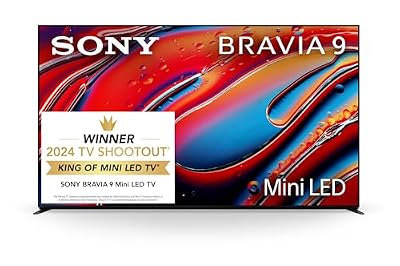
5. Sony Bravia 9 Mini LED TV
$2,500–$3,500 · Best for: Bright, large rooms that want a 75–85" screen with refined processing
- Panel
- Mini LED (full-array local dimming)
- Sizes
- 65, 75, 85 in.
- HDR
- Dolby Vision, HDR10, HLG
- HDMI 2.1 ports
- 2 (of 4)
If you want TV-level HDR punch at sizes up to 85 inches, the Bravia 9 is the most refined Mini LED here. Mini LED TVs use thousands of tiny LEDs behind an LCD panel, grouped into local dimming zones, and Sony's XR Backlight Master Drive controls them precisely enough to keep blooming (halos around bright objects) well under control. The result is very high brightness with deep blacks for an LCD.
Brightness is the point. A Mini LED can sustain much higher full-screen and highlight brightness than OLED, so HDR content looks closer to how it was mastered, and the picture holds up in a sunny room. Combine that with Sony's natural color and motion processing and you have a TV that suits both daytime sports and evening films.
It comes in 65, 75 and 85 inches, runs Google TV, supports Dolby Vision, and has a 120Hz panel. At 10 feet, the 85-inch model fills about 34 degrees of your view.
The trade-off: like the Bravia 8 II, it has only two HDMI 2.1 ports, and even the best local dimming cannot match OLED's per-pixel black in a fully dark room, especially with off-angle viewing. It is a premium TV, priced against flagship OLEDs. If your room is dark, the LG C5 is better value; if it is bright or you want 85 inches, the Bravia 9 is the pick. For more Mini LED brightness for less money, see the TCL below, and for sizes up to 100 inches, the Hisense U8QG.
Pros
- Very high brightness for bright rooms
- Sony processing keeps blooming well controlled
- Available up to 85"
- Dolby Vision and Google TV
Cons
- Only two HDMI 2.1 ports, one shared with eARC
- Expensive next to TCL and Hisense Mini LED
- 120 Hz maximum

6. TCL QM8L SQD-Mini LED TV
$950–$1,100 · Best for: Bright rooms and big-screen buyers who want maximum brightness for the money
- Panel
- SQD-Mini LED QLED (WHVA 2.0 panel)
- Refresh rate
- 144 Hz native; Game Accelerator 288 VRR
- HDR
- Dolby Vision IQ, HDR10, IMAX Enhanced
- Peak brightness
- Up to 6,000 nits (TCL claim)
Home theaters reward brightness as well as size, and on paper the QM8L gives you the most of it for the money. It is the successor to the QM8K and what TCL calls an SQD-Mini LED TV: up to 4,000+ dimming zones, up to 6,000 nits peak (TCL's claim), a 7,000:1 static contrast ratio and an Ultra Color Filter for purer color. It supports Dolby Vision IQ, HDR10 and IMAX Enhanced, runs Google TV with Gemini, and has eARC for your receiver or soundbar.
Why the brightness matters: a projector image at 16 foot-lamberts is about 55 nits (1 fL is about 3.43 nits), and even a punchy 60 fL is only about 205 nits. A 6,000-nit claim is roughly 30 times that bright projector for HDR highlights. Sustained output will sit below the claim, but it shrugs off afternoon sun.
For gaming, the panel runs 144 Hz natively (about 6.9 ms per frame) with Game Accelerator 288 VRR and AMD FreeSync Premium Pro.
Size maths: the Amazon listing is for the 65-inch model. At 10 feet, a 65-inch TV fills only about 27 degrees of your view, below SMPTE's 30-degree minimum, so it suits seats roughly 6.5 to 8.8 feet away.
The trade-off: processing and blooming. TCL's motion handling and upscaling are not as polished as Sony's, and Mini LED blooming is more visible than on the Bravia 9 in dark scenes with bright objects. If you want 85 inches or more, the Hisense U8QG below goes up to 100. More on TCL.
Pros
- Up to 6,000 nits and 4,000+ dimming zones claimed
- 7,000:1 static contrast
- 144 Hz with Game Accelerator 288 VRR and FreeSync Premium Pro
- Dolby Vision IQ, Dolby Atmos and IMAX Enhanced
- Google TV with Gemini and Bang & Olufsen audio
Cons
- Some blooming around bright objects on dark scenes
- Peak-brightness claims exceed real sustained output
- HDMI 2.1 port count not on the Amazon listing

7. Hisense U8QG Mini-LED TV
$1,000–$1,400 · Best for: Bright rooms and gamers who want high brightness and refresh for the money
- Panel
- Mini-LED (full-array local dimming)
- Refresh rate
- Up to 165 Hz
- HDR
- Dolby Vision IQ, HDR10+, HDR10, HLG
- Sizes
- 55 to 100 in.
The U8QG is the value pick for a bright room or a mixed-use living room. It is a Mini LED TV designed around high brightness, so HDR highlights pop and the picture stays punchy with windows and lamps around, at a price well below premium OLED and Mini LED models.
It supports Dolby Vision and HDR10+ (unlike Samsung, Hisense supports both), runs Google TV, and comes in sizes from 55 to 100 inches. That makes it one of the most affordable routes to a 100-inch TV, a size that until recently meant a projector.
Size maths: at 12 feet, a 100-inch TV fills about 34 degrees of your field of view, comfortably in the home theater range. A 75-inch at the same distance fills only about 26 degrees, so for a larger room, size up.
For home theater use, connect your receiver or soundbar to the eARC port to pass Dolby Atmos and lossless audio. Our home theater systems guide has options at every budget.
The trade-off: dark-room performance. Blooming around bright objects is more noticeable than on the Sony Bravia 9, black uniformity is not as clean as OLED, and the out-of-box picture mode benefits from some adjustment. In a dark, dedicated theater, the LG C5 is the better image; in a bright living room at 85 inches and up, the Hisense gives you more TV for the money. Compared with the TCL QM8L, it costs a little more but comes in sizes up to 100 inches. More on Hisense.
Pros
- High brightness for bright rooms
- Refresh up to 165 Hz for gaming
- Dolby Vision IQ and HDR10+
- Sizes up to 100"
Cons
- Some blooming on dark scenes
- Only two HDMI 2.1 ports
- Contrast drops off-angle

8. Hisense U7SG Mini-LED TV
$750–$850 · Best for: Budget theaters and bright family rooms that want a large Mini-LED screen for less
- Panel
- Mini-LED ULED with Hi-QLED (full-array local dimming)
- Refresh rate
- 165 Hz native; VRR up to 330 Hz
- HDR
- Dolby Vision IQ, HDR10+, HDR10, IMAX Enhanced
- Peak brightness
- Up to 3,000 nits (Hisense claim)
The U7SG brings Mini LED to a budget price, and it is the best TV for a home theater when money is tight. It is Hisense's 2026 U7 and the successor to the U75QG, with up to 3,000 local dimming zones and up to 3,000 nits peak brightness claimed, so contrast and HDR are well beyond cheap edge-lit LCDs. It supports Dolby Vision IQ and HDR10+, runs Google TV, has eARC, and adds a dual-layer anti-reflection screen that helps with windows behind the sofa.
Where to spend instead: for many budget home theaters, the smartest move is to put the savings into sound. Its built-in 2.1.2-channel Atmos speakers are fine for TV, but a budget Mini LED with a good 5.1 system feels far more like a home theater. Our budget home theater system guide covers affordable speakers and receivers.
Size maths: the Amazon listing is for the 65-inch model (about 56.7 inches wide), which suits seats about 6.5 to 8.8 feet away. At 9 feet, a 65-inch TV fills just under 30 degrees of your view.
Gaming is covered too: a native 165 Hz panel (about 6.1 ms per frame) with VRR up to 330 Hz.
The trade-off: expect more blooming than the Hisense U8QG and pricier sets, weaker contrast off-angle, and less refined processing than Sony or LG. If you need a bigger screen on a budget, the TCL QM7K comes in 55 to 98 inches. For a dark room on a budget, a budget projector can give you a much larger image for similar money.
Pros
- Up to 3,000 nits and up to 3,000 dimming zones claimed
- Native 165 Hz with VRR up to 330 Hz
- Dolby Vision IQ and HDR10+
- Dual-layer anti-reflection screen
- 2.1.2-channel built-in speakers with Dolby Atmos
Cons
- More blooming than pricier Mini LED and OLED sets
- Peak claims exceed real sustained brightness
- HDMI 2.1 port count not on the Amazon listing
4. TV for Home Theater Side by Side
| Product | Score | Price | Panel | Sizes | Refresh rate | HDR | HDMI 2.1 ports | Buy |
|---|---|---|---|---|---|---|---|---|
| LG C5 OLED evo TV Best Overall | 88 | $1,600–$2,200 | WOLED (OLED evo) | 42, 48, 55, 65, 77, 83 in. | 144 Hz | Dolby Vision, HDR10, HLG | 4 | Amazon → |
| Sony Bravia 8 II OLED TV Best for Movie Purists | 89 | $2,800–$3,500 | QD-OLED | 55, 65 in. | 120 Hz | Dolby Vision, HDR10, HLG | 2 (of 4) | Amazon → |
| LG C6 OLED evo TV Best Value OLED | 89 | $1,300–$1,500 | OLED evo (self-lit pixels) | 65 in. (Amazon listing) | Up to 165 Hz (VRR) | Dolby Vision, HDR10, HLG | — | Amazon → |
| Samsung S95F OLED TV Best OLED for Bright Rooms | 91 | $2,800–$3,400 | QD-OLED with Glare Free matte finish | 55, 65, 77, 83 in. | 165 Hz | HDR10, HDR10+, HLG (no Dolby Vision) | 4 | Amazon → |
| Sony Bravia 9 Mini LED TV Best Mini LED | 87 | $2,500–$3,500 | Mini LED (full-array local dimming) | 65, 75, 85 in. | 120 Hz | Dolby Vision, HDR10, HLG | 2 (of 4) | Amazon → |
| TCL QM8L SQD-Mini LED TV Best Mini LED Value | 86 | $950–$1,100 | SQD-Mini LED QLED (WHVA 2.0 panel) | 65 in. (Amazon listing) | 144 Hz native; Game Accelerator 288 VRR | Dolby Vision IQ, HDR10, IMAX Enhanced | — | Amazon → |
| Hisense U8QG Mini-LED TV Best Bright-Room Value | 84 | $1,000–$1,400 | Mini-LED (full-array local dimming) | 55 to 100 in. | Up to 165 Hz | Dolby Vision IQ, HDR10+, HDR10, HLG | 2 | Amazon → |
| Hisense U7SG Mini-LED TV Best Budget | 81 | $750–$850 | Mini-LED ULED with Hi-QLED (full-array local dimming) | 65 in. (Amazon listing) | 165 Hz native; VRR up to 330 Hz | Dolby Vision IQ, HDR10+, HDR10, IMAX Enhanced | — | Amazon → |
5. How We Ranked These TVs
We compared every TV in our catalog on:
- Picture fundamentals: contrast, HDR brightness, color volume and processing, based on manufacturer specs and widely published independent measurements.
- Home theater connectivity: eARC, number of HDMI 2.1 ports, HDR format support.
- Size range: how big each model goes, and the price per inch at large sizes.
- Room fit: dark-room vs bright-room strengths.
- Owner-reported reliability, including panel issues and software support.
We have not bench-tested these TVs in a lab. Rankings come from spec research, published measurements, seat-distance maths and owner reports, and we leave out figures we could not confirm. We deliberately included options for dark rooms, bright rooms, very large screens and tight budgets.
6. Projector vs TV for a Home Theater
This is the most important decision in a home theater, so here is the comparison in one place.
| Factor | TV (OLED / Mini LED) | Projector |
|---|---|---|
| Size | Mainstream sizes top out around 98 to 100 inches | 100 to 150 inches is routine |
| HDR highlights | 1,000+ nits possible | Typically 100 to 170 nits on screen |
| Black level | OLED: perfect; Mini LED: very good | Depends on projector and room |
| Daytime viewing | Excellent | Needs ALR screen or dark room |
| Setup | Plug in, wall-mount | Screen, mount, throw distance, cabling |
| Cost per square inch at 100 inches and up | High | Low |
The size maths: a 120-inch projected image has about 2.4 times the area of a 77-inch TV and about twice the area of an 85-inch TV. A 100-inch projected image has 2.4 times the area of a 65-inch TV.
The brightness maths: a good projector on a 120-inch screen produces around 30 to 50 foot-lamberts, roughly 100 to 170 nits. A Mini LED TV can exceed 1,000 nits in HDR highlights. That is why TVs win on HDR impact and in bright rooms.
Choose a TV if you watch in daylight, want the best HDR, or the size you want is 100 inches or less. Choose a projector if you want more than 100 inches, can control light in the evening, and want a cinema-like experience. Our best projector for home theater guide covers the options, and an ultra short throw like the Hisense PX3-Pro is the closest projector to a TV experience.
7. OLED vs Mini LED for Movies
OLED (LG C5 and C6, Sony Bravia 8 II, Samsung S95F and S90F) makes light at each pixel. Black is truly black, there is no blooming, and viewing angles are wide, so every seat in the room sees the same picture. The trade-off is brightness: OLEDs are dimmer than Mini LED, especially on full-screen bright scenes, and there is a small long-term risk of burn-in with static content, though modern panels manage this well.
Mini LED (Sony Bravia 9, TCL QM8L and QM7K, Hisense U8QG and U7SG) lights an LCD panel from behind with thousands of small LEDs in dimming zones. It gets far brighter, which helps HDR and daytime viewing, and it comes in larger sizes for less money. The trade-off is blooming around bright objects on dark backgrounds and weaker off-angle performance.
For a dedicated, dark home theater, OLED is the better choice. For a bright living-room theater, or if you want 85 to 100 inches on a budget, Mini LED makes more sense.
8. What Size TV for a Home Theater?
Size from your seats. For a 16:9 TV, a 40-degree field of view (THX immersive) means sitting about 1.2 times the diagonal away, and a 30-degree view (SMPTE minimum) about 1.6 times.
| Seating distance | Immersive (40°) | Minimum (30°) |
|---|---|---|
| 6 ft | about 60 in | about 45 in |
| 8 ft | about 80 in | about 60 in |
| 10 ft | about 100 in | about 75 in |
| 12 ft | about 120 in | about 90 in |
Most living rooms put the sofa 8 to 10 feet from the screen, which means 75 inches is the practical minimum for a home theater feel and 85 to 100 inches is ideal. With 4K, you can sit at 1.0 to 1.5 times the diagonal without seeing pixels, so "too big" is rarely a problem. At 12 feet or more, only a 100-inch TV or a projector reaches the immersive range. Run your numbers in the viewing distance calculator.
9. Connecting a TV to a Home Theater System
There are two main ways to build sound around a TV:
TV-centric (eARC): connect your sources (streaming box, console, Blu-ray player) to the TV, then connect the TV's eARC port to a receiver or soundbar. eARC carries lossless Dolby TrueHD, DTS-HD and Dolby Atmos. This is the simplest setup and keeps HDMI 2.1 features on the TV.
Receiver-centric: connect sources to the receiver, which passes video to the TV. This gives the receiver full control of audio but requires a receiver with HDMI 2.1 passthrough for 4K/120 gaming. See our home theater receiver guide.
A few compatibility notes:
- Sony Bravia 8 II and Bravia 9 have two HDMI 2.1 ports, one shared with eARC. With two consoles, route one through a receiver.
- Samsung TVs do not support Dolby Vision; they use HDR10+.
- Format passthrough varies by brand and firmware, so check that your TV passes the audio formats your receiver supports.
For a complete package, see the best home theater systems or the best soundbar for home theater.
10. Who Should Buy a TV Instead of a Projector
Buy a TV if: your room gets daylight, you want the best possible HDR, you want a simple setup with no screen or mount, or you sit close enough that 75 to 100 inches fills your view. A TV is also the better choice for households where the screen is on all day.
Buy a projector if: you want 110 inches or more, you have a basement or dedicated room you can darken, and you are comfortable with a little more setup.
Consider both: many home theaters pair a TV for daily viewing with a drop-down screen and projector for movie nights. Our projector screen guide includes motorized screens that drop in front of a TV.
11. Common Mistakes to Avoid
Buying too small
At 9 or 10 feet, a 65-inch TV fills less than 30 degrees of your view, below the home theater minimum. Size up to 75 to 85 inches, or calculate from your seating distance.
Choosing OLED for a sunny room without checking glare
Glossy OLEDs reflect windows and lamps. In a bright room, choose an anti-glare OLED like the Samsung S95F or a bright Mini LED instead.
Ignoring HDMI port limits
Some TVs have only two HDMI 2.1 ports, and one is often shared with eARC. Count your 4K/120 devices before you buy, or plan to route them through a receiver.
Relying on TV speakers
Even premium TV speakers cannot fill a room. Budget for a soundbar or a receiver and speakers, connected via eARC, from the start.
Leaving the TV in its default picture mode
Store-demo modes push brightness and blue tones. Switch to Filmmaker Mode or the Cinema preset for accurate movie color, then adjust brightness for your room.
12. Frequently Asked Questions
Is a projector better than a TV for a home theater?
A projector is better if you want a picture larger than about 100 inches and can darken the room; a 120-inch image has about twice the area of an 85-inch TV. A TV is better for bright rooms, daytime viewing and HDR, since OLED and Mini LED TVs are far brighter and have deeper blacks.
What is the best TV for a home theater room?
For a dark home theater room, the LG C5 OLED is the best TV for most people thanks to perfect blacks, four HDMI 2.1 ports and Dolby Vision. The Sony Bravia 8 II has the most refined picture for films, and the Hisense U8QG is the best value at 85 inches and up.
Is OLED or Mini LED better for a home theater?
OLED is better for a dark, dedicated home theater because it delivers perfect black with no blooming and wide viewing angles. Mini LED is better for bright rooms and for very large screens on a budget, because it gets much brighter and costs less per inch at 85 inches and up.
What size TV should I get for a 10 ft viewing distance?
At 10 feet, a 100-inch TV gives an immersive 40-degree field of view, and 75 inches is the 30-degree minimum recommended for home theater. In practice, 85 inches is a great balance of immersion and price, and 4K resolution means you will not see pixels at that distance.
What is the best 85-inch TV for home theater?
The Sony Bravia 9 is the best 85-inch TV for home theater if you want the most refined Mini LED picture. For more value, the Hisense U8QG and TCL QM7K come in 85 inches for considerably less. The LG C5 OLED tops out at 83 inches if you prefer OLED.
Do I need eARC for a home theater?
You need eARC if you send audio from the TV to a receiver or soundbar and want lossless Dolby TrueHD or Dolby Atmos from streaming apps and discs played through the TV. Regular ARC is limited to compressed formats. Every TV in this guide has an eARC port.
Does a TV need Dolby Vision for a home theater?
It is helpful but not essential. Dolby Vision adds scene-by-scene HDR metadata used widely by streaming services and many 4K Blu-rays. LG, Sony, TCL and Hisense support it; Samsung uses HDR10+ instead. Without Dolby Vision, content falls back to standard HDR10.
Is a 100-inch TV worth it over a projector?
A 100-inch TV is worth it if your room is bright or you want simple setup: it stays punchy with lights on and needs no screen or mount. A projector is better value if you can darken the room, because a 120-inch image has about 44% more area than a 100-inch TV.
Related Guides
Projectors
Best Projector for Home Theater
The best projector for home theater in 2026, matched to your room: 8 picks from budget 4K to laser, native 4K and UST, with lumens and throw maths for each.
Soundbars
Best Soundbar for Home Theater
The best soundbar for home theater in 2026: eight bars and soundbar systems ranked on real channels, subwoofer, eARC and expandability, from Sonos to Samsung.
Home Theater Systems
Best Home Theater Systems
The best home theater systems for 2026, from all-in-one Atmos soundbar kits to 5.1 speaker packages. Eight picks ranked on spec-sheet maths and room size.
The Bottom Line
The best TV for home theater for most rooms is the LG C5 OLED: perfect blacks, four HDMI 2.1 ports and sizes up to 83 inches. Film purists should pick the Sony Bravia 8 II, the newer LG C6 is the value OLED with a 165 Hz panel, and the Samsung S95F is the bright-room OLED with an anti-glare finish. The Sony Bravia 9 is the most refined Mini LED, the TCL QM8L claims the most brightness for the money, the Hisense U8QG delivers bright-room punch at sizes up to 100 inches, and the Hisense U7SG is the budget pick. If you want more than 100 inches and can darken the room, a projector is the better buy.