Speaker Wire & Cables
Best Speaker Wire for Home Theater
We research every product against its spec sheet and independent measurements. When you buy through our links we may earn a commission, at no cost to you. How we score · Disclosure
The best speaker wire for home theater is thick enough for your run length, made of solid copper rather than copper-clad aluminum, and rated for in-wall use if it goes behind drywall. Beyond that, expensive cable buys looks, not sound. This guide is for anyone wiring a 5.1, 7.1 or Atmos system and wondering what gauge to buy and how much.
Our top pick is the Monoprice 12AWG oxygen-free copper wire, which covers long surround and height runs with margin to spare. For typical living rooms, Amazon Basics 14-gauge is the value choice, and FosPower banana plugs make hookups cleaner.
Our top picks at a glance



Quick answer
For most home theaters, buy 14 AWG oxygen-free copper for runs under about 40 feet to 8-ohm speakers, and 12 AWG for longer runs or 4-ohm speakers. The Monoprice 12AWG is our top pick, Amazon Basics 14-gauge is the best value, and in-wall runs need cable printed with a CL2 or CL3 rating. Avoid copper-clad aluminum unless you go two gauge sizes thicker.
On this page
- 1. How to Choose the Best Speaker Wire for Home Theater
- 2. Speaker Wire Gauge vs Run Length
- 3. The Best Speaker Wire and Accessories
- 4. Speaker Wire for Home Theater Side by Side
- 5. How We Chose These Cables
- 6. CCA vs OFC Copper
- 7. In-Wall Ratings and Plenum Cable
- 8. Banana Plugs, Spades or Bare Wire?
- 9. Subwoofer, HDMI and Other Home Theater Cables
- 10. How to Hide Home Theater Speaker Wire
- 11. Does Expensive Speaker Wire Sound Better?
- 12. Common Mistakes to Avoid
- 13. Frequently Asked Questions
1. How to Choose the Best Speaker Wire for Home Theater
Speaker wire choice comes down to four specs, in this order:
- Gauge (AWG). Lower numbers mean thicker wire and less resistance. 16, 14 and 12 AWG cover nearly every home theater.
- Conductor. Pure copper, often sold as oxygen-free copper (OFC), is the standard. Copper-clad aluminum (CCA) is cheaper but has more resistance and is more fragile.
- Jacket rating. Exposed runs can use any jacket. Runs inside walls and ceilings need a fire-rated jacket, usually CL2 or CL3.
- Length. Buy enough for every run with a couple of feet of slack at each end. A 100-foot spool covers most 5.1 living rooms; Atmos systems with ceiling speakers often need 200 feet or more.
Speaker impedance matters too. A 4-ohm speaker is twice as sensitive to wire resistance as an 8-ohm speaker, so it needs thicker wire for the same run.
2. Speaker Wire Gauge vs Run Length
The goal is to keep the wire's resistance small compared with the speaker's impedance. A widely used rule of thumb keeps wire resistance under 5% of the speaker's nominal impedance. Using copper resistance per 1,000 feet (16 AWG about 4.02 ohms, 14 AWG about 2.53, 12 AWG about 1.59, 10 AWG about 1.00) and remembering that current travels out and back, here are the maximum one-way run lengths:
| Gauge (copper) | 4-ohm speakers | 6-ohm speakers | 8-ohm speakers |
|---|---|---|---|
| 16 AWG | about 24 ft | about 36 ft | about 48 ft |
| 14 AWG | about 39 ft | about 58 ft | about 77 ft |
| 12 AWG | about 61 ft | about 92 ft | about 122 ft |
| 10 AWG | about 97 ft | about 146 ft | about 194 ft |
Worked example: a 35-foot run to an 8-ohm surround speaker with 16 AWG is 70 feet of conductor, or 0.28 ohms. That is 3.5% of 8 ohms, a level loss of about 0.3 dB. It is inside the limit. The same run to a 4-ohm speaker is 7% of the load, over the limit, so step up to 14 AWG.
When in doubt, go one size thicker. The cost difference on a spool is small, and thicker wire never hurts.
3. The Best Speaker Wire and Accessories

1. Monoprice 12AWG Speaker Wire
$35–$60 · Best for: Long runs, 4-ohm speakers and in-wall or attic installs
- Gauge
- 12 AWG, 2-conductor
- Conductor
- Oxygen-free pure bare copper
- Suggested max run
- About 125 ft at 8 Ω, 60 ft at 4 Ω (5% rule)
- In-wall rated
- CL2-rated versions sold
Monoprice's 12-gauge wire is the one spool we'd buy if we were wiring a room from scratch. It uses oxygen-free copper conductors, so there are no copper-clad aluminum compromises, and 12 AWG covers almost any home theater run.
The maths: 12 AWG copper measures about 1.59 ohms per 1,000 feet. A 50-foot run to a rear surround means 100 feet of conductor (out and back), or about 0.16 ohms. Against an 8-ohm speaker, that is 2% of the load, a level loss of roughly 0.17 dB, which no one can hear. Even into 4-ohm towers it stays near 4%.
It suits long surround and height runs, 4-ohm speakers, and anyone who wants one spool for the whole system. Polarity markings on the jacket make it easy to keep positive and negative straight.
The trade-off is size. 12 AWG is stiff and thick, so it can be hard to fit into small spring clips on budget speakers and some receiver terminals; banana plugs help. For short front-channel runs in a small room, 14 AWG like Amazon Basics 14-gauge is easier to work with and costs less. If you want 12 AWG that bends more easily, look at the KnuKonceptz Kord.
Pros
- Low resistance for long runs and 4-ohm loads
- Oxygen-free pure copper
- CL2-rated versions for in-wall use
- Good value for 12 AWG
Cons
- Thick and stiff, harder to route and terminate
- May not fit small spring-clip terminals
- Overkill for short runs

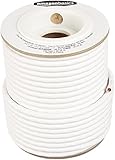
2. Amazon Basics 14-Gauge Speaker Wire
$30–$40 · Best for: Most 5.1 and 7.1 living rooms with runs up to about 40–80 feet
- Gauge
- 14 AWG, 2-conductor
- Conductor
- 99.9% oxygen-free copper
- Suggested max run
- About 80 ft at 8 Ω, 40 ft at 4 Ω (5% rule)
- In-wall rated
- No CL2/CL3 rating listed
Amazon Basics 14-gauge wire is the sensible default for living-room theaters. It uses 99.9% oxygen-free copper, not copper-clad aluminum, comes on a 100-foot spool and has a color-coded insulated jacket so you can keep positive and negative straight at both ends.
Here is why 14 AWG is enough for most rooms. It measures about 2.53 ohms per 1,000 feet. A 30-foot surround run means 60 feet of conductor, about 0.15 ohms, under 2% of an 8-ohm load. The commonly cited limit for keeping wire resistance under 5% of the speaker's impedance is about 77 feet for 8-ohm speakers and about 39 feet for 4-ohm speakers, which covers nearly every surround run in a typical room.
A 100-foot spool also goes further than people expect. In a 12 by 16-foot room, a 5.1 system needs roughly 10 feet per front speaker, 6 feet for the center and 20 feet per surround: about 66 feet, plus slack. The subwoofer uses an RCA cable, not speaker wire. A 7.1.4 layout with ceiling speakers usually needs a second spool.
The trade-off: the listing shows no CL2 or CL3 rating, so keep it to exposed runs along baseboards or through open cabinetry. For runs through walls or ceilings, buy CL2 or CL3 cable like the in-wall versions of the GearIT. For runs past 40 feet to 4-ohm speakers, step up to the Monoprice 12AWG.
Pros
- 99.9% oxygen-free copper, not CCA
- 14 AWG covers most home theater run lengths
- Color-coded for clear polarity
- 100-foot spool covers a typical 5.1 system
Cons
- No CL2/CL3 in-wall rating on the listing
- Thicker than 16 AWG, so slightly harder to hide
- One length only

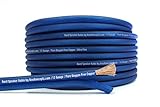
3. KnuKonceptz Kord 12 Gauge Speaker Wire
$40–$70 · Best for: Exposed runs where flexibility and easy routing matter
- Gauge
- 12 AWG, 2-conductor
- Conductor
- Oxygen-free copper (OFC) on the linked Kord listing
- Suggested max run
- About 125 ft at 8 Ω if copper; about 80 ft if CCA (5% rule)
- In-wall rated
- Varies by listing (CL rating)
KnuKonceptz Kord is the 12-gauge wire to buy if stiff cable drives you mad. It uses oxygen-free copper with a high strand count, so it bends around corners and along baseboards more easily than typical 12 AWG.
KnuKonceptz markets Kord as true-spec gauge, meaning the copper cross-section actually matches the stated AWG. That matters because some cheap wire is labeled with the jacket size rather than the conductor size, which hides a thinner, higher-resistance conductor inside.
It suits visible runs along walls, setups where you route wire around furniture, and anyone who has struggled to strip and twist thick, stiff cable. Fine strands also twist neatly into banana plugs.
The trade-off is that the colored jacket stands out against most walls more than white or black cable, and it is not rated for in-wall installation. Electrically, it does the same job as the Monoprice 12AWG, so pick Kord for handling and Monoprice for value. For short runs, 14 AWG like Amazon Basics 14-gauge is plenty.
Pros
- Very flexible and easy to route
- Thick 12 AWG gauge for headroom
- Strips and terminates cleanly
- Durable jacket
Cons
- Check the listing for copper vs CCA
- Not primarily sold for in-wall use
- Costs more than basic 12 AWG

4. GearIT 14AWG Speaker Wire
$20–$40 · Best for: Budget buyers who check the listing for OFC or in-wall-rated versions
- Gauge
- 14 AWG, 2-conductor
- Conductor
- OFC on Pro Series listings (CCA versions also sold)
- Suggested max run
- About 80 ft at 8 Ω, 40 ft at 4 Ω if copper (5% rule)
- In-wall rated
- CL2/CL3-rated versions sold
GearIT sells 14-gauge speaker wire in standard zip-cord form and in in-wall versions with a CL2 rating, which is why it is our pick for wiring through walls and ceilings. Buy the CL2-rated listing for anything behind drywall; the standard version is for exposed runs only.
Why the rating matters: building codes in most of the US require low-voltage cable inside walls to carry a fire-resistance rating such as CL2 or CL3, printed on the jacket. In-wall cable also comes as a round, jacketed bundle (for example, two conductors for one speaker or four for a pair), which is easier to pull through studs and joists than flat zip cord.
It suits in-ceiling Dolby Atmos speakers, in-wall surrounds and anyone pre-wiring a room during a renovation. 14 AWG suits most in-wall runs; for very long runs to 4-ohm speakers, look for a 12-gauge CL2 or CL3 cable instead.
The trade-off is that you must read the listing carefully, because the standard and CL2 versions look similar in search results. Check whether the conductors are copper or copper-clad aluminum on the specific listing too. Compared with Amazon Basics 14-gauge, the in-wall GearIT costs more per foot but is the right cable for walls. See our in-wall speaker guide for speakers to pair with it.
Pros
- OFC versions at a budget price
- CL2/CL3-rated versions for in-wall runs
- Flexible and easy to strip
- Clear polarity marking
Cons
- CCA versions sold under similar names
- Must check the listing for in-wall rating
- Jacket is basic

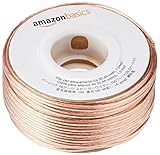
5. Amazon Basics 16-Gauge Speaker Wire
$15–$25 · Best for: Short runs to 8-ohm speakers and budget bedroom or desk systems
- Gauge
- 16 AWG, 2-conductor
- Conductor
- Varies by listing (copper vs copper-clad aluminum)
- Suggested max run
- About 50 ft at 8 Ω, 25 ft at 4 Ω if copper (5% rule)
- In-wall rated
- Not sold as CL2/CL3-rated
Amazon Basics 16-gauge wire is the cheapest acceptable option for short runs: front speakers a few feet from the receiver, a small 5.1 system in a bedroom, or bookshelf speakers beside a TV.
16 AWG measures about 4.02 ohms per 1,000 feet. A 10-foot front-channel run is 20 feet of conductor, about 0.08 ohms, which is 1% of an 8-ohm load and completely inaudible. The 5% rule of thumb puts the limit around 48 feet for 8-ohm speakers and about 24 feet for 4-ohm speakers, so it is fine for fronts and center in most rooms but marginal for rear surrounds in a large room.
It suits tight budgets and small rooms where every run is short. The thinner cable is also easier to fit into spring clips on budget speakers.
The trade-off: check the conductor material on the current listing. Budget speaker wire is sometimes sold as copper-clad aluminum, which has roughly 50% to 60% more resistance than copper, making 16 AWG CCA closer to 18 AWG copper. If the listing says CCA, use it only for short runs, or step up to the copper Amazon Basics 14-gauge, which is the better all-round buy.
Pros
- Very cheap
- Thin and flexible, easy to hide
- Polarity marking on the jacket
- Fine for short runs
Cons
- 16 AWG limits run length, especially with 4-ohm speakers
- Not rated for in-wall use
- Verify copper versus CCA on the listing

6. FosPower Banana Plugs (12 Pairs)
$25–$35 · Best for: Anyone wiring a passive speaker system who wants tidy, secure connections
- Length
- 12 pairs (24 plugs)
- Conductor
- 24K gold-plated, closed type with dual set screws
- Gauge
- Fits 12–18 AWG
- Jacket
- Color-coded collars
Banana plugs do not improve sound, but they make home theater wiring faster, neater and more reliable. FosPower's pack has 12 pairs (24 plugs) with 24K gold-plated contacts and a closed design with two set screws: strip the wire, insert it, tighten both screws and push the plug into any standard binding post. No soldering or crimping is needed, and color-coded collars mark polarity.
Why use them: bare wire twisted into binding posts can fray, leave stray strands that short between terminals, and loosen over time. The closed body keeps strands contained, and plugs make it easy to swap gear or move speakers without re-stripping wire.
Count what you need. Each speaker needs two plugs at the receiver end and two at the speaker end if both have binding posts, so a 5.1 system uses 20 plugs (the sub uses an RCA cable), and one pack covers it with four spare. A 7.1 system needs 28 and a 7.1.4 system up to 44, so buy two packs or plug only the receiver end.
FosPower lists compatibility with 12 to 18 AWG wire, so the plugs take everything on this page, from the Monoprice 12AWG to Amazon Basics 16-gauge. The trade-off: screw terminals take longer to fit than spring-loaded plugs, thick 12 AWG needs its strands twisted tightly so both screws clamp cleanly, and they're no use on spring-clip terminals. FosPower backs them with a limited lifetime warranty.
Pros
- 12 pairs covers both ends of a 5.1 system
- Closed design with two set screws holds wire securely
- Accepts 12 to 18 AWG wire
- Limited lifetime warranty
Cons
- One pack isn't enough for both ends of a 7.1 system
- Screw terminals take longer to fit than spring-loaded plugs
- Useless with spring-clip terminals
4. Speaker Wire for Home Theater Side by Side
| Product | Score | Price | Gauge | Conductor | Length | In-wall rated | Buy |
|---|---|---|---|---|---|---|---|
| Monoprice 12AWG Speaker Wire Best Overall | 85 | $35–$60 | 12 AWG, 2-conductor | Oxygen-free pure bare copper | Multiple spool lengths (100 ft common) | CL2-rated versions sold | Amazon → |
| Amazon Basics 14-Gauge Speaker Wire Best Value | 81 | $30–$40 | 14 AWG, 2-conductor | 99.9% oxygen-free copper | 100 ft | No CL2/CL3 rating listed | Amazon → |
| KnuKonceptz Kord 12 Gauge Speaker Wire Best Flexible 12 Gauge | 78 | $40–$70 | 12 AWG, 2-conductor | Oxygen-free copper (OFC) on the linked Kord listing | Multiple spool lengths | Varies by listing (CL rating) | Amazon → |
| GearIT 14AWG Speaker Wire Best for In-Wall Runs | 76 | $20–$40 | 14 AWG, 2-conductor | OFC on Pro Series listings (CCA versions also sold) | Multiple spool lengths | CL2/CL3-rated versions sold | Amazon → |
| Amazon Basics 16-Gauge Speaker Wire Best Budget for Short Runs | 70 | $15–$25 | 16 AWG, 2-conductor | Varies by listing (copper vs copper-clad aluminum) | Multiple spool lengths (100 ft common) | Not sold as CL2/CL3-rated | Amazon → |
| FosPower Banana Plugs (12 Pairs) Best Banana Plugs | 80 | $25–$35 | Fits 12–18 AWG | 24K gold-plated, closed type with dual set screws | 12 pairs (24 plugs) | Not applicable | Amazon → |
5. How We Chose These Cables
Speaker wire is a commodity, so we judged it on facts that can be checked on a spec sheet or by looking at the cable: true gauge, conductor material (we favored oxygen-free copper over CCA), strand count and flexibility, jacket type and in-wall rating, polarity markings, and spool length. Owner reports helped flag listings where the stated gauge or conductor did not match what arrived. We have not run listening tests, and we don't think a sighted listening test of speaker wire tells you much; resistance, gauge and material are what matter.
6. CCA vs OFC Copper
Copper-clad aluminum (CCA) is an aluminum core with a thin copper coating. It costs less, but aluminum conducts electricity much less well than copper, so CCA has roughly 50% to 60% more resistance than copper of the same gauge. Each AWG step changes resistance by about 26%, so CCA is roughly two gauge sizes worse: 14 AWG CCA behaves like 16 AWG copper.
CCA also has practical downsides. Aluminum strands break more easily when bent repeatedly, and exposed aluminum oxidizes at the cut ends, which can loosen connections over time.
Oxygen-free copper (OFC) is copper processed to reduce oxygen content. Its main real-world benefit is resistance to corrosion over the years; the audible difference between OFC and ordinary pure copper is negligible at speaker frequencies. What matters is that the conductor is copper at all. If a listing does not say "copper" clearly, or says "CCA", assume the worst and size up.
7. In-Wall Ratings and Plenum Cable
If speaker wire runs inside a wall, floor or ceiling, the National Electrical Code and most local codes require a cable with a suitable fire-resistance rating printed on the jacket. For speaker wire, that usually means:
- CL2: rated for Class 2 circuits up to 150 volts. Fine for nearly all home theater speaker runs.
- CL3: rated for Class 3 circuits up to 300 volts, and it can be used anywhere CL2 is allowed. Common on higher-power or commercial installs.
- CL2R / CL3R: riser-rated, for vertical runs between floors.
- CL2P / CL3P (plenum): for air-handling spaces such as some drop ceilings used as return air paths. Required only there.
Use round, jacketed in-wall cable (two-conductor for one speaker, four-conductor for a pair) rather than flat zip cord. Keep speaker cable away from electrical wiring where possible, cross mains wiring at right angles, and never share a hole or box with high-voltage wiring. If you are unsure what your local code requires, ask an electrician or your building department before closing walls. Pre-wiring for in-ceiling speakers during a renovation is the cheapest time to do it.
8. Banana Plugs, Spades or Bare Wire?
All three work if the connection is tight and clean.
- Bare wire is free and fine for terminals you rarely touch. Twist strands tightly, insert fully and make sure no stray strand touches the other terminal, which can trip an AV receiver's protection.
- Banana plugs push into five-way binding posts, so you can swap gear in seconds. They are the best choice for AV receivers with crowded terminal panels.
- Spade connectors clamp under binding posts for a very secure connection, popular on high-end amplifiers.
- Pin connectors suit spring-clip terminals found on budget speakers and some subwoofers.
Avoid connectors that need the wire to be cut down to fit, and check that your speaker terminals accept bananas; some European-market gear ships with plugs in the post holes.
9. Subwoofer, HDMI and Other Home Theater Cables
Speaker wire is only part of the job:
- Subwoofer cable: a powered subwoofer connects to the receiver's LFE or sub output with a single RCA (coaxial) cable, not speaker wire. Any well-shielded RCA cable long enough to reach your chosen sub position works. Buy length for the best placement, not the most convenient one; see our subwoofer guide.
- HDMI: for 4K120, 8K or gaming features, use cables certified as Ultra High Speed for HDMI 2.1. For long runs to a projector, active optical HDMI cables are more reliable than passive copper.
- eARC: the connection from TV to receiver or soundbar uses a standard HDMI cable on the eARC port; a High Speed or better cable is enough in most cases.
- Optical: a fallback for older gear, limited to compressed surround formats, so it cannot carry lossless Dolby Atmos.
10. How to Hide Home Theater Speaker Wire
The best way to hide home theater speaker wire depends on whether you can open walls:
- In-wall: fish CL2 or CL3 cable through walls and ceilings to wall plates near each speaker. Cleanest result, most work.
- Under carpet edges: tuck flat wire under the carpet at the tack strip along the wall. Do not run wire across walkways under carpet, where foot traffic damages it.
- Baseboard and crown raceways: paintable plastic channels that run along baseboards, door frames or the ceiling line. Ideal for rentals.
- Flat adhesive wire: ultra-thin speaker wire that can be painted over, best for short runs at low power.
- Wireless rears: if routing is impossible, consider a system with wireless surrounds; see our wireless speaker guide.
11. Does Expensive Speaker Wire Sound Better?
No, not once the gauge is right for the run. At audio frequencies over home-theater distances, a speaker cable's behavior is dominated by resistance, which depends on gauge, length and conductor material. Inductance and capacitance differences between ordinary cables are too small to matter for normal runs. A correctly sized copper cable from a basic spool performs electrically like a designer cable costing many times as much.
Who should spend more: people who need in-wall ratings, very long runs, flexible cable for visible routing, or a neat look. Who can skip upgrades: anyone with short runs and working copper wire. That money is far better spent on speakers or room treatment.
12. Common Mistakes to Avoid
Buying CCA by accident
Cheap listings often hide "copper-clad aluminum" in the details. If you buy CCA, go two gauge sizes thicker than you would with copper.
Running zip cord inside walls
Standard speaker wire is not fire-rated for in-wall use. Use cable printed with CL2 or CL3 (or plenum-rated where required).
Using thin wire with 4-ohm speakers
A 4-ohm speaker is twice as sensitive to wire resistance as an 8-ohm one. Use the 4-ohm column in the gauge table, not the 8-ohm column.
Reversing polarity on one speaker
If one speaker is wired out of phase, bass thins out and imaging smears. Use the polarity stripe or ridge on the jacket and check every connection.
Leaving stray strands at the terminals
A single strand bridging positive and negative can short the amplifier channel and trigger protection mode. Twist strands tightly or use banana plugs.
13. Frequently Asked Questions
What gauge speaker wire is best for home theater?
For most home theaters, 14 AWG copper is the best balance: it covers runs up to about 77 feet to 8-ohm speakers and about 39 feet to 4-ohm speakers. Use 12 AWG for longer runs or 4-ohm towers, and 16 AWG only for short runs under about 24 to 48 feet depending on impedance.
Is 16 gauge speaker wire good enough for surround sound?
Yes, for short runs. 16 AWG copper stays within the common 5% resistance guideline up to about 48 feet with 8-ohm speakers and about 24 feet with 4-ohm speakers. For rear surrounds in a large room or 4-ohm speakers, 14 AWG is the safer choice.
Is 12 gauge speaker wire better than 14 gauge?
Electrically, 12 AWG has about 37% less resistance than 14 AWG, so it handles longer runs and 4-ohm speakers better. For runs under about 40 feet to 8-ohm speakers, the difference is inaudible. 12 AWG is stiffer and harder to fit into small terminals, so use it where the run length calls for it.
What speaker wire can go in walls?
Use speaker cable printed with a CL2 or CL3 rating for in-wall and in-ceiling runs; CL3 can be used anywhere CL2 is allowed. Plenum-rated cable (CL2P or CL3P) is needed only in air-handling spaces. Standard zip-cord speaker wire is not rated for inside walls.
Is oxygen-free copper speaker wire worth it?
It is worth choosing copper, and most copper speaker wire is sold as oxygen-free. OFC resists corrosion better over time, but its sound is no different from ordinary pure copper of the same gauge. The bigger issue is avoiding copper-clad aluminum, which has much higher resistance.
Do banana plugs improve sound quality?
No. Banana plugs make connections faster, tidier and more secure, and they prevent stray strands from shorting terminals, but a tight, clean bare-wire connection sounds identical. They are still worth buying for convenience, especially on AV receivers with crowded binding posts.
How much speaker wire do I need for a 5.1 system?
Measure each run along the path the wire will take, then add 2 to 3 feet of slack per end. In a 12 by 16-foot living room, a 5.1 system typically needs around 65 to 80 feet, so a 100-foot spool is usually enough. Atmos systems with ceiling speakers often need 200 feet or more.
Related Guides
Bookshelf Speakers
Best Home Theater Speakers
The best home theater speakers for 2026: 8 packages, towers, bookshelf and center picks, plus the sensitivity and amp-power maths to build a matched 5.1.
In-Wall & Ceiling Speakers
Best In-Wall Speakers for Home Theater
The best in-wall speakers for home theater in 2026: 8 in-wall and in-ceiling picks, with Dolby Atmos placement angles worked out for real ceiling heights.
Guides
Best Home Theater Setup Components
Best home theater setup components, the right configuration for your room, Dolby speaker placement angles, subwoofer placement and step-by-step calibration.
The Bottom Line
The Monoprice 12AWG is the best speaker wire for home theater if you want one spool that covers every run. Amazon Basics 14-gauge is the value choice for typical living rooms, the KnuKonceptz Kord is the flexible 12-gauge option, the CL2 version of the GearIT 14AWG is for in-wall runs, and Amazon Basics 16-gauge covers short runs cheaply. Finish the job with FosPower banana plugs, and size gauge to run length and impedance using the chart above.