Surge Protectors & Power
Best Surge Protector for Home Theater
We research every product against its spec sheet and independent measurements. When you buy through our links we may earn a commission, at no cost to you. How we score · Disclosure
The best surge protector for home theater does three jobs: it absorbs voltage spikes before they reach your AV receiver, TV and projector, it protects the coax and network lines that surges also travel down, and it gives you enough well-spaced outlets for every box and power brick. This guide is for anyone plugging a few thousand dollars of gear into one wall outlet.
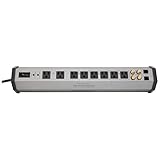
Our top pick is the Panamax M5300-PM, a home-theater power center with 11 outlets, noise filtering and automatic disconnect when the wall voltage goes dangerously high or low. For a simpler, cheaper strip with coax and Ethernet protection, the Tripp Lite TLP118DBNET is the value pick.
Our top picks at a glance



Quick answer
The best surge protector for home theater is the Panamax M5300-PM if you want surge protection, noise filtering and automatic over- and under-voltage shutoff in one component-style box. The Tripp Lite TLP118DBNET is the best value, with 11 outlets, a 4,200-joule rating and coax, Ethernet and phone protection. Whatever you buy, look for a UL 1449 listing, a voltage protection rating of 330 to 400 V, a joule rating of at least 1,000 (higher is better) and protection for every cable that enters your system.
On this page
- 1. How to Choose the Best Surge Protector for Home Theater
- 2. The Best Surge Protectors and Power Conditioners for Home Theater
- 3. Surge Protector for Home Theater Side by Side
- 4. How We Chose These Protectors
- 5. Joules, Clamping Voltage and UL Ratings Explained
- 6. Power Conditioners vs Surge Protectors
- 7. Do You Need a UPS or Battery Backup?
- 8. Protect Every Path: Coax, Ethernet and Whole-Home Protection
- 9. Placement, Outlet Maths and Circuit Load
- 10. Who Should Buy What
- 11. Common Mistakes to Avoid
- 12. Frequently Asked Questions
1. How to Choose the Best Surge Protector for Home Theater
Ignore marketing like "home theater grade" and check these specs on the box or spec sheet:
- UL 1449 listing. This is the US safety standard for surge protective devices. If a strip is not UL 1449 listed, skip it.
- Voltage protection rating (VPR) or clamping voltage. Lower is better. 330 V is the lowest standard rating for 120 V outlets; 400 V is also good; avoid 500 V and above for AV gear.
- Joule rating. Higher means more surge energy absorbed before the protective parts wear out. Treat 1,000 joules as a minimum for a home theater and 2,000 or more as preferable for expensive gear.
- Protected lines. Coax (cable, satellite, antenna) and Ethernet carry surges too. Protect every line that connects to your system.
- Outlets and spacing. Count devices, then add power bricks that block neighboring outlets, then add two for growth.
- Indicators. "Protected" and "grounded" lights tell you when the unit has worn out or the outlet is miswired.
- Automatic shutdown. On power conditioners like the Panamax, automatic disconnect during over- or under-voltage protects against events a basic strip cannot.
Response-time claims in nanoseconds are not a useful way to compare models; stick to UL listing, VPR and joules.
2. The Best Surge Protectors and Power Conditioners for Home Theater

1. Panamax M5300-PM Power Conditioner
$250–$400 · Best for: Rack or shelf systems with expensive gear and unreliable mains power
- Outlets
- 11
- Voltage protection
- Protect or Disconnect (automatic over/under-voltage shutoff)
- Filtering
- Linear Filtering Technology (LiFT)
- Coax/Ethernet protection
- Coax and network/phone lines
The M5300-PM is the pick for a full home theater because it does more than a power strip. Panamax gives it 11 outlets, surge suppression, noise filtering and its automatic voltage monitoring, branded Protect or Disconnect, which cuts power to your gear if the incoming voltage swings dangerously high or low, then restores it when the line returns to normal.
That last feature matters more than many buyers realize. A surge is a spike lasting microseconds; a sustained overvoltage from a wiring fault or a utility problem can last seconds or minutes and cook equipment that a basic surge strip happily passes power to. Automatic disconnect protects against both.
It also protects coax and network lines, closing the back doors surges use to reach a TV, receiver or streamer. Its component-style chassis sits on a shelf beside your AV receiver rather than on the floor.
The trade-off is cost and bulk. It costs several times as much as a good surge strip, and its filtering will not fix hum caused by ground loops, which usually come from cable TV coax. Compared with the Tripp Lite TLP118DBNET, you pay extra for voltage monitoring, filtering and a rack-style look; the Tripp Lite protects against spikes just as a surge protector should, for far less.
Pros
- Automatic disconnect for over- and under-voltage
- Noise filtering for the whole system
- Coax and network line protection
- Component chassis fits AV racks and shelves
Cons
- Expensive compared with surge strips
- Large footprint
- Overkill for simple setups

2. Tripp Lite TLP118DBNET Home Theater Surge Protector
$40–$55 · Best for: Most TV and home theater setups on a budget
- Outlets
- 11 (6 side-facing)
- Joule rating
- 4,200 J
- Coax/Ethernet protection
- Coax, Ethernet (up to 100 Mbps) and phone
- Warranty
- Lifetime limited
The TLP118DBNET from Tripp Lite is the surge protector most home theaters actually need, typically in the $40–$55 band. It has 11 outlets, a 4,200-joule rating, EMI/RFI noise filtering and protection for coax, Ethernet and phone lines. It is UL 1449 and UL 1363 certified, with a 15 A resettable breaker, an 8 ft braided cord with a flat plug and a lifetime limited warranty.
Outlet count is the hidden spec. Count your plugs: TV or projector, AV receiver, subwoofer, streamer, disc player, console and network switch is already seven, before power bricks block neighbors. Eleven outlets, six of them side-facing for bulky adapters, give you room to grow.
Do the load maths too. The breaker limits it to 15 A × 120 V = 1,800 W, so keep continuous load under about 1,440 W; a receiver, TV, streamer and console fit comfortably, while a big separate amplifier and two subs may want a second circuit.
One catch: the Ethernet pass-through is rated at 100 Mbps. A 4K stream needs roughly 25 Mbps, so streaming is fine, but if you pay for gigabit internet, route a fast wired connection around the strip.
The trade-off: it is a surge protector, not a power conditioner, so it will not disconnect your gear during a sustained overvoltage the way the Panamax M5300-PM does. Compared with the Tripp Lite Isobar 8, it has a higher joule rating (4,200 J vs 3,840 J), more outlets and line protection, while the Isobar adds an all-metal case and isolated filter banks.
Pros
- 4,200-joule rating at a low price
- Coax, Ethernet and phone protection
- 11 outlets, six side-facing for adapters
- 8 ft flat-plug cord and lifetime limited warranty
Cons
- Ethernet pass-through limited to 100 Mbps
- No over-voltage disconnect
- Surge protection wears out over time

3. Tripp Lite Isobar 8 Outlet Surge Protector
$90–$140 · Best for: Systems with noisy devices like subs and projectors that benefit from isolated filtering
- Outlets
- 8
- Joule rating
- 3,840 J
- Filtering
- Isolated filter banks with EMI/RFI noise filtering
- Form factor
- All-metal power strip
The Isobar is the surge protector electricians and IT departments have trusted for years, and it suits home theater well. Tripp Lite builds it in an all-metal housing with 8 outlets and isolated filter banks: the outlets are split into groups with their own noise filtering, which helps keep electrical noise from one component, such as a subwoofer amp or a switching power supply, from reaching another.
Joule ratings on Isobar models run into the thousands, the highest-capacity Ultra versions especially, and Tripp Lite offers a lifetime limited warranty. Diagnostic lights show protection and grounding status, and the heavy-duty cord and metal case are built for being shoved behind a cabinet.
It suits anyone who wants a protector that survives being kicked, stepped on and moved, and systems with power-hungry gear such as a large subwoofer or a multichannel amplifier sharing a strip with sensitive sources.
The trade-off: 8 outlets fill quickly in a full system, and most Isobar models do not include coax or Ethernet protection, so check the specific model if you need those lines protected. Compared with the cheaper Tripp Lite TLP118DBNET, the Isobar is tougher and better filtered but has fewer outlets, a slightly lower 3,840-joule rating and no coax or Ethernet protection; compared with the Furman PST-8D, it is the workhorse rather than the AV-styled choice.
Pros
- 3,840-joule rating
- Isolated filter banks reduce cross-device noise
- All-metal housing
- Long installer reputation
Cons
- No coax or Ethernet protection
- Only 8 outlets
- Heavier and bulkier than plastic strips

4. Furman PST-8D Surge Protector
$80–$130 · Best for: TV cabinets and mid-size systems that want better protection than a basic strip
- Outlets
- 8
- Voltage protection
- Extreme Voltage Shutdown (EVS)
- Filtering
- RF/EMI noise filtering
- Coax/Ethernet protection
- Coax and phone line
Furman is a long-standing name in professional audio power, and the PST-8D brings that pedigree to a home strip. It has 8 outlets, surge suppression and noise filtering, and the D version adds protection for coax and phone lines, so cable or antenna feeds are covered along with AC power. Furman's Extreme Voltage Shutdown also cuts power during a dangerous overvoltage.
It suits smaller home theaters: a TV, a soundbar or compact AV receiver, a subwoofer, a streamer and a console. Eight outlets cover that with a couple to spare.
Why it is not ranked higher: it lacks the under-voltage protection and shelf chassis of the Panamax M5300-PM, and it offers fewer outlets than the Tripp Lite TLP118DBNET, which costs less and also protects Ethernet. Its advantage is brand trust and AV-focused design rather than raw numbers.
The trade-off, then, is value. If you want a Furman because you already use the brand in a rack or studio, or you like its filtering approach, the PST-8D is a sound choice. If you simply want the most protection per dollar, the Tripp Lite TLP118DBNET wins; if you want a shelf component with voltage monitoring, step up to the Panamax.
Pros
- Extreme Voltage Shutdown for sustained over-voltage
- RF/EMI noise filtering
- Coax and phone line protection
- Trusted brand in AV power
Cons
- No under-voltage (brownout) disconnect
- No rack-mount chassis
- Fewer outlets than some rivals

5. Austere VII Series 6-Outlet Surge Protector
$70–$110 · Best for: Visible setups where looks and USB charging matter
- Outlets
- 6 (wide-spaced)
- Joule rating
- 4,000 J
- Filtering
- Isolated EMI/RFI filtering
- Form factor
- Power strip, WovenArmor braided cord, right-angle flat plug, wall-mountable; 1 × 45 W USB-C PD, 2 × USB-C, 2 × USB-A (2.4 A)
Austere builds power products for people who care how the strip looks, and the VII Series 6-outlet unit is the one to buy when your surge protector will be visible, such as beside a wall-mounted TV, under an open media console or on a glass stand. It has 6 wide-spaced outlets, a WovenArmor braided cord with a right-angle flat plug, a 4,000-joule rating and isolated EMI/RFI filtering, typically in the $70–$110 band.
It doubles as a charging station: five USB ports, including a 45 W USB-C PD port, two more USB-C and two USB-A at 2.4 A, handy for phones, a tablet or game controllers by the sofa. Austere adds a lifetime guarantee and a 7-year component guarantee that promises to replace a connected device the strip is responsible for damaging.
Do the outlet maths before you buy. TV, receiver, streaming box, console and a subwoofer is already five plugs, leaving one spare; a projector, second sub or powered speakers will need another strip.
The trade-off is that you pay for design. Compared with the Tripp Lite TLP118DBNET, it has fewer outlets and no coax or Ethernet protection listed, for more money. It is also a surge protector rather than a conditioner with voltage monitoring like the Panamax M5300-PM.
Choose the Austere if looks and USB charging matter and your system fits on six outlets. Choose the TLP118DBNET or the Isobar if it will live behind a cabinet where nobody sees it.
Pros
- 4,000-joule rating with isolated EMI/RFI filtering
- Five USB ports, including 45 W USB-C PD
- Wide-spaced outlets and right-angle flat plug
- 7-year connected-device component guarantee
Cons
- Only six AC outlets
- No coax or Ethernet protection listed
- Pricey for the protection you get
3. Surge Protector for Home Theater Side by Side
| Product | Score | Price | Outlets | Joule rating | Coax/Ethernet protection | Filtering | Buy |
|---|---|---|---|---|---|---|---|
| Panamax M5300-PM Power Conditioner Best Overall | 88 | $250–$400 | 11 | — | Coax and network/phone lines | Linear Filtering Technology (LiFT) | Amazon → |
| Tripp Lite TLP118DBNET Home Theater Surge Protector Best Value | 80 | $40–$55 | 11 (6 side-facing) | 4,200 J | Coax, Ethernet (up to 100 Mbps) and phone | EMI/RFI noise filtering | Amazon → |
| Tripp Lite Isobar 8 Outlet Surge Protector Best Build Quality | 84 | $90–$140 | 8 | 3,840 J | None | Isolated filter banks with EMI/RFI noise filtering | Amazon → |
| Furman PST-8D Surge Protector Best for Smaller Systems | 80 | $80–$130 | 8 | — | Coax and phone line | RF/EMI noise filtering | Amazon → |
| Austere VII Series 6-Outlet Surge Protector Best Design-Led Pick | 75 | $70–$110 | 6 (wide-spaced) | 4,000 J | None listed | Isolated EMI/RFI filtering | Amazon → |
4. How We Chose These Protectors
We have not surged these units in a lab. We compared them on published specifications (UL 1449 listing, joule rating, voltage protection rating, outlet count and spacing, coax and Ethernet protection, filtering and automatic voltage monitoring), warranty and connected-equipment policies, build quality, and long-term owner reports, then ranked them for typical home theater systems. Where a feature varies by model or listing, we flag it in the pick.
5. Joules, Clamping Voltage and UL Ratings Explained
Joules measure how much surge energy the protector's components, usually metal oxide varistors (MOVs), can absorb over their life. Every surge, big or small, uses up some of that capacity. A 3,000-joule unit is not "three times safer" than a 1,000-joule unit in a single strike, but it will usually last through more surges before wearing out.
Clamping voltage, published under UL 1449 as the voltage protection rating (VPR), is how much voltage gets through to your gear during a standardized 6,000-volt test surge. Standard VPR steps start at 330 V, then 400 V, 500 V and higher. A normal 120 V outlet peaks at about 170 V, so a 330 V rating lets through roughly twice normal peak voltage before clamping, which modern power supplies handle easily.
UL 1449 is the standard that covers how surge protectors are tested and labeled, including VPR. Point-of-use strips are typically Type 3 surge protective devices. Look for the UL mark and the rating printed on the unit itself, not just the box.
The maths for wear-out: a protector does not tell you how many joules remain. That is why the protected indicator matters, and why replacing a strip after a major storm or every several years is cheap insurance.
6. Power Conditioners vs Surge Protectors
A surge protector clamps spikes. A power conditioner usually adds:
- EMI/RFI noise filtering, which can reduce buzz or interference from other appliances on the circuit.
- Automatic voltage monitoring that disconnects equipment during sustained over- or under-voltage (the Panamax M5300-PM does this).
- Outlet banks and sequencing for larger systems, plus a component-style chassis that fits a rack or shelf.
What a power conditioner usually does not do: regulate voltage (that needs a dedicated voltage regulator), or cure hum. Most home theater hum is a ground loop, often introduced by cable TV coax connected to a grounded AV receiver; a coax ground loop isolator or correct grounding fixes it, not a filter.
Do you need one? If you have stable power and a mid-range system, a quality surge protector is enough. A power conditioner makes sense for expensive systems, areas with frequent brownouts or voltage swings, and anyone who wants a shelf component with clean cable management. Claims that conditioners dramatically improve picture or sound quality on normal household power are not well supported.
7. Do You Need a UPS or Battery Backup?
A UPS (uninterruptible power supply) adds a battery that keeps gear running during brief outages. For home theaters it is most useful for:
- Lamp-based projectors, which benefit from a controlled shutdown rather than losing power while hot. Laser and LED projectors are less sensitive.
- Network gear such as routers, switches and media servers, so streams and downloads survive short flickers.
- Areas with frequent momentary outages that reboot everything mid-film.
Choose a line-interactive UPS with pure sine wave output for AV gear; many modern power supplies dislike the stepped output of cheaper units. Size it by watts: add the rated power draw of the devices you want on battery and choose a UPS with headroom. Do not put a powerful subwoofer or multichannel amplifier on a small UPS; their peak current draw can overload it. Most people only need the projector or TV, streamer and network gear on battery.
8. Protect Every Path: Coax, Ethernet and Whole-Home Protection
Surges do not only arrive on power lines. Lightning-induced surges also travel on coaxial cable from a cable or antenna feed and on Ethernet connected to outdoor equipment. If your TV is protected on AC power but connected to an unprotected coax line, the surge simply takes the other path. Route coax and Ethernet through the same protector as your AC power so all lines share a common ground reference.
For the most complete protection, use layers:
- A whole-home surge protector (Type 1 or Type 2) installed at your electrical panel by an electrician, which handles large external surges.
- Point-of-use protectors (Type 3) like the picks above at the equipment, which catch what gets through plus surges generated inside the house by motors and appliances.
Neither layer can stop a direct lightning strike. Unplug gear during severe storms if you can.
9. Placement, Outlet Maths and Circuit Load
A standard 15-amp, 120-volt household circuit supplies up to 1,800 watts, and a common guideline is to keep continuous loads under 80%, or about 1,440 watts. Add up the rated power consumption printed on each device's label: a large AV receiver, a powered subwoofer and a projector can account for a big share of that on loud movie peaks. If the theater shares a circuit with a space heater or a popcorn machine, move those to another circuit.
Placement tips:
- Plug the protector straight into a grounded wall outlet; never daisy-chain it into another strip or an extension cord.
- Keep it ventilated, not buried under carpet or wedged behind a hot receiver.
- Put power bricks on the outlets spaced for them.
- Plug power recliners, lighting and appliances into a different outlet so motors do not share the protected strip with sensitive gear.
10. Who Should Buy What
Buy a power conditioner like the Panamax M5300-PM if your system is expensive, your area has unstable voltage, or you want a shelf component with voltage monitoring.
Buy a quality surge strip like the Tripp Lite TLP118DBNET or Tripp Lite Isobar if you have a typical home theater on normal household power. This is the right answer for most people.
Add a UPS only if you have a lamp projector, frequent short outages or network gear you want to keep online.
You can skip expensive conditioners if your system is a TV and soundbar; a good surge protector with coax protection covers it. Spend the difference on speakers or a better receiver.
11. Common Mistakes to Avoid
Buying a power strip that is not a surge protector
Cheap power strips add outlets but no protection. Look for UL 1449 listing and a printed voltage protection rating, not just "surge" in the name.
Leaving coax and Ethernet unprotected
A surge on the cable or antenna line bypasses AC protection entirely. Route coax and network lines through the protector.
Keeping a worn-out protector
Surge components wear out silently. If the "protected" light is off, replace the unit, even if the outlets still supply power.
Daisy-chaining strips and extension cords
Plugging one strip into another can overload the first and void warranties. Use one protector per wall outlet, sized for the job.
Expecting a conditioner to fix hum
Hum is usually a ground loop, often via cable TV coax. Fix the loop with a coax isolator or correct grounding rather than buying a more expensive filter.
12. Frequently Asked Questions
What is the best surge protector for home theater?
The Panamax M5300-PM is the best overall surge protector for home theater, combining 11 outlets, noise filtering, coax and network protection and automatic disconnect during over- or under-voltage. The Tripp Lite TLP118DBNET is the best value, with 11 outlets, a 4,200-joule rating and coax, Ethernet and phone protection in a simple strip.
How many joules do I need for a home theater surge protector?
Aim for at least 1,000 joules, and 2,000 or more for expensive systems. Joules measure how much surge energy the protector can absorb over its life, so higher ratings usually last longer. Check the voltage protection rating too: 330 to 400 V is what you want.
Is a power conditioner better than a surge protector?
Not automatically. A power conditioner adds noise filtering and, on some models, automatic shutdown during unsafe voltage, which is useful for expensive systems or unstable power. For most home theaters on normal household power, a quality UL 1449 surge protector with coax and Ethernet protection does the essential job for far less.
What clamping voltage is best for a surge protector?
Lower is better. The lowest standard UL 1449 voltage protection rating for 120 V protectors is 330 V, and 400 V is also good for AV gear. Ratings of 500 V and above let more voltage through before clamping, so avoid them for expensive electronics.
Do I need a UPS for my home theater?
Most people do not. A UPS is worth it for lamp-based projectors that benefit from a controlled shutdown, network gear you want online during flickers, or areas with frequent short outages. Choose a line-interactive, pure sine wave model and keep subwoofers and big amplifiers off it.
Should I plug my subwoofer into a surge protector?
Yes. A subwoofer has electronics and an amplifier that surges can damage. Plug it into the same protector as your AV receiver so they share a ground, which also reduces the chance of hum. Just keep the subwoofer off a small UPS, where its peak draw can overload the battery.
How often should you replace a surge protector?
Replace it when the protection indicator goes out, after any major surge or nearby lightning strike, and as a rule every several years. Surge components wear down with every spike and give no warning beyond the indicator light, so a strip can keep supplying power after it has stopped protecting.
Related Guides
Guides
Best Home Theater Setup Components
Best home theater setup components, the right configuration for your room, Dolby speaker placement angles, subwoofer placement and step-by-step calibration.
AV Receivers
Best Home Theater Receiver
The best home theater receiver for 5.1, 7.2 and Dolby Atmos rooms, ranked on real channel counts, rated power, 4K/120 HDMI and room correction.
Projectors
Best Projector for Home Theater
The best projector for home theater in 2026, matched to your room: 8 picks from budget 4K to laser, native 4K and UST, with lumens and throw maths for each.
The Bottom Line
The Panamax M5300-PM is the best surge protector for home theater if you want voltage monitoring, filtering and line protection in one component. The Tripp Lite TLP118DBNET is the best value for most systems, the Tripp Lite Isobar 8 is the toughest build, the Furman PST-8D suits smaller systems, and the Austere VII 6-outlet is the one to buy when looks matter. Whichever you pick, check for UL 1449, a 330 to 400 V rating and protection for coax and Ethernet.