Guides
Soundbar vs Home Theater
We research every product against its spec sheet and independent measurements. When you buy through our links we may earn a commission, at no cost to you. How we score · Disclosure
Soundbar vs home theater is the first decision in any TV audio upgrade, and the right answer depends more on your room than on your budget. In short: a home theater (an AV receiver with separate speakers) sounds better and scales further, while a soundbar wins on space, simplicity and looks. A soundbar system with a subwoofer and rear speakers, like the JBL Bar 1000, closes most of the gap in a typical living room.
This guide compares the two paths on sound quality, cost, space and setup, explains what 5.1, 7.1 and Atmos layouts really add, and clears up the "amplifier vs home theater" question. We finish with four example setups, one for each path, so you can see what each choice looks like in practice.
Our top picks at a glance



Quick answer
A home theater with an AV receiver and separate speakers is best for sound quality, large rooms, music and long-term upgrades. A soundbar is best for small rooms, minimal wiring and a clean look. For most living rooms, a soundbar system with a subwoofer and real rear speakers is the best balance; choose separates if your room exceeds about 3,000 cubic feet or music matters as much as movies.
On this page
- 1. The Short Answer
- 2. What Counts as a Soundbar and What Counts as a Home Theater
- 3. Example Setups for Each Path
- 4. Soundbar vs Home Theater Side by Side
- 5. Sound Quality: Where Each Wins
- 6. Cost Compared at Each Budget
- 7. Space, Wires and Setup Time
- 8. Surround Layouts Compared: Which Channel Count Fits
- 9. Amplifier vs Home Theater Receiver: Which Is Best?
- 10. Soundbar vs Home Theater: Which Is Best for You?
- 11. Common Mistakes to Avoid
- 12. Frequently Asked Questions
1. The Short Answer
Choose a home theater (receiver plus separate speakers) if your room is large, you care about music as much as films, you want in-ceiling Atmos speakers, or you like the idea of upgrading one piece at a time for years.
Choose a soundbar if your room is small, you want one cable to the TV and one remote, you rent or cannot run wire, or the system has to blend into a shared living room.
Choose a soundbar system with a sub and rears if you want most of the home theater experience with soundbar simplicity. For a typical living room of 1,500–3,000 cubic feet, this is the best balance.
| Factor | Soundbar | Soundbar system | Home theater |
|---|---|---|---|
| Sound quality | Good | Very good | Best |
| Real surround | No | Yes | Yes |
| Bass | Limited | Good | Best, scalable |
| Setup time | Minutes | Under an hour | An afternoon |
| Space needed | Least | Moderate | Most |
| Upgrade path | Limited | Limited | Any component |
2. What Counts as a Soundbar and What Counts as a Home Theater
The terms overlap, so it helps to define them.
A soundbar is a single cabinet holding several speakers, the amplifiers to drive them, and a processor to decode the soundtrack. It connects to the TV with one HDMI cable. Some include a subwoofer; many can add one.
A soundbar system adds a subwoofer and rear speakers to the bar, usually linked wirelessly. The bar still does all the decoding.
A home theater, in the traditional sense, is an AV receiver driving separate passive speakers: left, center, right, surrounds, often height speakers, and a powered subwoofer. The receiver decodes audio, amplifies each speaker and switches your video sources.
A home theater in a box bundles a receiver with matched speakers. It is a home theater, just sold as one product.
The key difference is where the speakers sit. In a home theater, every channel has its own speaker in its correct position. A single soundbar puts them all in one box under the TV and simulates the rest.
3. Example Setups for Each Path

1. Sonos Beam (Gen 2)
$400–$500 · Best for: Small living rooms and bedrooms with 40–55-inch TVs
- Channels
- 5 drivers (virtual surround and height)
- Atmos/DTS:X
- Dolby Atmos (virtualized; no DTS:X)
- Subwoofer
- Optional Sonos Sub 4 or Sub Mini
- Inputs
- HDMI eARC (optical via adapter)
The simplest path is a single compact soundbar, and the Sonos Beam (Gen 2) shows what it does well. It is a five-channel bar about two feet wide that connects to your TV with one HDMI eARC cable, decodes Dolby Atmos (using processing rather than up-firing drivers), and tunes itself to the room with Trueplay.
What it fixes: muffled dialogue, thin TV sound and the need for a remote juggling act. In a bedroom, den or small living room, it is a dramatic improvement over TV speakers and takes ten minutes to set up.
What it cannot do: deep bass and real surround. Without a subwoofer, the lowest octave of a film soundtrack simply is not there, and without rear speakers, surround effects stay in front of you.
The Beam's advantage over cheaper single bars is that it does not lock you in. You can add a Sonos sub and a pair of Era 100 rears later, turning it into a compact 5.1 system. That makes it a good illustration of the soundbar path's best feature: you can start small and stop as soon as it sounds good enough. For bigger single bars, see our best soundbar for home theater guide.
Pros
- Compact size suits smaller TVs
- HDMI eARC with Dolby Atmos decoding
- Excellent app and Trueplay tuning
- Expands to 5.1 with Sonos sub and rears
Cons
- Virtual height only, no up-firing drivers
- No Bluetooth
- Limited output in larger rooms

2. JBL Bar 1000
$800–$1,000 · Best for: Living rooms that want real rear surround without permanent rear speakers
- Channels
- 7.1.4
- Atmos/DTS:X
- Dolby Atmos and DTS:X
- Subwoofer
- 10-inch wireless subwoofer included
- Inputs
- 3x HDMI in (4K Dolby Vision pass-through), HDMI eARC, optical, Bluetooth
The middle path is a soundbar system: bar, subwoofer and rear speakers sold together. The JBL Bar 1000 is a good example because it includes all three in one box and rates the layout at 7.1.4.
The subwoofer is wireless and uses a 10-inch driver, so it supplies the film bass a bar alone cannot. The rear speakers detach from the bar and run on batteries (JBL quotes around 10 hours), so you can put real speakers behind the sofa without an outlet there. Up-firing drivers add Dolby Atmos height, and the system decodes DTS:X too. Three HDMI inputs mean you can plug sources into the bar directly.
This path captures most of what a home theater offers: dialogue anchored to the screen, effects from behind you, overhead sound and real bass. Setup still takes under an hour, and there is one remote.
What it gives up against separates: headroom in large rooms, the ability to upgrade one piece at a time, and the stereo width of two front speakers spaced well apart. Battery surrounds also need docking between films. For most living rooms, though, this is the sweet spot. Other options are in our wireless home theater system guide.
Pros
- Detachable battery rears give real surround on demand
- 10-inch wireless sub included
- Three HDMI inputs plus eARC
- Decodes Dolby Atmos and DTS:X
Cons
- Rear speakers need regular recharging
- 880 W figure is a system total, not per channel
- Bulky bar when the rears are docked

3. Yamaha YHT-5960U Home Theater System
$550–$700 · Best for: Small to mid-size rooms that want a calibrated 5.1 system with minimal effort
- Channels
- 5.1
- Subwoofer
- Powered subwoofer included
- Surrounds
- Included (compact satellites)
- Amplification
- Yamaha receiver included
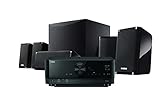
"Home theater in a box" is the entry point to the receiver path. The Yamaha YHT-5960U includes a Yamaha 5.1-channel AV receiver, compact satellites, a center and a powered subwoofer, all matched and ready to wire, typically in the $550–$700 band.
The receiver is what makes it a home theater rather than a soundbar. Your streaming box, game console and disc player plug into its HDMI inputs, which pass 4K HDR (including HDR10, HLG and Dolby Vision) through to the TV, and ARC brings TV apps back to the speakers. It powers each speaker through its own amplifier channel, and Bluetooth covers music from your phone.
It also shows what calibration adds. YPAO uses a supplied microphone at your seat to set speaker distances, levels and EQ automatically, the same job a soundbar's room tuning does, but across six separate boxes. See room correction for what it fixes.
The practical difference from the soundbar path is wiring and placement. You run speaker wire to five locations and place the sub; plan an afternoon with our home theater setup guide.
The payoff is flexibility: the receiver can drive better passive speakers later, so you can upgrade the part you hear most. The trade-offs: it is 5.1 only, with no Atmos height channels and no way to add them, no Wi-Fi streaming, and no 4K120 pass-through for current consoles. It usually costs less than the JBL system above. More starter options in our budget home theater system guide.
Pros
- YPAO auto-calibration takes the guesswork out of setup
- 4K HDR pass-through including Dolby Vision
- Matched speakers and powered sub in one box
- Yamaha receivers have a good reliability reputation
Cons
- 5.1 only, so no Atmos upgrade path
- Compact satellites limit dynamics in big rooms
- No 4K120 pass-through for current consoles

4. SVS Prime Satellite 5.1 System
$330–$380 per pair · Best for: Rooms where speakers must stay small but bass still needs to be tight and full
- Channels
- 5.1 (two satellite pairs + Prime Center + sub)
- Satellite drivers
- 1-inch aluminum dome tweeter, 4.5-inch woofer, SoundMatch 2-way crossover
- Subwoofer
- Not included; SVS SB-1000 Pro (12-inch sealed) suggested, sold separately
- Amplification
- Passive speakers; needs an AV receiver
Separates mean buying speakers and a receiver individually, choosing each for its job. The SVS Prime Satellite 5.1 shows how that works, because you build it piece by piece: the Amazon link is one pair of Prime Satellites (typically $330–$380 per pair), and the 5.1 takes two pairs for fronts and surrounds, an SVS Prime Center and a subwoofer such as the sealed 12-inch SVS SB-1000 Pro, each bought separately.
Each satellite pairs a 4.5-inch woofer with a 1-inch aluminum dome tweeter, and the Prime Center uses the same tweeter family, so sound keeps its character as it moves around the room. Set the receiver's crossover to 80–100 Hz and the sub handles everything below, which a sealed 12-inch driver with a 325 W RMS amp does tightly.
Add a receiver such as the Denon AVR-X1800H. It brings Audyssey room correction, HEOS and AirPlay 2 streaming, and seven amplified channels, so you can add height speakers later for 5.1.2.
This is the home theater path at its most typical: more boxes, more wire and a higher starting cost than a soundbar kit, in exchange for better sound quality, more headroom and the freedom to replace any piece. It is also easy to buy in stages: start with one pair, the center and the sub, then add the surround pair. In a room up to about 2,000 cubic feet, it outperforms soundbar systems, especially with music. Our best home theater receiver guide covers other partners.
Pros
- Compact satellites wall- or ceiling-mount easily
- 1-inch aluminum tweeter and 4.5-inch woofer cross over cleanly at 80–100 Hz
- Prime-series voicing keeps the center and satellites matched
- Pairs with a 12-inch sealed SB-1000 Pro for tight bass
- Easy to build in stages, one pair at a time
Cons
- Amazon link is one pair: the 5.1 needs two pairs, a center and a sub bought separately
- Needs a separate AV receiver
- No height speakers
4. Soundbar vs Home Theater Side by Side
| Product | Score | Price | Channels | Atmos/DTS:X | Subwoofer | Surrounds | Buy |
|---|---|---|---|---|---|---|---|
| Sonos Beam (Gen 2) Best Soundbar-Only Setup | 79 | $400–$500 | 5 drivers (virtual surround and height) | Dolby Atmos (virtualized; no DTS:X) | Optional Sonos Sub 4 or Sub Mini | Optional (pair of Era 100 or Era 300) | Amazon → |
| JBL Bar 1000 Best Soundbar System With Real Surrounds | 85 | $800–$1,000 | 7.1.4 | Dolby Atmos and DTS:X | 10-inch wireless subwoofer included | Detachable battery-powered rears | Amazon → |
| Yamaha YHT-5960U Home Theater System Best Starter Home Theater | 71 | $550–$700 | 5.1 | No | Powered subwoofer included | Included (compact satellites) | Amazon → |
| SVS Prime Satellite 5.1 System Best Separates Starting Point | 83 | $330–$380 per pair | 5.1 (two satellite pairs + Prime Center + sub) | Via your receiver (no height speakers included) | Not included; SVS SB-1000 Pro (12-inch sealed) suggested, sold separately | Second Prime Satellite pair (sold separately) | Amazon → |
5. Sound Quality: Where Each Wins
Front stage width. A home theater's left and right speakers sit six to eight feet apart; a soundbar's sit inside a box three or four feet wide. Separate speakers create a wider, more convincing stereo image for music and on-screen movement. Soundbars widen the image with processing and side-firing drivers, which works best in symmetrical rooms with hard side walls.
Dialogue. Close contest. A good soundbar's center channel is excellent, and features like dialogue enhancement help. A home theater's dedicated center speaker, matched to the fronts and calibrated by the receiver, is equally clear and plays louder without strain.
Surround. Physical rear speakers win, whether they belong to a soundbar system or a home theater. A single bar reflecting sound off walls cannot match them.
Bass. Home theaters win because you can choose any subwoofer, or two, sized to your room. Soundbar systems lock you into the brand's sub.
Headroom. Larger drivers and dedicated amplifier channels give separates more output before distortion. In a room over about 3,000 cubic feet, the difference becomes obvious at film volumes.
Music. Separates win clearly, because a real stereo pair matters more for music than any channel count.
6. Cost Compared at Each Budget
Street-price bands, all-in:
| Total budget | Soundbar path | Home theater path |
|---|---|---|
| $250–$500 | Compact bar, or a 5.1 or 5.1.2 kit such as the VIZIO 5.1.2 Elevate SE | Hard to do well; save for a home theater in a box |
| $500–$1,000 | Flagship single bar, or a mid-range kit like the JBL Bar 1000 | Home theater in a box such as the Yamaha YHT-5960U, or a small speaker package plus a 5.2 receiver |
| $1,000–$2,000 | Complete flagship system like the Samsung HW-Q990F | A 5.1 tower package such as the Polk T-Series 5.1 plus a receiver |
| $2,000 and up | Fully expanded Sonos, Sony or Bose system | SVS Prime Satellite 5.1 built from two pairs, center and sub plus a receiver, or an Atmos speaker package plus a seven- or nine-channel receiver |
At the low end, soundbar kits give more channels per dollar because you are not paying for a receiver's HDMI switching and amplifier channels; the cheapest boxed home theater starts around where good soundbar kits top out. From the $1,000–$2,000 band up, separates pull ahead on performance per dollar.
Long-term cost tilts further toward separates. A good speaker package can last 15 years or more, while receivers get replaced for new HDMI features. Soundbar systems are replaced as a unit, typically every five to eight years.
7. Space, Wires and Setup Time
Soundbar: one box under the TV, one HDMI cable, one power cord. Setup takes minutes.
Soundbar system: add a subwoofer anywhere with an outlet and rear speakers that need power (or batteries, in the JBL's case). Setup takes under an hour.
Home theater: a receiver on a shelf with ventilation, five to eleven speakers, a subwoofer, and speaker wire to every passive speaker. Setup takes an afternoon, longer if you run wire through walls or ceilings.
Two practical notes. First, if you rent or cannot hide cables, a soundbar system avoids long speaker wire runs. Second, "wireless" soundbar speakers still need outlets; see our wireless home theater guide for power planning. For room layout and seating, our home theater room design guide and the viewing distance calculator help.
8. Surround Layouts Compared: Which Channel Count Fits
Whichever path you choose, the layout numbers mean the same thing: ear-level speakers, then subwoofers, then height speakers for Dolby Atmos or DTS:X.
5.1 vs 7.1. A 5.1 system has left, center, right, two surrounds and a sub. 7.1 adds two rear surrounds behind the seats. Those rears help only if there are roughly 3 feet or more between your seats and the back wall. In most living rooms, the sofa is against the wall and 7.1 adds little.
5.1.2 vs 7.1. Both use seven amplified channels plus a sub. 5.1.2 spends two on height speakers; 7.1 spends them on rears. For most rooms, height adds more.
5.1.2 vs 7.1.4. 7.1.4 adds rear surrounds and a second pair of height speakers, so overhead effects can move from front to back. It needs eleven amplified channels with separates, which usually means a nine-channel receiver plus an external amplifier. It suits larger rooms and dedicated theaters; 5.1.2 suits typical living rooms.
With soundbars, these numbers are often partly virtual. A single bar rated 7.1.4 has no speakers behind you. A soundbar system with rears is closer to the real thing.
9. Amplifier vs Home Theater Receiver: Which Is Best?
"Amplifier vs home theater" usually compares a stereo amplifier with passive speakers against a surround home theater system. They are built for different jobs.
- Stereo integrated amplifier: powers two speakers, sometimes with a subwoofer output. No surround decoding and often no HDMI, though some newer models add an HDMI ARC input for TV sound. Best for music, where a high-quality stereo pair beats more channels at the same budget.
- AV receiver: decodes surround formats, powers five to eleven speakers, switches HDMI video and runs room correction. Best for movies, games and mixed use.
- Power amplifier: has no inputs for sources and no decoding. It adds amplifier channels or power to an AV receiver, for example to run 7.1.4 from a nine-channel receiver. See our home theater amplifier guide.
Which is best? For music first, a stereo amplifier and good speakers. For films and TV, an AV receiver. For both, an AV receiver with strong front speakers, since most current receivers handle music streaming well. A soundbar replaces the receiver entirely, with its amplifiers and decoding built in.
10. Soundbar vs Home Theater: Which Is Best for You?
Match your situation to a path:
- Small room, simple needs: a single soundbar like the Sonos Beam (Gen 2), with a sub added later if you want bass.
- Typical living room, want surround without hassle: a soundbar system with sub and rears. The JBL Bar 1000 is the mid-range example; see our best soundbar for home theater picks for others.
- First real home theater on a budget: a home theater in a box like the Yamaha YHT-5960U.
- Music and movies, room to grow: separates, such as the SVS Prime Satellite 5.1 built pair by pair, with a seven-channel receiver.
- Large room or dedicated theater: separates with a strong subwoofer, and Atmos speakers when the budget allows. Our best home theater systems roundup covers speaker packages.
If you are still undecided, ask one question: will you ever want to upgrade a single part? If yes, go home theater. If no, a soundbar system will make you happy for years.
11. Common Mistakes to Avoid
Comparing a single soundbar with a full home theater
The fair comparison for a home theater is a soundbar system with a sub and rears. A single bar cannot deliver real surround at any price.
Buying more channels than the room can use
Rear surrounds need space behind the seats. In most living rooms, a 5.1 or 5.1.2 layout beats 7.1.
Forgetting the receiver when budgeting for speakers
Passive speaker packages need an AV receiver with enough amplified channels. Include it in the cost comparison with soundbar kits.
Using a stereo amplifier for surround
A stereo amplifier cannot decode surround formats or drive five or more speakers. For movies with surround, you need an AV receiver or a soundbar.
12. Frequently Asked Questions
Soundbar vs home theater: which is best?
A home theater with an AV receiver and separate speakers is best for sound quality, large rooms, music and upgrades. A soundbar is best for small rooms, simplicity and a clean look. For most living rooms, a soundbar system with a subwoofer and rear speakers is the best balance of performance and convenience.
Is a soundbar better than a home theater system?
Not for sound quality. A home theater system with separate speakers has a wider front stage, more convincing surround and more headroom. A soundbar is better for space, setup time and appearance. A premium soundbar system with real rear speakers comes close to a home theater in a typical living room.
Is 5.1 or 7.1 better?
5.1 is better for most rooms. 7.1 adds two rear surround speakers that help only when there are roughly 3 feet or more between your seats and the back wall. In a typical living room, spend those two channels on height speakers for a 5.1.2 Atmos layout instead.
Is 5.1.2 better than 7.1?
For most rooms, yes. Both use seven amplified channels plus a subwoofer, but 5.1.2 uses two of them for height speakers that create Dolby Atmos overhead effects, while 7.1 uses them for rear surrounds. Height adds more in typical living rooms, especially when seating sits close to the back wall.
Which is better, an amplifier or a home theater?
It depends on what you watch and play. A stereo amplifier with good speakers is better for music. A home theater with an AV receiver is better for films and TV, because it decodes surround formats, drives five or more speakers and switches HDMI sources. For mixed use, choose an AV receiver with strong front speakers.
Can I add a soundbar to a home theater system?
You can, but it rarely makes sense. A soundbar and a receiver both decode audio and drive speakers, so running both duplicates the job. If you want a center channel, add a proper center speaker to the receiver instead. Some people use a soundbar for everyday TV and the full system for films.
Do soundbars last as long as home theater speakers?
Usually not. Passive speakers can last decades because they have no electronics or software. Soundbars include amplifiers, processors and firmware, so they age with HDMI standards and app support, and are typically replaced within five to eight years. Receivers age similarly, but you replace only the receiver, not the speakers.
Related Guides
Soundbars
Best Soundbar for Home Theater
The best soundbar for home theater in 2026: eight bars and soundbar systems ranked on real channels, subwoofer, eARC and expandability, from Sonos to Samsung.
Home Theater Systems
Best Home Theater Systems
The best home theater systems for 2026, from all-in-one Atmos soundbar kits to 5.1 speaker packages. Eight picks ranked on spec-sheet maths and room size.
AV Receivers
Best Home Theater Receiver
The best home theater receiver for 5.1, 7.2 and Dolby Atmos rooms, ranked on real channel counts, rated power, 4K/120 HDMI and room correction.
The Bottom Line
In the soundbar vs home theater decision, a receiver with separate speakers wins on sound, scale and upgrades, and a soundbar wins on simplicity and space. For most living rooms, a soundbar system with a sub and rears like the JBL Bar 1000 is the best balance. Choose a compact bar such as the Sonos Beam (Gen 2) for small rooms, the Yamaha YHT-5960U for a first real home theater with automatic calibration, and the SVS Prime Satellite 5.1, built in stages with a seven-channel receiver, if music and future upgrades matter.
More in Guides
Guides
Best Movies for Home Theater
The best movies for home theater demos: Dolby Atmos showcases, bass-heavy scenes for your subwoofer, 4K HDR reference picture and what each scene tests.
Guides
Best Home Theater Room Design
Best home theater room design guide: room size and screen size maths, the best carpet, wall colors and paint, acoustic panels, lighting and blackout curtains.
Guides
Best Home Theater Setup Components
Best home theater setup components, the right configuration for your room, Dolby speaker placement angles, subwoofer placement and step-by-step calibration.