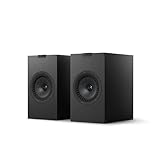
KEF · Bookshelf Speakers
KEF Q3 Meta Bookshelf Speakers
Quick answer
KEF's 6.5-inch Uni-Q bookshelf with MAT tweeter absorber offers exceptionally even dispersion and clean treble, the best all-round bookshelf here if your receiver has decent power.
KEF Q3 Meta Bookshelf Speakers Specs
| Type | 2-way bookshelf, coaxial |
|---|---|
| Drivers | Uni-Q with MAT: 1-inch vented aluminum dome tweeter in 6.5-inch aluminum cone |
| Sensitivity | 87 dB |
| Impedance | 8 ohms |
| Bass loading | Rear port |
| Sold as | Pair |
BHTR Score: 88/100
Our score weighs the spec sheet, the price band and what owners report over time. See how we score.
Our Verdict
The Q3 Meta uses KEF's 12th-generation Uni-Q coaxial driver: a 1-inch vented aluminum dome tweeter at the center of a 6.5-inch aluminum cone, plus Metamaterial Absorption Technology (MAT) behind the tweeter. KEF says MAT absorbs 99% of the unwanted sound from the rear of the tweeter, which in practice means cleaner, less edgy treble.
Show the maths. Compared with its smaller sibling, the KEF Q1 Meta, the 6.5-inch cone has roughly 6.5² ÷ 5.25² ≈ 1.5 times the area, worth about 3.7 dB more output at the same excursion. Sensitivity is 87 dB: at 3 m (10 ft), 1 W gives about 77.5 dB at your seat, so 95 dB peaks need about 56 W (sensitivity explained).
The Uni-Q's real benefit for home theater is consistency. Treble and midrange radiate from one point, so off-axis seats get the same tonal balance as the center seat, and voices don't change character as they pan across the front stage.
The trade-off is efficiency: it's 9 dB less sensitive than the Klipsch RP-600M II, so it needs eight times the power for equal volume. A good midrange AVR is enough for most rooms.
Pair it with the Q6 Meta center and Q7 Meta towers for a fully coaxial front stage. It's our benchmark in the best bookshelf speakers for home theater.
Pros
- Uni-Q coaxial driver gives very even off-axis sound
- MAT absorber cleans up treble
- 6.5-inch cone has about 1.5x the area of the Q1 Meta
- Matches the Q6 Meta center for seamless pans
Cons
- 87 dB sensitivity needs about 8x the power of a 96 dB Klipsch
- Rear port wants space from the wall
- Costs noticeably more than the Q1 Meta
Alternatives to the KEF Q3 Meta Bookshelf Speakers
Cheaper options


KEF Q3 Meta Bookshelf Speakers FAQ
What is MAT on the KEF Q3 Meta?
Metamaterial Absorption Technology is a maze-like disc behind the tweeter that soaks up the sound radiating from its rear. KEF says it absorbs 99% of that unwanted output. The result is cleaner, less harsh treble, which you notice most on dialogue and bright effects.
What center channel goes with the KEF Q3 Meta?
The KEF Q6 Meta. It uses the same Uni-Q driver with MAT, so tonal balance stays identical as voices move from the left speaker to the center and right. That timbre match matters more for dialogue than any single spec.
Is the KEF Q3 Meta Bookshelf Speakers worth it?
KEF's 6.5-inch Uni-Q bookshelf with MAT tweeter absorber offers exceptionally even dispersion and clean treble, the best all-round bookshelf here if your receiver has decent power. It scores 88/100 on our BHTR Score, ranking #1 of the 13 bookshelf speakers we track. It is best for wide sofas and mixed movie/music rooms where every seat matters; skip it if you need maximum volume from a low-powered receiver.
What is a cheaper alternative to the KEF Q3 Meta Bookshelf Speakers?
The Polk Signature Elite ES20 ($350–$500 per pair) scores 84/100. A smooth, balanced 6.5-inch bookshelf with Polk's Power Port, best on a receiver with some real power because its 86 dB sensitivity asks for more watts than horn rivals.
Featured In
- Best Bookshelf Speakers for Home Theater (Best Overall)