Bookshelf Speakers
Best Budget Home Theater Speakers
We research every product against its spec sheet and independent measurements. When you buy through our links we may earn a commission, at no cost to you. How we score · Disclosure
The best budget home theater speakers are not the cheapest boxes you can find; they are the ones that keep your front three matched and play loud on an entry-level receiver. Our top pick is the Polk Audio T-Series 5.1 Home Theater System, a full matched set with two towers, a center, two surrounds and a 10-inch powered subwoofer in one box.
This guide is for anyone building a first surround system on a tight budget, or replacing the speakers from an old home-theater-in-a-box. We cover complete packages, build-your-own pairs and one all-in-one bundle with a receiver, and we explain where cheap speakers cut corners so you know which compromises are worth making.
Our top picks at a glance


Quick answer
The best budget home theater speakers for most people are the Polk T-Series 5.1 system, because it gives you five matched speakers, including towers, and a 10-inch powered sub in one purchase. If you would rather build your own, Sony's SS-CS5 bookshelf speakers with the matching SS-CS3 towers and SS-CS8 center are the cheapest matched 3-way route. For low-power receivers, the 93 dB Klipsch R-50M plays loudest per watt.
On this page
- 1. Where Cheap Speakers Cut Corners
- 2. The Best Budget Home Theater Speakers
- 3. Budget Home Theater Speakers Side by Side
- 4. How We Ranked These Budget Speakers
- 5. What the Best Budget Home Theater Speakers Cost
- 6. Making a Cheap Receiver and Cheap Speakers Work Together
- 7. Packages Versus Separate Budget Speakers
- 8. Budget In-Wall and Ceiling Options
- 9. Who Should Buy Budget Speakers and Who Should Wait
- 10. Common Mistakes to Avoid
- 11. Frequently Asked Questions
1. Where Cheap Speakers Cut Corners
Every budget speaker makes compromises. The trick is knowing which ones hurt a home theater and which ones barely matter.
Compromises that matter:
- Mismatched centers. Many cheap packages pair decent fronts with a tiny, unrelated center. Since the center carries nearly all dialogue, this is the worst place to save.
- Undersized subwoofers. An 8-inch sub in a large room runs out of output quickly. Bass is where budget systems sound most obviously cheap.
- Low sensitivity with a cheap receiver. A budget receiver and inefficient speakers is a double compromise that leads to strained, compressed sound at volume.
Compromises that barely matter: vinyl cabinet wrap instead of veneer, small surrounds, and limited bass extension on fronts and surrounds, because with an 80 Hz crossover the subwoofer handles the deep bass anyway.
So the spending rule is simple: protect the center and front pair, buy a sub that suits your room, and save on surrounds. Check speaker sensitivity and impedance against your receiver before anything else.
2. The Best Budget Home Theater Speakers
1. Polk Audio T-Series 5.1 Home Theater System
$750–$900 · Best for: First-time buyers who want a complete receiver-based 5.1 system for a small to mid-size room
- Channels
- 5.1
- Fronts
- 2x T50 towers: 6.5-inch driver, 1-inch tweeter, two 6.5-inch passive radiators
- Subwoofer
- Polk PSW10, 10-inch powered, up to 100 W
- Surrounds
- Included (2x T15 bookshelf: 5.25-inch driver, 0.75-inch tweeter)
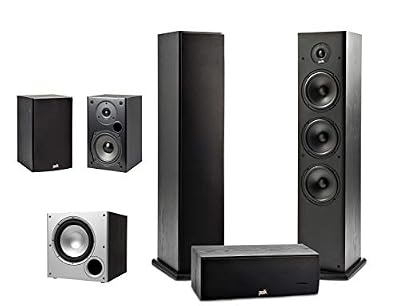
The Polk T-Series 5.1 system wins because it solves the two problems that ruin most cheap surround setups, mismatched speakers and missing pieces, in one purchase. You get two T50 towers (a 6.5-inch driver, a 1-inch tweeter and two 6.5-inch passive bass radiators each), a T30 center with two 5.25-inch drivers and a 1-inch tweeter, two T15 bookshelf surrounds (5.25-inch driver, 0.75-inch tweeter) and a Polk PSW10 10-inch powered subwoofer rated up to 100 W.
The maths on the towers: one 6.5-inch driver plus two 6.5-inch radiators gives about three times the radiating area of the driver alone, which is why the T50s reach lower than the bookshelf speakers and take some load off the sub.
Pair it with any five-channel receiver that has a sub pre-out, such as the Yamaha RX-V4A, and set everything to Small with an 80 Hz crossover. Polk notes the set can grow to 7.1 or more later if your receiver has the channels.
The trade-off is the sub. A 10-inch, up-to-100 W sub suits small to mid-size rooms; in a large or open-plan space it runs out of steam first, so plan to upgrade to a 12-inch model such as the Polk Monitor XT12 or a pick from our budget subwoofer guide. There are no height speakers in the box either. Compared with the Sony build below, the Polk set includes the sub and towers in one box; the Sony route costs less up front but you source the sub yourself.
Pros
- Complete 5.1 set: towers, center, surrounds and powered sub in one bundle
- Towers add two 6.5-inch passive radiators each for fuller bass
- Compatible with most home theater receivers
- Can grow to 7.1 or more later
Cons
- 10-inch, up-to-100 W sub runs out of steam in large rooms
- No height speakers for Atmos
- Needs a separate AV receiver

2. Sony SS-CS5 Bookshelf Speakers
$100–$150 per pair · Best for: Budget 5.1 systems that want a matched speaker family
- Drivers
- 0.75-inch super tweeter; 1-inch polyester tweeter; 5.12-inch mica-reinforced cellular woofer
- Sensitivity
- 88 dB (2.83 V / 1 m)
- Impedance
- 6 ohms
- Frequency response
- 53 Hz–50 kHz
Sony's SS-CS series is one of the cheapest ways to get a properly matched system with a real 3-way design. The SS-CS5 bookshelf uses a 5.12-inch woofer, a 1-inch tweeter and a 0.75-inch super tweeter, with a quoted response of 53 Hz to 50 kHz and a 6-ohm nominal impedance. The matching SS-CS3 tower and SS-CS8 center share the same driver family, so you can build a full 5.0 front-and-surround system from one range for the price of many single pairs.
A good budget layout: two SS-CS3 towers up front, the SS-CS8 center, and two SS-CS5s as surrounds, then add a budget sub such as the Polk PSW10 or Dayton Audio Classic CS1200. That gives you five matched speakers and a sub without stretching to a premium package.
The trade-off is the load. At 6 ohms, these speakers draw a little more current than 8-ohm designs, and owners report they sound best with the receiver's room correction engaged, because the treble can be lively out of the box. Any current mid-range receiver handles 6-ohm speakers without issue. Compared with the Polk package above, you get more speakers for the money but need to buy the sub separately.
Pros
- 3-way design with super tweeter at a budget price
- 88 dB sensitivity suits entry-level receivers
- Matches the SS-CS8 center and SS-CS3 towers
- Long track record with owners
Cons
- 6-ohm load means the 2.83 V rating flatters it slightly
- Treble can be a touch bright
- Basic cabinet finish

3. Klipsch R-50M Bookshelf Speakers
$200–$300 per pair · Best for: Budget 5.1 systems on modest receivers in small to medium rooms
- Drivers
- 1-inch aluminum LTS tweeter on Tractrix horn; 5.25-inch spun-copper IMG woofer
- Sensitivity
- 93 dB (2.83 V / 1 m)
- Impedance
- 8 ohms
- Sold as
- Pair
If your receiver is an entry-level model or an older unit with modest power, efficiency matters more than anything else, and the Klipsch R-50M is the most efficient pick on this page. Klipsch rates it at 93 dB sensitivity with an 8-ohm load and 58 Hz to 21 kHz (±3 dB) response, from a 5.25-inch spun-copper woofer and a 1-inch aluminum tweeter in Klipsch's Tractrix horn.
Here is why 93 dB matters. Compared with a typical 86 dB budget speaker, the R-50M is 7 dB more sensitive, which means it reaches the same volume with about one-fifth of the amplifier power. On a 5.2-channel receiver like the Yamaha RX-V4A, that is the difference between clean peaks and audible strain.
Use a pair as fronts with the matching Klipsch R-50C center, and you have a horn-loaded front stage where dialogue cuts through clearly at modest volume. The trade-off is bass: with a 58 Hz lower limit, the R-50M must be paired with a subwoofer and set to Small with an 80 Hz crossover. The horn treble is also brighter than the ELAC below, so rooms with hard floors benefit from a rug.
Pros
- 93 dB sensitivity means low-powered receivers go loud
- Horn tweeter gives crisp, punchy dialogue and effects
- Matches the R-50C center and other Reference models
- Compact enough for shelves and stands
Cons
- 5.25-inch woofer needs a subwoofer for movies
- Forward treble can be fatiguing in bright, hard rooms
- Vinyl-wrapped cabinet feels its price

4. ELAC Debut 2.0 B6.2
$250–$400 per pair · Best for: Shelves and near-wall placement where rear-ported speakers sound boomy
- Drivers
- 1-inch cloth dome tweeter; 6.5-inch aramid-fiber woofer
- Sensitivity
- 87 dB (2.83 V / 1 m)
- Impedance
- 6 ohms
- Bass loading
- Front port
If the same speakers will play music as often as movies, the ELAC Debut 2.0 B6.2 is the budget bookshelf to buy. Designed by Andrew Jones, it uses a 6.5-inch aramid-fiber woofer and a 1-inch cloth dome tweeter, with ELAC quoting 44 Hz to 35 kHz, 87 dB sensitivity and a 6-ohm nominal impedance.
That 44 Hz figure is the important number. It is about an octave deeper than most compact budget speakers, which means the B6.2 has real midbass weight on its own for music, and it hands off to a subwoofer smoothly at 60 to 80 Hz for movies. The cloth tweeter gives a smoother, less forward treble than the Klipsch horns above, which suits long listening sessions.
Build a 5.1 around it with the ELAC Debut 2.0 C5.2 center, a 3-way design that is one of the best budget centers for dialogue, and the ELAC Debut Sub3030 if your budget stretches. The trade-off is efficiency: at 87 dB and 6 ohms, the B6.2 needs roughly four times the power of the R-50M for the same volume. It is a large bookshelf speaker too, so budget for sturdy stands rather than a crowded shelf.
Pros
- Front-firing port tolerates near-wall and shelf placement
- Neutral, smooth voicing that suits dialogue
- 6.5-inch aramid woofer rated to 44 Hz
- Matching center and Atmos modules in the same range
Cons
- 6-ohm load means 2.83 V sensitivity flatters it by about 1.2 dB
- Less punchy than horn-loaded rivals
- Plain cabinet finish

5. Dayton Audio Classic T65 Tower Speakers
$200–$250 per pair · Best for: The cheapest route to a pair of real floorstanders
- Type
- Floorstanding
- Drivers
- 1-inch silk dome tweeter; dual 6.5-inch poly woofers
- Bass loading
- Bass reflex
- Sold as
- Pair
The Dayton Audio Classic T65 is the cheapest way to put real towers at the front of your room. Each speaker pairs two 6.5-inch poly woofers with a 1-inch silk dome tweeter and a real crossover in a bass reflex cabinet over 39 inches tall, with 150 W power handling and gold-plated binding posts that take banana plugs. It's sold as a pair.
Towers matter on a budget because two woofers per side give more output than a small bookshelf at the same volume. The maths: two 6.5-inch cones equal the area of one driver about 9.2 inches across, roughly 3 dB more output than a single 6.5-inch bookshelf at the same excursion, the same gain as doubling amplifier power. That takes pressure off a cheap subwoofer. The tall cabinet also puts the tweeter close to seated ear height, about 36 to 40 inches on a typical sofa.
The trade-off is information and matching. Dayton doesn't publish sensitivity, impedance or frequency response on the listing, and there's no matched Dayton center, so pair the towers with Dayton Classic B65 bookshelf speakers as surrounds and choose a center from our center channel guide. Run them with a sub below 80 Hz. Compared with the Sony SS-CS3, the Dayton costs less and has bigger woofers; the Sony publishes full specs and has a matched center.
Pros
- Dual 6.5-inch woofers per speaker
- Silk dome tweeter sits near seated ear height
- 150 W power handling
- Sold as a pair at a low price
Cons
- No sensitivity, impedance or frequency response on the listing
- No matched Dayton center in our catalog
- Budget cabinet construction

6. Klipsch Reference Theater Pack 5.1
$500–$700 · Best for: Small rooms and apartments that want discrete 5.1 without big speakers
- Channels
- 5.1
- Subwoofer
- 8-inch powered, front-firing
- Surrounds
- Included (four identical satellites)
- Amplification
- Passive speakers; needs an AV receiver
If you want five speakers and a sub that disappear into a room, the Klipsch Reference Theater Pack is the compact choice. It includes four small satellites, a matching center and an 8-inch powered subwoofer, all voiced together and all using Klipsch's horn-loaded tweeter, so timbre matching is built in.
The satellites are small enough to sit on a TV stand, on bookshelves or on wall mounts, which makes this one of the best small home theater speaker sets for apartments and bedrooms. Because the speakers are tiny, the receiver crossover does a lot of work here: set everything to Small and start at 100 to 120 Hz, then lower it only if voices stay full.
The trade-off is scale. Small satellites and an 8-inch sub cannot match the output, bass depth or dynamic range of the Polk T-Series set at the top of this list, and the system works best in rooms of roughly 150 to 250 square feet. Place the sub near the front of the room so bass does not seem to come from a different direction than the small speakers. For a step up in refinement, the SVS Prime Satellite 5.1 route is built from two satellite pairs, the Prime Center and a sub, each bought separately.
Pros
- Compact, wall-mountable satellites that disappear in a room
- Horn-loaded tweeters keep dialogue clear at low volume
- Powered 8-inch sub included, so a basic receiver can run it
- Cheaper than buying five separate speakers and a sub
Cons
- Small 3-inch woofers need a high 100–120 Hz crossover
- Runs out of headroom in large or open-plan rooms
- No receiver included and no Atmos path inside the kit

7. Yamaha YHT-5960U Home Theater System
$550–$700 · Best for: Small to mid-size rooms that want a calibrated 5.1 system with minimal effort
- Channels
- 5.1
- Subwoofer
- Powered subwoofer included
- Surrounds
- Included (compact satellites)
- Amplification
- Yamaha receiver included
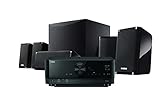
If you do not own an AV receiver yet, the Yamaha YHT-5960U solves everything in one box: a Yamaha 5.1 receiver, five speakers and a powered subwoofer, with 4K HDR pass-through and Bluetooth streaming. It is the simplest route from a TV with no sound system to real surround sound.
The main argument for a bundle like this is cost. A separately bought receiver eats a large share of a small budget, and a home-theater-in-a-box spreads that money across the whole system. You also avoid any doubt about compatibility, since the receiver and speakers are designed to work together, and auto-calibration takes care of distances and levels.
The trade-off is the upgrade path. Bundled speakers are compact and modest, and when you outgrow them you will want to replace all of them at once. The receiver is also the weakest long-term link: check its HDMI features against your TV and streaming box before buying, especially if you want Dolby Atmos later, which a 5.1 receiver cannot add. Compared with buying a budget receiver and the Polk package, this costs less but leaves you less room to grow. For more all-in-one options, see our budget home theater systems guide.
Pros
- YPAO auto-calibration takes the guesswork out of setup
- 4K HDR pass-through including Dolby Vision
- Matched speakers and powered sub in one box
- Yamaha receivers have a good reliability reputation
Cons
- 5.1 only, so no Atmos upgrade path
- Compact satellites limit dynamics in big rooms
- No 4K120 pass-through for current consoles
3. Budget Home Theater Speakers Side by Side
| Product | Score | Price | Type | Drivers | Buy |
|---|---|---|---|---|---|
| Polk Audio T-Series 5.1 Home Theater System Best Overall Budget Package | 74 | $750–$900 | — | — | Amazon → |
| Sony SS-CS5 Bookshelf Speakers Best Budget Build-Your-Own | 74 | $100–$150 per pair | 3-way bookshelf | 0.75-inch super tweeter; 1-inch polyester tweeter; 5.12-inch mica-reinforced cellular woofer | Amazon → |
| Klipsch R-50M Bookshelf Speakers Best for Low-Power Receivers | 78 | $200–$300 per pair | 2-way bookshelf, horn-loaded | 1-inch aluminum LTS tweeter on Tractrix horn; 5.25-inch spun-copper IMG woofer | Amazon → |
| ELAC Debut 2.0 B6.2 Best for Music and Movies | 82 | $250–$400 per pair | 2-way bookshelf | 1-inch cloth dome tweeter; 6.5-inch aramid-fiber woofer | Amazon → |
| Dayton Audio Classic T65 Tower Speakers Best Cheap Tower Speakers | 68 | $200–$250 per pair | Floorstanding | 1-inch silk dome tweeter; dual 6.5-inch poly woofers | Amazon → |
| Klipsch Reference Theater Pack 5.1 Best Compact Budget Set | 72 | $500–$700 | — | — | Amazon → |
| Yamaha YHT-5960U Home Theater System Best All-in-One With a Receiver | 71 | $550–$700 | — | — | Amazon → |
4. How We Ranked These Budget Speakers
These rankings are built on the spec sheet and owner feedback rather than lab measurements. For each pick we looked at:
- Matching: whether you can build a full 5.1 from one family, or at least the front three.
- Sensitivity and impedance against the power of entry-level receivers, using the rule that every 3 dB of extra sensitivity halves the power needed.
- Subwoofer size and bass extension for packages, and whether the speakers can hand off cleanly at 80 Hz.
- Upgrade path: whether you can add Atmos modules or better speakers later without starting again.
- Owner-reported reliability and long-term satisfaction, where widely documented.
Individual pairs rank on how well they anchor a system, not how they sound alone.
5. What the Best Budget Home Theater Speakers Cost
People search for the best home theater speakers under $500, under $1,000 and under $2,000, and those bands map neatly onto different kinds of system.
| Budget for speakers | What you can realistically get |
|---|---|
| Under $300 | A compact satellite package, or good surrounds only |
| Under $500 | A compact 5.1 package, or a quality pair of fronts plus center |
| Under $1,000 | A full matched 5.1 with a 10- or 12-inch sub |
| Under $2,000 | Towers, a 3-way center, matched surrounds, a strong sub and Atmos modules |
A useful split for a full system:
- Front left and right: about 35% of the speaker budget
- Center: about 15 to 20%
- Subwoofer: about 25 to 30%
- Surrounds: about 15 to 20%
If you cannot afford everything at once, buy the front three and sub first (a 3.1 system) and add matched surrounds later. That beats buying a cheap 5.1 that you outgrow within a year. Remember the receiver too: our budget home theater receiver guide covers models that drive every speaker here.
6. Making a Cheap Receiver and Cheap Speakers Work Together
Entry-level receivers are usually rated at around 70 to 100 watts per channel, but that rating is often measured with two channels driven. With five or seven channels running, real power per channel is lower. That is why speaker efficiency matters most on a budget.
The maths, for a 10-foot seat and loud movie peaks 10 dB below Dolby reference (95 dB at the seat):
- 93 dB speaker (Klipsch R-50M): about 14 watts per channel
- 87 dB speaker (ELAC B6.2): about 56 watts per channel
- 85 dB speaker (small budget satellites): about 90 watts per channel
The efficient speaker leaves your receiver in its comfort zone; the inefficient one pushes it toward clipping, which is what really damages tweeters. With a modest receiver in a medium or large room, favor efficient speakers.
Two free improvements also help: set every speaker to Small with an 80 Hz crossover so the subwoofer handles deep bass, and run the receiver's room correction. Both reduce the load on the amplifier and improve clarity more than any cheap speaker upgrade.
7. Packages Versus Separate Budget Speakers
A budget package gives you guaranteed matching in one box. A build-your-own system lets you spend unevenly, putting money into the front three and saving on surrounds.
Choose a package if you want simplicity, you are filling a small to medium room, and you value matched timbre over maximum output. The Polk T-Series 5.1 and Klipsch Reference Theater Pack are the strongest options here.
Choose separates if you want towers or larger bookshelf speakers up front, you already own part of a system, or you want to stagger your spending. The Sony SS-CS family and ELAC Debut 2.0 family are the best value for this approach.
For the full range of picks at every price, see our main best home theater speakers guide.
8. Budget In-Wall and Ceiling Options
In-wall and in-ceiling speakers can be surprisingly affordable. Budget 8-inch ceiling speakers such as the Micca M-8C cost less per pair than many bookshelf speakers, and they are a cheap way to add Dolby Atmos height channels or hide surrounds entirely.
Budget for in-wall rated cable and installation time, and favor models with pivoting tweeters so you can aim treble at the seats.
For full recommendations, including Atmos placement angles, see our best in-wall speakers for home theater guide.
9. Who Should Buy Budget Speakers and Who Should Wait
Buy budget home theater speakers if:
- You are moving from TV speakers or a basic soundbar to real surround sound.
- Your room is small to medium and you listen at moderate volume.
- You want to start with a 3.1 or 5.1 now and upgrade piece by piece.
Wait or spend more if:
- Your room is large or open plan. Budget speakers and subs run out of output in big spaces, and an extra few hundred dollars on the sub alone makes more difference than anything else.
- You have no receiver and no budget for one. A soundbar may be a better use of a small budget.
10. Common Mistakes to Avoid
Saving money on the center channel
A cheap, unmatched center undermines the whole system because it carries almost all dialogue. If you must cut costs, cut them on the surrounds instead, and buy the center from the same series as your front speakers.
Buying an underpowered subwoofer for a big room
An 8-inch sub can sound fine in a bedroom but thin and strained in an open-plan living room. Match the sub to your room volume; it is the component where extra money makes the most audible difference on a budget.
Ignoring sensitivity on an entry-level receiver
Low-sensitivity speakers and a cheap receiver force the amplifier into clipping at volume. Choose speakers around 90 dB or higher if your receiver is modest, or keep volume moderate.
Running small speakers full range
Leaving budget speakers set to Large sends deep bass they cannot reproduce, which causes distortion and wastes amplifier power. Set them to Small and use an 80 to 120 Hz crossover depending on speaker size.
Buying a box with proprietary connectors
Some very cheap bundles use speakers that only work with their own receiver. When one part fails, the whole system goes. Favor packages built from standard passive speakers you can reuse later.
11. Frequently Asked Questions
What are the best budget home theater speakers?
The best budget home theater speakers for most rooms are the Polk T-Series 5.1 system, which gives you five matched speakers, including towers, and a 10-inch powered sub. For a build-your-own system, Sony's SS-CS family is the cheapest matched 3-way range, and the 93 dB Klipsch R-50M is best when your receiver has modest power.
How much should I spend on home theater speakers?
Plan on roughly $500 to $1,000 for a decent matched 5.1 speaker system, plus a receiver. Below $500 you are limited to compact packages; above $1,000 you can add towers, a 3-way center and Atmos modules. Spend most on the front three speakers and the subwoofer, and save on surrounds.
Are cheap home theater speakers worth it?
Yes, cheap home theater speakers are worth it if they are matched and paired with a decent subwoofer. Even an inexpensive 5.1 system gives real surround placement that TV speakers and basic soundbars cannot. Avoid ultra-cheap bundles with proprietary connectors, since you cannot reuse them when you upgrade.
Is a 5.1 speaker system under $1,000 good enough?
A well-chosen 5.1 speaker system under $1,000 is good enough for most living rooms, and it is a large step up from any soundbar in its price range. The Polk T-Series 5.1 package and a Sony SS-CS build both fit; add height speakers later with a seven-channel receiver if you want Atmos.
Do budget speakers need an expensive receiver?
No. Budget speakers work well with an entry-level receiver as long as their sensitivity is reasonable, ideally around 87 dB or higher, and their impedance is 6 or 8 ohms. Efficient speakers such as the Klipsch R-50M need very little power to play loud, which suits modest receivers.
Should I buy budget speakers or a soundbar?
Buy budget speakers if you have a receiver or can afford one, and can place surrounds behind your seat. You will get better separation, a bigger soundstage and an upgrade path. Buy a soundbar if space, wiring or simplicity matters more, especially in small rooms.
Related Guides
AV Receivers
Best Budget Home Theater Receiver
The best budget home theater receiver picks for 5.1 and 5.1.2 Atmos, ranked by what each tier gets you: 4K/120 HDMI, room EQ and honest watts.
Subwoofers
Best Budget Subwoofer for Home Theater
The best budget subwoofer for home theater at every price tier, ranked by honest RMS power and ±3 dB extension, with placement tips for cheap subs.
Bookshelf Speakers
Best Home Theater Speakers
The best home theater speakers for 2026: 8 packages, towers, bookshelf and center picks, plus the sensitivity and amp-power maths to build a matched 5.1.
The Bottom Line
The best budget home theater speakers for most people are the Polk T-Series 5.1 system: matched, complete with towers, and backed by a 10-inch powered sub you can upgrade later in a bigger room. Builders on the tightest budget should look at Sony's SS-CS5 with the SS-CS3 and SS-CS8, owners of low-power receivers at the 93 dB Klipsch R-50M, and music lovers at the ELAC Debut 2.0 B6.2. The Dayton Classic T65 is the cheapest good tower, the Klipsch Reference Theater Pack the compact choice, and the Yamaha YHT-5960U the all-in-one with a receiver. Protect the center and front pair, buy a sub that suits your room, and save on surrounds.