Subwoofers
Best Budget Subwoofer for Home Theater
We research every product against its spec sheet and independent measurements. When you buy through our links we may earn a commission, at no cost to you. How we score · Disclosure
The best budget subwoofer for home theater is the ELAC Debut 2.0 Sub3030: a 12-inch sub with a 500 W RMS amplifier, a rated response down to 25 Hz, and app control with automatic room EQ, features that usually cost much more. This guide is for anyone who wants real movie bass without paying premium-sub money, whether you're finishing a first 5.1 system or replacing a weak sub from a speaker package.
Cheap subwoofers vary more than any other budget component. Some have honest specs and real output; others quote huge peak watts and a frequency range with no tolerance. We rank by the numbers that predict performance: RMS power, driver size and extension at a stated limit. If the Sub3030 is a stretch, the Klipsch R-120SW and Dayton Audio Classic CS1200 cover cheaper tiers.
Our top picks at a glance



Quick answer
The ELAC Debut 2.0 Sub3030 is the best budget subwoofer for home theater: a 12-inch driver, 500 W RMS, 25 Hz extension and app-based AutoEQ. The BIC Acoustech PL-200 II offers the most output per dollar when you can find it, the Klipsch R-120SW is the best value 12-inch from a major brand, and the Dayton Audio Classic CS1200 is the cheapest 12-inch sub worth buying.
On this page
- 1. What You Get, and Give Up, With a Cheap Subwoofer
- 2. Reading Budget Sub Specs: RMS, Peak and Hz
- 3. The best budget home theater subwoofers
- 4. Budget Subwoofer for Home Theater Side by Side
- 5. How We Picked the Best Budget Subwoofer for Home Theater
- 6. Best Budget Sub at Each Price Tier
- 7. Two Cheap Subs or One Better Sub?
- 8. Getting More From a Budget Subwoofer
- 9. Who Should Buy a Budget Sub, and Who Should Save Up
- 10. Common Mistakes to Avoid
- 11. Frequently Asked Questions
1. What You Get, and Give Up, With a Cheap Subwoofer
Budget subwoofers save money in three places:
- Amplifier power. Many cheap subs have 50–150 W RMS amps. Every halving of power costs 3 dB of headroom.
- Driver and cabinet quality. Lighter cabinets resonate, and cheaper drivers have less excursion, which limits output in the lowest octave.
- Controls. Budget subs rarely have app control or EQ, so you rely on your receiver's room correction.
What you can still get: a 12-inch driver (the biggest single factor in output), honest extension into the high 20s or low 30s, and enough output for a medium living room. That's why every pick here except the PSW10 is a 12-inch sub.
Is a cheap subwoofer worth it? Yes, if your current system has no sub or a tiny one. Adding even a modest 12-inch sub and setting the receiver's crossover to 80 Hz takes the hardest job away from your speakers, so they play cleaner and louder. It's often the biggest single improvement in a budget system.
2. Reading Budget Sub Specs: RMS, Peak and Hz
Budget subwoofer spec sheets are where marketing gets creative. Three rules help:
1. Ignore peak watts. "1,000 W peak" usually means a much smaller continuous amp. The BIC Acoustech PL-200 II is 1,000 W peak but 250 W RMS; RMS is the number to compare.
2. Look for a tolerance on frequency response. "29–120 Hz ±3 dB" (the Klipsch R-120SW) tells you where output is within 3 dB of flat. "24–160 Hz" with no tolerance could mean anything from flat to -10 dB at 24 Hz.
3. Compare in decibels. Power differences translate to headroom with 10 × log10(P1/P2):
| Amp power | vs 100 W |
|---|---|
| 50 W RMS | -3 dB |
| 100 W RMS | 0 dB |
| 200 W RMS | +3 dB |
| 250 W RMS | +4 dB |
| 500 W RMS | +7 dB |
Driver size matters as much as power. A 12-inch driver has roughly 480 cm² of cone area, versus about 330 cm² for a 10-inch and 200 cm² for an 8-inch.
3. The best budget home theater subwoofers

1. ELAC Debut 3030 Subwoofer
$500–$700 · Best for: Rooms with boomy bass and a receiver with basic room correction
- Driver
- 12-inch
- Inputs
- LFE/line-level RCA
- App/EQ
- ELAC SUB Control app (Bluetooth) with Auto EQ
The Debut 2.0 Sub3030 is the budget sub that behaves like a much pricier one. ELAC rates its amplifier at 500 W RMS (1,000 W peak) driving a 12-inch woofer, with a frequency response of 25–150 Hz. That's more than double the RMS power of most subs in this price range, and real extension into the mid-20s.
The headline feature is app control with AutoEQ. You use your phone's microphone to measure the sub in your room, and the app applies correction to flatten bass peaks, the main cause of boomy, one-note bass in cheap systems. It also gives you volume, phase and crossover from the sofa, which makes setup much easier than reaching behind a sub.
Why does 500 W matter? Going from a 200 W budget sub to 500 W is about 4 dB more amplifier headroom (10 × log10 of 2.5). In practice, that means the Sub3030 can play loud action scenes cleanly in a medium room where cheaper subs start to distort or compress.
The trade-off: it sits at the top of the budget range, and it's heavier than other picks here at around 50 pounds. Compared with the SVS SB-1000 Pro, it has more amplifier power and similar app features, while the SVS is sealed, smaller and rated a little deeper. For most budgets near the $500 line, it's the best budget home theater subwoofer.
Pros
- ELAC SUB Control app with Auto EQ
- 12-inch driver suits medium rooms
- Easy tuning from the listening seat
Cons
- Auto EQ corrects for one measurement position only
- Costs more than budget 12-inch subs without EQ

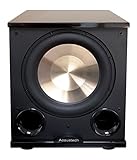
2. BIC Acoustech PL-200 II
$300–$450 · Best for: Budget buyers who want maximum output in a medium room
- Driver
- 12-inch
- Amplifier
- 250 W RMS / 1,000 W peak (manufacturer rating)
- Inputs
- LFE/line-level RCA
- App/EQ
- None (use your receiver's room correction)
The BIC Acoustech PL-200 II has been a budget favorite for years for one reason: output. It pairs a 12-inch long-throw woofer with a 250 W RMS (1,000 W peak) BASH amplifier and dual flared front ports, so it plays loud in a medium-sized room for the money.
The front ports are a practical advantage: you can push the sub against a wall or into a corner without blocking airflow, and corner loading adds output for free. Owners consistently report that it fills living rooms with punchy bass for action movies.
The honest limit is depth. Reviewers note that output falls away below about 30 Hz, so the very lowest rumble in effects-heavy films is reduced. For most movies and music, that's barely noticeable; for bass-heavy blockbusters, an ELAC Debut Sub3030 goes deeper with more power.
The trade-off beyond depth: there's no app or EQ, so you rely on your receiver's room correction, and the cabinet is large for its class. Availability is patchy: several retailers have listed it as discontinued, so buy it only if you find it at a good price from a reputable seller. Against the Klipsch R-120SW, it has 50 W more RMS power and similar extension. As the best cheap home theater subwoofer for raw output, it's still hard to beat when it's in stock.
Pros
- 250 W RMS amp at a budget price
- 12-inch driver for medium rooms
- Strong output per dollar
Cons
- 1,000 W peak rating overstates real power
- No app or built-in EQ
- Basic finish

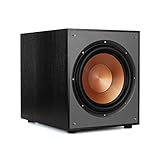
3. Klipsch R-120SW
$300–$400 · Best for: Medium living rooms on a budget
- Driver
- 12-inch copper-spun
- Amplifier
- 200 W RMS / 400 W peak
- Frequency response
- 29–120 Hz ±3 dB
- Enclosure
- Front-firing, ported
The Klipsch R-120SW is the safe, widely available budget 12-inch. It uses a front-firing 12-inch woofer, a ported cabinet and a 200 W RMS / 400 W peak amplifier, with a rated response of 29–120 Hz (±3 dB).
The ±3 dB tolerance is worth noting. Many budget subs quote a frequency range without one, which makes a "25 Hz" claim impossible to compare. Klipsch's 29 Hz at ±3 dB is an honest number: it tells you the R-120SW delivers strong bass down to the high 20s, which covers kick drums, bass guitar and most movie effects, and then rolls off.
It matches Klipsch's Reference speakers in looks, so it's a natural fit with the Klipsch Reference Theater Pack, Klipsch R-600F towers or R-50M bookshelves. Klipsch's dealer network also makes it easy to find and return if needed.
The trade-off: no app, no EQ and a modest amp compared with the ELAC Debut Sub3030, which has more than double the RMS power and goes deeper. If you see the Klipsch R-12SW at a similar price, it's another 12-inch option, but its 400 W is a dynamic (peak) rating and Klipsch's listing gives no frequency response. For medium rooms on a budget, the R-120SW is a dependable buy, and it's our budget pick in the main subwoofer guide.
Pros
- 12-inch driver for the price of many 10-inch subs
- 200 W RMS amp with plenty of mid-bass punch
- Simple setup with LFE input
Cons
- Rolls off below 29 Hz
- No app or built-in room EQ
- Less refined than sealed rivals with music

4. Polk Monitor XT12
$200–$300 · Best for: Small and medium rooms on a tight budget
- Driver
- 12-inch
- Amplifier
- 100 W RMS
- Inputs
- LFE RCA, line-level
- App/EQ
- None (use your receiver's room correction)
The Polk Monitor XT12 is one of the least expensive 12-inch subs from a major speaker brand. Polk rates it as a 12-inch, 100 W powered subwoofer with a frequency response of 24–160 Hz, and it's designed to match Polk's Monitor XT speakers, such as the Polk Monitor XT20 bookshelves and Monitor XT60 towers.
The 100 W rating is the catch. Compared with the Klipsch R-120SW at 200 W RMS, that's 3 dB less amplifier headroom (half the power), so the XT12 runs out of output sooner in medium and large rooms. In a small or medium living room at normal volumes, the 12-inch driver still moves plenty of air, and it's a large step up from the 8- or 10-inch subs bundled with many budget systems.
Polk's 24 Hz figure isn't given with a tolerance, so treat it as the point where bass is audible rather than flat; expect strong output from the low 30s upward.
The trade-off: limited power, no app and basic controls. Who it suits: anyone building a Polk Monitor XT system, a budget 5.1 setup in a small room, or a buyer who wants a 12-inch sub under $300. If you can spend a little more, the R-120SW is the better movie sub.
Pros
- 12-inch driver at a budget price
- Matches Polk Monitor XT speakers
- Easy LFE hookup
Cons
- Modest 100 W RMS amp limits headroom
- No app or built-in room EQ
- Not for large rooms

5. Dayton Audio Classic CS1200
$200–$275 · Best for: Small to medium rooms on the tightest budget
- Driver
- 12-inch
- Amplifier
- 200 W Class-D
- Inputs
- Stereo RCA, LFE and speaker-level; auto-on
- Enclosure
- Rigid, braced cabinet with swappable grille
The Dayton Audio Classic CS1200 is the sub to buy when the budget is very small but you still want a 12-inch driver. It pairs that driver with a 200 W Class-D amplifier in a rigid, braced cabinet, takes stereo RCA, LFE and speaker-level inputs with auto-on, and comes with a five-year warranty.
What makes it work at this price is the 12-inch driver. Cone area is (12 ÷ 10)² = 1.44 times that of a 10-inch, about 3 dB more output at the same cone travel, so it moves more air at low frequencies than cheap 10-inch or 8-inch subs. On paper its amp matches the Klipsch R-120SW's 200 W, but Dayton doesn't say whether that's a continuous figure, so treat it as a ceiling rather than an RMS match.
Room maths: a 12 × 15 ft room with an 8 ft ceiling is 1,440 cubic feet, about the upper end for a budget 12-inch with this amp. The speaker-level inputs also let it work with a stereo amp that has no sub output.
The trade-off: Dayton publishes no frequency response on the listing, so you can't compare its depth with the R-120SW's 29 Hz (±3 dB), and there's no app or EQ. Who it suits: tight budgets, second rooms and anyone replacing a tiny sub from a home-theater-in-a-box. It's also an easy way to try two subs in a room without spending much.
Pros
- 12-inch driver at a budget price
- Line, LFE and speaker-level inputs with auto-on
- Five-year warranty
- Swappable grille
Cons
- No frequency response on the listing
- No app or built-in EQ
- 200 W amp limits headroom in larger rooms

6. Polk PSW10
$100–$200 · Best for: Small rooms and older stereo systems
- Driver
- 10-inch
- Amplifier
- 50 W RMS / 100 W peak
- Enclosure
- Front-firing, ported
- Inputs
- Line-level RCA and speaker-level
The Polk PSW10 is a simple 10-inch powered sub that's been around for years, and it remains one of the cheapest ways to add a subwoofer from an established brand. It's compact enough for a bedroom, dorm room or small apartment, and it accepts both line-level (LFE) and speaker-level connections, so it works with a receiver, a stereo amp or an older system without a sub output.
The 10-inch driver and small amp limit how loud and how deep it goes. In a room under about 1,000 cubic feet (say 10 × 12 × 8 feet, or 960), that's fine: room gain in a small space boosts low bass, and you won't need much output. In a medium or open-plan living room, it will sound thin at high volume.
Think of it as a 2.1 or small 5.1 sub, not a movie powerhouse. Pair it with small bookshelf speakers like the Micca MB42X or Dayton Classic B65 and set the receiver's crossover to 80–100 Hz.
The trade-off: limited extension and output compared with any 12-inch pick here. Other small-room alternatives include the Fluance DB10, Sony SA-CS9, Yamaha NS-SW100 and the compact Kanto SUB8. If you have the space and a little more money, the Dayton Audio Classic CS1200 gives you a 12-inch driver and a 200 W amp for not much more.
Pros
- Very low price
- Line-level and speaker-level inputs
- Small enough for bedrooms and offices
Cons
- 50 W RMS amp limits output
- 10-inch driver with modest deep-bass reach
- Older design than newer budget rivals

7. SVS SB-1000 Pro
$650–$800 · Best for: Living rooms up to about 2,000 cubic feet
- Driver
- 12-inch
- Amplifier
- 325 W RMS / 820 W peak (Class D)
- Frequency response
- 20–270 Hz ±3 dB
- Enclosure
- Sealed, front-firing
If your budget stretches toward $1,000, the SVS SB-1000 Pro is the point where budget compromises stop. It has a 12-inch driver in a sealed cabinet only about 13 inches on each side, a 325 W RMS amplifier and a rated response of 20–270 Hz (±3 dB). That's genuinely flat to 20 Hz, a full octave-and-a-bit deeper in practice than most budget subs' honest limits.
Sealed subs suit small and medium rooms because room gain lifts their low bass. You get tight, controlled bass that blends easily with speakers and doesn't boom near walls. The SVS app adds parametric EQ, phase, crossover and room-gain compensation from your phone, and SVS's warranty and support are among the best in the business.
Compare it with the ELAC Debut Sub3030: the ELAC has more amplifier power and AutoEQ; the SVS is smaller, sealed and rated deeper at a stated tolerance. For movies in a medium room, both are excellent; for music and small rooms, many owners prefer the SVS's tighter sound.
The trade-off: it costs more than most budget subs, and in large rooms a sealed 12-inch runs out of headroom. That's when the bigger models in our main subwoofer guide make sense. It's the best home theater subwoofer under $1,000 for small and medium rooms.
Pros
- Compact sealed cabinet fits most living rooms
- 325 W RMS amp drives a 12-inch driver
- SVS app with parametric EQ, phase and room gain compensation
- Tight, even bass that suits music as well as movies
Cons
- Less deep-bass output than the ported PB-1000 Pro
- One sub is not enough for large rooms
- Costs more than budget 12-inch subs
4. Budget Subwoofer for Home Theater Side by Side
| Product | Score | Price | Driver | Amplifier | Inputs | App/EQ | Buy |
|---|---|---|---|---|---|---|---|
| ELAC Debut 3030 Subwoofer Best Budget Subwoofer Overall | 77 | $500–$700 | 12-inch | — | LFE/line-level RCA | ELAC SUB Control app (Bluetooth) with Auto EQ | Amazon → |
| BIC Acoustech PL-200 II Most Output for the Money | 76 | $300–$450 | 12-inch | 250 W RMS / 1,000 W peak (manufacturer rating) | LFE/line-level RCA | None (use your receiver's room correction) | Amazon → |
| Klipsch R-120SW Best Value 12-Inch From a Major Brand | 78 | $300–$400 | 12-inch copper-spun | 200 W RMS / 400 W peak | LFE RCA, line-level | — | Amazon → |
| Polk Monitor XT12 Best Under $300 | 73 | $200–$300 | 12-inch | 100 W RMS | LFE RCA, line-level | None (use your receiver's room correction) | Amazon → |
| Dayton Audio Classic CS1200 Cheapest 12-Inch Worth Buying | 72 | $200–$275 | 12-inch | 200 W Class-D | Stereo RCA, LFE and speaker-level; auto-on | None (simple on-board controls) | Amazon → |
| Polk PSW10 Best for Small Rooms on a Tiny Budget | 64 | $100–$200 | 10-inch | 50 W RMS / 100 W peak | Line-level RCA and speaker-level | — | Amazon → |
| SVS SB-1000 Pro Best Step-Up (Under $1,000) | 84 | $650–$800 | 12-inch | 325 W RMS / 820 W peak (Class D) | Line-level RCA (stereo) | SVS app (Bluetooth): parametric EQ, phase, crossover, room gain compensation | Amazon → |
5. How We Picked the Best Budget Subwoofer for Home Theater
We ranked these subs on spec-sheet research, room maths, widely published independent measurements and owner reports. We haven't measured them ourselves.
For budget subs, the ranking logic differs from our main subwoofer guide, where depth and refinement lead. Here it's usable output per dollar:
- RMS power and driver size. A 12-inch driver with honest RMS power beats a smaller sub with a big peak number.
- Honest extension. Ratings with a ±3 dB tolerance ranked above unqualified ranges.
- Features that fix rooms. App control and AutoEQ (as on the ELAC Debut Sub3030) earned extra credit because room problems are worse than amp limits in most budget systems.
- Availability and support. A great sub you can't buy, or can't return, is less useful. We flag patchy availability.
- Placement flexibility. Front-firing ports and drivers make cheap subs easier to place.
6. Best Budget Sub at Each Price Tier
Prices move, so think in tiers:
- Under $200: the Polk PSW10 (10-inch, small rooms). Expect modest output; fine for bedrooms, small living rooms and 2.1 music systems.
- Under $300: the Dayton Audio Classic CS1200 (12-inch, 200 W) and the Polk Monitor XT12, a 12-inch from a major brand. The Fluance DB10 and Sony SA-CS9 are 10-inch alternatives.
- Under $400–$500: the Klipsch R-120SW and, when available, the BIC Acoustech PL-200 II. This is where budget subs start to sound like real home theater subs.
- At the top of the budget range: the ELAC Debut Sub3030, with 500 W RMS and AutoEQ.
- Under $1,000: the SVS SB-1000 Pro, sealed and rated flat to 20 Hz.
If you're spending the same total on speakers and sub, a good rule is to put a third of the budget into the subwoofer for movie-focused systems.
7. Two Cheap Subs or One Better Sub?
This is the most useful budget question. Two subwoofers in different positions smooth out the peaks and nulls that room modes create, so bass is more even from seat to seat. Two identical subs also add about 6 dB of output when placed together.
Two cheap subs win if: you have a wide sofa or two rows, your room is over about 2,000 cubic feet, or one sub sounds boomy in some seats and thin in others. Two Dayton Audio Classic CS1200s can outperform one more expensive sub in seat-to-seat consistency.
One better sub wins if: there's one main seat, the room is small, or you want deep extension below 25 Hz, which cheap subs can't deliver no matter how many you use.
To run two subs, your receiver needs two subwoofer outputs (most current models have them, including the Denon AVR-S770H and Yamaha RX-V4A), or use a Y-splitter on a single output.
8. Getting More From a Budget Subwoofer
A cheap sub that's well placed and well set up often beats an expensive sub that isn't. Five steps:
- Do the subwoofer crawl. Put the sub at your seat, play bass, crawl along the walls, and place the sub where bass sounds smoothest.
- Use corner loading for more output. Corners add several dB, which helps low-powered subs, though bass can get boomier. Room EQ can tame it.
- Set the crossover to 80 Hz. Speakers to "Small," sub's own low-pass filter to maximum or bypass. See our crossover explainer.
- Run room correction after placement. Audyssey, YPAO or the sub's own app EQ does more for cheap subs than anything else.
- Don't run it too hot. Set the level by calibration, then add only 2–3 dB if you want more impact.
Our receiver guide covers budget AVRs with good bass management and two sub outputs.
9. Who Should Buy a Budget Sub, and Who Should Save Up
Buy a budget sub if: your system has no sub or a tiny bundled one, your room is small or medium, or you want to add a second sub cheaply.
Save up if: your room is large or open-plan, you want genuine extension below 25 Hz, or you watch at high volume. A ported sub like the SVS PB-2000 Pro from our main guide will outperform two or three budget subs in a big space.
Using a soundbar? Most soundbars only work with their own brand's sub. See our soundbar guide instead.
10. Common Mistakes to Avoid
Comparing peak watts
A 1,000 W peak sub can have a 250 W amp. Only RMS figures are comparable between subs.
Trusting a frequency range without a tolerance
"24 Hz" means little without "±3 dB." Treat untoleranced figures as optimistic and expect strong output to start several hertz higher.
Choosing an 8-inch sub for a living room
Small drivers can't move enough air for a medium room at movie volumes. Unless space is the constraint, choose a 12-inch.
Skipping room correction
Budget subs rarely have EQ. If you don't run your receiver's calibration after placement, room peaks will make bass boomy.
Buying a soundbar sub for a receiver (or vice versa)
Wireless soundbar subs don't have LFE inputs for receivers, and receiver subs won't pair with most soundbars. Check compatibility.
11. Frequently Asked Questions
What is the best budget subwoofer for home theater?
The ELAC Debut 2.0 Sub3030 is the best budget subwoofer for home theater: a 12-inch driver, 500 W RMS, 25 Hz extension and app-based AutoEQ. On a smaller budget, the Klipsch R-120SW is the best value 12-inch from a major brand, and the Dayton Audio Classic CS1200 is the cheapest 12-inch worth buying.
What is the best home theater subwoofer under $500?
Near the $500 mark, the ELAC Debut Sub3030 is the best choice thanks to 500 W RMS and AutoEQ. Below it, the Klipsch R-120SW (200 W RMS, 29 Hz ±3 dB) and the BIC Acoustech PL-200 II (250 W RMS) offer strong output for movies in medium rooms.
What is the best subwoofer for home theater under $300?
The Polk Monitor XT12 is a good 12-inch sub under $300, rated at 100 W with a 24–160 Hz response. The Dayton Audio Classic CS1200 is also 12-inch, with a 200 W amp and speaker-level inputs, though Dayton publishes no frequency response. Both suit small to medium rooms; for bigger rooms or louder listening, stretch to the Klipsch R-120SW.
Is a cheap subwoofer worth it?
Yes, if your system has no sub or a small bundled one. Even a modest 12-inch sub lets your speakers hand off deep bass at 80 Hz, so they play cleaner and louder, and movies gain real weight. The key is choosing a sub with honest RMS power and placing it carefully.
Is it better to have two cheap subwoofers or one expensive one?
Two cheap subs are better for smooth bass across several seats, because their room-mode peaks and nulls partly cancel, and they add about 6 dB together. One expensive sub is better for a single seat or for deep extension below 25 Hz, which budget subs can't reach in any number.
Is a 10-inch or 12-inch budget subwoofer better?
A 12-inch is better for most home theaters. It has about 45% more cone area than a 10-inch, so it moves more air and plays deeper bass louder. A 10-inch makes sense in small rooms, bedrooms, or when the sub must fit a tight space.
Where should I put a budget subwoofer?
Find the spot with the subwoofer crawl: put the sub at your seat, play bass, and crawl along the walls to find the smoothest bass. Corners add output, which helps low-powered subs, but can sound boomy. Then run your receiver's room correction and set the crossover to 80 Hz.
Related Guides
Subwoofers
Best Subwoofer for Home Theater
The best subwoofer for home theater, matched to your room: sealed vs ported, driver size vs room volume, placement and when two subs beat one.
AV Receivers
Best Budget Home Theater Receiver
The best budget home theater receiver picks for 5.1 and 5.1.2 Atmos, ranked by what each tier gets you: 4K/120 HDMI, room EQ and honest watts.
Bookshelf Speakers
Best Budget Home Theater Speakers
The best budget home theater speakers for 2026: 7 cheap packages and pairs, with a spend plan for 5.1 setups and the maths to match them to a budget AVR.
The Bottom Line
The ELAC Debut 2.0 Sub3030 is the best budget subwoofer for home theater, with 500 W RMS, 25 Hz extension and AutoEQ near the top of the budget range. The BIC Acoustech PL-200 II offers the most output per dollar when you can find it, the Klipsch R-120SW is the dependable 12-inch from a major brand, and the Polk Monitor XT12 and Dayton Audio Classic CS1200 cover tighter budgets. The Polk PSW10 suits small rooms, and if you can stretch, the SVS SB-1000 Pro is where budget compromises end.