Brand Reviews
Yamaha Home Theater Review
We research every product against its spec sheet and independent measurements. When you buy through our links we may earn a commission, at no cost to you. How we score · Disclosure
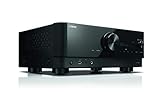
The best Yamaha home theater receiver for most people is the Yamaha RX-V6A: seven channels rated at 100 W each (8 ohms, 20 Hz–20 kHz, two channels driven), HDMI 2.1 with 4K/120 support, YPAO room calibration and MusicCast multiroom streaming, wrapped in what is still one of the easiest receivers to set up. This review is for anyone weighing Yamaha against Denon, Sony or Onkyo, or choosing between Yamaha's receivers, home-theater-in-a-box packages, subwoofers and amps.
We cover what Yamaha does well (usability, music, multiroom), where it falls short (room correction depth, slower model updates), and which Yamaha product fits which room. If you're on a budget, the Yamaha RX-V4A is the 5.2 pick; if you want an all-in-one box, the Yamaha YHT-5960U bundles everything.
Our top picks at a glance



Quick answer
Yamaha makes some of the easiest, most music-friendly home theater receivers available. The RX-V6A is the best Yamaha receiver for most rooms (7.2, 100 W, 4K/120, YPAO, MusicCast), the RX-V4A is the budget 5.2 pick, and the AVENTAGE RX-A4A is the premium choice. Denon offers more channels and advanced room correction for similar money; Yamaha wins on usability and multiroom music.
On this page
- 1. The Short Verdict
- 2. Who Yamaha Is
- 3. The Yamaha home theater lineup
- 4. Yamaha Home Theater Review Side by Side
- 5. What Yamaha Does Well
- 6. Where Yamaha Falls Short
- 7. Yamaha vs Denon, Sony and Onkyo
- 8. Choosing the Best Yamaha Home Theater Receiver for Your Speakers
- 9. Who Should Skip Yamaha
- 10. Common Mistakes to Avoid
- 11. Frequently Asked Questions
1. The Short Verdict
Yamaha is the best choice for buyers who value ease of use and music as much as movies. Its receivers are the friendliest to set up, MusicCast is one of the best multiroom systems built into any AVR, and Yamaha's amplifiers have a reputation for clean, reliable performance.
Where it loses ground is on the spec sheet's sharp end. At similar money, Denon gives you more channels, more advanced Audyssey tiers and Dirac Live upgrades on higher models, while Onkyo and Pioneer offer Dirac at lower prices. Yamaha's current RX-V and AVENTAGE lines date from 2020, so they update more slowly than rivals.
Our picks: the RX-V6A for most rooms, the RX-V4A on a budget, the RX-A4A for premium build, and the YHT-5960U if you want one box. In short: the best Yamaha home theater receiver is the one whose channel count fits your speakers, and for most people that's seven channels.
2. Who Yamaha Is
Yamaha started in 1887 as a maker of reed organs and grew into one of the world's largest musical instrument companies, making pianos, guitars, drums and pro audio gear. (Yamaha Motor, the motorcycle maker, is a separate company that shares the name and logo heritage.) That musical background shapes its audio products: Yamaha has long voiced its receivers and amplifiers with music in mind.
In home theater, Yamaha is known for a few signature technologies:
- CINEMA DSP: digital sound-field processing that simulates the acoustics of real venues. Yamaha has refined it for decades; the newer Surround:AI on AVENTAGE models applies it automatically by scene.
- YPAO (Yamaha Parametric room Acoustic Optimizer): Yamaha's room correction system, included on every current receiver, with multipoint measurement on higher models.
- MusicCast: Yamaha's multiroom platform, linking receivers, soundbars and wireless speakers in one app.
Today's lineup splits into the mainstream RX-V receivers, the premium AVENTAGE (RX-A) line, home-theater-in-a-box packages, and a range of speakers, subwoofers, in-wall speakers like the NS-IW480 and stereo amplifiers. See all products on our Yamaha brand page.
3. The Yamaha home theater lineup

1. Yamaha RX-V6A
$600–$800 · Best for: 5.1.2 Atmos systems with lots of HDMI sources
- Channels
- 7.2
- Power (rated)
- 100 W/ch (8 Ω, 20 Hz–20 kHz, 0.06% THD, 2 ch driven)
- HDMI inputs
- 7 in / 1 out
- Room correction
- YPAO
The RX-V6A is the Yamaha we'd recommend first. It has seven amplified channels rated at 100 W per channel (8 ohms, 20 Hz–20 kHz, 0.06% THD, two channels driven), which runs a 5.1.2 Dolby Atmos or 7.1 layout. There are seven HDMI inputs with HDMI 2.1 features, including 8K/60 and 4K/120 support on some inputs, plus eARC on the output.
Yamaha's strengths show up in daily use. The on-screen setup walks you through speaker wiring with pictures, YPAO calibration runs in a few minutes, and MusicCast links the receiver to other Yamaha speakers and soundbars around the house. AirPlay 2, Spotify Connect and Bluetooth are built in. Yamaha's CINEMA DSP modes, a Yamaha signature for decades, add simulated room ambience if you like that sound; most purists leave them off for movies but enjoy them for concerts.
The trade-off: YPAO offers less control than Audyssey MultEQ XT or Dirac Live, and the RX-V6A is a 2020 design, so buy current stock and update firmware (some early Yamaha HDMI 2.1 units had a 4K/120 issue with the Xbox Series X that Yamaha addressed). Against the Denon AVR-X1800H, you get 20 W more per channel (about 1 dB) and better multiroom; Denon offers finer calibration. For a living room 5.1.2 system, it's the best Yamaha receiver for home theater.
Pros
- Seven channels for real 5.1.2 Atmos
- 100 W/ch rating is strong for the price
- Seven HDMI inputs
- MusicCast, AirPlay 2 and Spotify Connect
Cons
- YPAO is less capable than Audyssey MultEQ XT
- Early units needed an HDMI fix for 4K/120 with some consoles
- No path beyond 5.1.2

2. Yamaha RX-V4A
$450–$600 · Best for: Small living rooms that will stay 5.1
- Channels
- 5.2
- Power (rated)
- 80 W/ch (6 Ω, 20 Hz–20 kHz, 2 ch driven)
- Room correction
- YPAO
- Atmos/DTS:X
- Decodes Dolby Atmos and DTS:X; virtual height only
The RX-V4A is Yamaha's entry receiver and the best value in the lineup for a 5.1 system. It has five amplified channels, two subwoofer outputs and four HDMI 2.1 inputs supporting 8K/60 and 4K/120, so a console can run at 120 Hz through the receiver. You also get YPAO, MusicCast, AirPlay 2 and Bluetooth.
Note the power rating carefully. Yamaha's US spec sheet lists 80 W per channel at 6 ohms (20 Hz–20 kHz, 0.06% THD, two channels driven). Because the test load is 6 ohms, output into typical 8-ohm speakers will be somewhat lower. That's still enough for a small or medium living room: with 88 dB-sensitive speakers at 3 meters, roughly 70 W into 8 ohms would produce about 97 dB per speaker at your seat.
The trade-off: five channels means no height speakers. It decodes Dolby Atmos and DTS:X but plays them on ear-level speakers. If you want overhead sound, step up to the RX-V6A.
Compared with the Denon AVR-S770H, the RX-V4A has fewer channels but is often cheaper, and its setup is friendlier. Compared with the old Sony STR-DH590, it adds HDMI 2.1, Wi-Fi streaming and better room correction. It's the Yamaha to buy for a simple 5.1 room with a TV and console. See our budget receiver guide for rivals.
Pros
- MusicCast, AirPlay 2 and Spotify Connect built in
- YPAO auto calibration
- 8K/60 and 4K/120 HDMI pass-through
- Simple setup for first-time buyers
Cons
- Only five channels: no physical height speakers
- Only four HDMI inputs
- Early 2020 units had a 4K/120 HDMI chipset issue that Yamaha addressed with a free upgrade

3. Yamaha AVENTAGE RX-A4A
$1,000–$1,400 · Best for: Yamaha fans who want a sturdier 5.1.2 receiver with Surround:AI
- Channels
- 7.2
- Power (rated)
- 110 W/ch (8 Ω, 20 Hz–20 kHz, 0.06% THD, 2 ch driven)
- Room correction
- YPAO
- 8K/4K120 HDMI
- Yes (8K/60, 4K/120 pass-through)
AVENTAGE is Yamaha's premium receiver line, and the RX-A4A is its entry point. It's a 7.2-channel receiver rated at 110 W per channel (8 ohms, 20 Hz–20 kHz, 0.06% THD, two channels driven), with seven HDMI inputs, Dolby Atmos and DTS:X, and a second zone.
What AVENTAGE adds over the RX-V6A is mainly build and processing. The chassis is more rigid, with Yamaha's anti-resonance center foot to reduce vibration, and the YPAO calibration is a more advanced version with multipoint measurement for a wider listening area. Surround:AI analyzes scenes in real time and adjusts Yamaha's DSP effects automatically, which owners who like DSP modes find more natural than fixed presets.
The difference in rated power is small: 110 W versus 100 W is 0.4 dB, inaudible. So the case for the RX-A4A rests on build, calibration and features, not loudness.
The trade-off: you're paying more for refinement rather than capability. It's still seven channels (5.1.2 maximum), whereas the Denon AVR-X3800H offers nine amp channels, 11.4 processing and Audyssey XT32 at a comparable level. Before plugging in a 4K/120 console, check which HDMI inputs support it on your unit and firmware. Choose the RX-A4A if you value Yamaha's interface and sound, and your system will stay at 5.1.2. For larger systems, our main receiver guide has more expandable options.
Pros
- 110 W/ch rating, the highest of the Yamaha models here
- Surround:AI automatic sound-field processing
- MusicCast, AirPlay 2 and Spotify Connect
- Rigid AVENTAGE chassis
Cons
- Still seven channels: no 5.1.4
- YPAO is weaker than Audyssey XT32 or Dirac Live
- Only 0.4 dB more headroom than the RX-V6A

4. Yamaha YHT-5960U Home Theater System
$550–$700 · Best for: Small to mid-size rooms that want a calibrated 5.1 system with minimal effort
- Channels
- 5.1
- Subwoofer
- Powered subwoofer included
- Surrounds
- Included (compact satellites)
- Amplification
- Yamaha receiver included
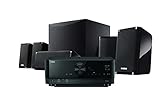
The YHT-5960U is Yamaha's home-theater-in-a-box: a Yamaha 5.1-channel receiver, five speakers and a powered subwoofer in one carton. It's the simplest way to get a complete Yamaha surround system, with matched components and no need to research speaker sensitivity or impedance.
It suits a particular buyer: someone who wants real surround sound in a living room or bedroom, values the convenience of one box, and isn't planning to upgrade piece by piece. The included receiver handles calibration, so setup is mostly running wires and placing speakers. Our setup guide covers speaker placement for 5.1.
The trade-offs are typical of packages. The bundled speakers are small satellites and the sub is compact, so output and bass depth trail a system built from separates like the RX-V4A with Polk Monitor XT20 bookshelves and a 12-inch subwoofer. The bundled receiver is an entry model without Dolby Atmos height channels or the HDMI 2.1 features of the RX-V4A and RX-V6A, so connect consoles to the TV and route audio back to the receiver. Yamaha has updated bundle components over time, so check the current listing for the exact receiver model included.
Compared with a budget soundbar system such as the Sony HT-S40R, the Yamaha takes more wiring but adds a real receiver, YPAO calibration and 4K HDR pass-through, including Dolby Vision. For more options, see our budget home theater system guide.
Pros
- YPAO auto-calibration takes the guesswork out of setup
- 4K HDR pass-through including Dolby Vision
- Matched speakers and powered sub in one box
- Yamaha receivers have a good reliability reputation
Cons
- 5.1 only, so no Atmos upgrade path
- Compact satellites limit dynamics in big rooms
- No 4K120 pass-through for current consoles

5. Yamaha NS-SW100
$150–$250 · Best for: Small rooms with Yamaha receivers at moderate volume
- Driver
- 10-inch
- Amplifier
- 50 W
- Inputs
- LFE/line-level RCA
- App/EQ
- None (use your receiver's room correction)
The NS-SW100 is a compact 10-inch powered subwoofer that matches Yamaha's receivers and speakers in looks. It's designed for small to medium rooms, and it's a common upgrade for owners of Yamaha packages whose bundled sub is smaller.
In a room under about 1,500 cubic feet (a 12 × 14 × 8-foot room is 1,344), a 10-inch sub like this can add real weight to movies, especially placed near a wall or corner to take advantage of room gain. Connect it to the receiver's subwoofer output, set your speakers to "Small" with an 80 Hz crossover, and run YPAO afterward.
The trade-off: a 10-inch driver with a modest amp can't match the output or depth of 12-inch subs. A 12-inch driver has about 45% more cone area, so in medium or large living rooms, or at high movie volumes, a sub like the Klipsch R-120SW or SVS SB-1000 Pro will sound fuller and cleaner. Yamaha's receivers work with any sub that has an LFE input, so there's no need to stay in-brand for bass.
Who it suits: small rooms, bedrooms and owners who want a matched Yamaha look. For bigger spaces, check our budget subwoofer guide for more output for the money.
Pros
- Compact cabinet
- Pairs neatly with Yamaha receivers
- Simple setup
Cons
- 50 W amp limits headroom
- Rivals offer 12-inch drivers at similar prices
- No app or built-in EQ

6. Yamaha A-S501 Integrated Amplifier
$500–$700 · Best for: 2.1 systems for music and TV in one room
- Channels
- 2
- Power (rated)
- 85 W/ch (8 Ω, 20 Hz–20 kHz, 0.019% THD)
- Inputs
- Optical and coaxial digital, phono (MM), line-level RCA
- Features
- Built-in DAC, subwoofer output, Pure Direct mode, tone controls
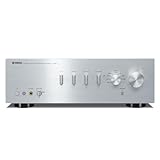
Not every Yamaha system needs surround. The A-S501 is a stereo integrated amplifier rated at 85 W per channel into 8 ohms (20 Hz–20 kHz), and it's the Yamaha to buy if music matters most but you still want your TV to sound better.
It has optical and coaxial digital inputs with a built-in DAC, so you can connect the TV's optical output directly, a phono stage for a turntable, and a subwoofer output for a 2.1 system. Pure Direct mode bypasses the tone controls for the cleanest path. Add a pair of good bookshelf speakers and a sub, and you have a TV-and-music system that often outperforms soundbars with music.
The trade-off: no HDMI, no surround decoding and no home theater bypass input. The TV downmixes surround soundtracks to stereo over optical, and the sub output is a simple filtered feed without the bass management and room correction of an AV receiver. If you plan on 5.1 later, the RX-V4A is the natural step, and the A-S501 can move to another room.
Compared with the Denon PMA-600NE, the A-S501 has more power and a dedicated sub output; the Denon adds Bluetooth. It's the best Yamaha home theater amplifier for a 2.1 setup. Our amplifier guide covers power amps for surround systems.
Pros
- 85 W/ch rated at 8 Ω, 20 Hz–20 kHz, 0.019% THD
- Optical and coaxial DAC for TV audio
- Subwoofer output for a 2.1 system
- MM phono stage for a turntable
Cons
- Stereo only: no surround or Atmos
- No HDMI or eARC
- No built-in streaming
4. Yamaha Home Theater Review Side by Side
| Product | Score | Price | Channels | Power (rated) | Room correction | Atmos/DTS:X | Buy |
|---|---|---|---|---|---|---|---|
| Yamaha RX-V6A Best Yamaha Receiver for Most Rooms | 80 | $600–$800 | 7.2 | 100 W/ch (8 Ω, 20 Hz–20 kHz, 0.06% THD, 2 ch driven) | YPAO | Dolby Atmos and DTS:X, up to 5.1.2 | Amazon → |
| Yamaha RX-V4A Best Budget Yamaha Receiver | 73 | $450–$600 | 5.2 | 80 W/ch (6 Ω, 20 Hz–20 kHz, 2 ch driven) | YPAO | Decodes Dolby Atmos and DTS:X; virtual height only | Amazon → |
| Yamaha AVENTAGE RX-A4A Best Premium Yamaha Receiver | 81 | $1,000–$1,400 | 7.2 | 110 W/ch (8 Ω, 20 Hz–20 kHz, 0.06% THD, 2 ch driven) | YPAO | Dolby Atmos and DTS:X, up to 5.1.2 | Amazon → |
| Yamaha YHT-5960U Home Theater System Best Yamaha Home Theater in a Box | 71 | $550–$700 | 5.1 | — | YPAO | No | Amazon → |
| Yamaha NS-SW100 Best Yamaha Subwoofer | 66 | $150–$250 | — | — | — | — | Amazon → |
| Yamaha A-S501 Integrated Amplifier Best Yamaha Amp for Music and TV | 80 | $500–$700 | 2 | 85 W/ch (8 Ω, 20 Hz–20 kHz, 0.019% THD) | — | — | Amazon → |
5. What Yamaha Does Well
Setup and usability. Yamaha's on-screen setup guide and app are among the clearest in the category. First-time receiver buyers consistently report fewer headaches with Yamaha than with denser Denon or Onkyo menus. The remote is sensibly laid out, and scene buttons let you switch source, volume and DSP mode at one press.
Multiroom music. MusicCast lets one app control Yamaha receivers, soundbars and wireless speakers throughout the house. It works alongside AirPlay 2, Spotify Connect and Bluetooth, so it's flexible even if you don't buy other Yamaha gear.
Honest specs. Yamaha quotes full-bandwidth, two-channel-driven ratings with THD figures, and its US sheet even shows the RX-V4A's rating at 6 ohms rather than hiding the test load. That makes comparison easier for buyers who read the details.
Music voicing. Owners often describe Yamaha receivers as clean and neutral with music, and Pure Direct mode bypasses processing for stereo listening. If your front speakers double as your music system, that matters.
Reliability. Yamaha's amplifier sections have a good long-term reputation, and the brand has a broad US dealer and service network.
6. Where Yamaha Falls Short
Room correction depth. YPAO is reliable and easy, but it gives you less control than Audyssey MultEQ XT32 (Denon's higher models) or Dirac Live (Onkyo, Pioneer, and Denon and Marantz upgrades). If you have two subwoofers or a tricky room, that difference can be audible.
Channels for the money. At similar prices, Denon typically offers more amplified channels or more processing. Yamaha's RX-V6A and RX-A4A both top out at seven channels, so 5.1.4 Atmos needs a higher AVENTAGE model, whereas Denon's AVR-X3800H offers nine channels and 11.4 processing.
Slower updates. Yamaha's current receiver lines launched in 2020. That's not a problem in itself, since HDMI 2.1 and eARC are included, but rivals have released newer models more frequently. Check for successors before buying, and buy current production stock.
Early HDMI 2.1 hiccups. Like several brands, Yamaha's first HDMI 2.1 receivers had a 4K/120 compatibility issue with the Xbox Series X, which Yamaha addressed. Update firmware on day one.
Packages are basic. The YHT-5960U is convenient, but bundled speakers and subs trail separates of similar total cost.
7. Yamaha vs Denon, Sony and Onkyo
| Yamaha | Denon | Sony | Onkyo / Pioneer | |
|---|---|---|---|---|
| Strength | Ease of use, MusicCast, music voicing | Channels per dollar, Audyssey tiers, expandability | Bravia integration, 360 Spatial Sound Mapping | Dirac Live at lower prices, THX models |
| Room correction | YPAO | Audyssey MultEQ / XT / XT32, Dirac on higher models | Sound Field Optimization | AccuEQ or MCACC, Dirac Live |
| Multiroom | MusicCast | HEOS | Chromecast | Chromecast on many models |
| Best for | Living rooms, music lovers, first-time buyers | Growing Atmos systems | Sony TV owners | Tinkerers, tricky rooms |
Is Denon or Yamaha better? Denon is better if you want the most channels and the best room correction for your money, and if your system will grow toward 5.1.4 or 7.1.4. Yamaha is better if you want simple setup, great multiroom music and a receiver that's pleasant to live with. For a 5.1 or 5.1.2 living room, both are excellent; the RX-V6A and Denon AVR-X1800H are closely matched.
Yamaha vs Sony: Sony's STR-AN1000 suits Bravia TV owners and adds virtual-speaker processing; Yamaha has better calibration and multiroom.
Yamaha vs Onkyo: the Onkyo TX-NR6100 offers Dirac Live and THX certification at a similar level; Yamaha is easier to use and has a broader support network. Our receiver guide ranks all of them.
8. Choosing the Best Yamaha Home Theater Receiver for Your Speakers
Match the receiver to your speaker count first:
- 5.1 (five speakers and a sub): RX-V4A. Best value, HDMI 2.1, YPAO.
- 5.1.2 Atmos or 7.1: RX-V6A. The best Yamaha receiver for most living rooms.
- 5.1.2 with premium build and Surround:AI: RX-A4A.
- 5.1.4 or bigger: a higher AVENTAGE model, or a Denon AVR-X3800H if you're open to other brands.
- One-box convenience: YHT-5960U.
- Stereo or 2.1 music-first: A-S501.
Best speakers for a Yamaha receiver? Yamaha receivers are happiest with 6–8 ohm speakers of average or better sensitivity (87 dB and up). Good matches include the Polk Monitor XT range, ELAC Debut 2.0 and Klipsch Reference series. Avoid hard-to-drive 4-ohm towers unless you add an external amplifier. Our home theater speakers guide covers full systems.
9. Who Should Skip Yamaha
Skip Yamaha if: you want 5.1.4 or 7.1.4 Atmos at mainstream prices, you want Dirac Live or Audyssey XT32-level room correction, or you need four independent subwoofer outputs for a dedicated room. Denon's X-series or a Dirac-equipped Onkyo such as the TX-RZ50 is the better fit.
Also skip it if you don't want wired speakers at all. A soundbar or wireless system is simpler; see our best home theater systems guide for all-in-one options, including soundbar packages.
Stick with Yamaha if you want a receiver that's easy to live with, you play a lot of music, or you already use MusicCast speakers around the house.
10. Common Mistakes to Avoid
Buying a five-channel Yamaha for an Atmos plan
The RX-V4A decodes Atmos but has no outputs for height speakers. For 5.1.2, start at the RX-V6A.
Assuming AVENTAGE means more channels
The RX-A4A is still seven channels. AVENTAGE adds build quality, Surround:AI and better YPAO, not extra speakers. For 5.1.4, look higher in the range or at Denon.
Skipping firmware updates
Yamaha's 2020 HDMI 2.1 receivers have had important fixes for 4K/120 and streaming. Update before calibrating.
Running YPAO from one seat on the sofa cushion
Use a tripod at ear height and measure every position the receiver offers within your seating area for the best result.
Pairing an entry Yamaha with 4-ohm towers
Yamaha's mainstream receivers are best with 6–8 ohm speakers. Demanding 4-ohm loads at high volume call for an external amp.
11. Frequently Asked Questions
What is the best Yamaha home theater receiver?
The Yamaha RX-V6A is the best Yamaha home theater receiver for most people. It has seven channels at 100 W each (8 ohms, two channels driven) for 5.1.2 Atmos, HDMI 2.1 with 4K/120 support, YPAO calibration and MusicCast. Choose the RX-V4A for a budget 5.1 system or the AVENTAGE RX-A4A for premium build.
Is Denon or Yamaha better?
Denon is better for channel count, room correction and expandability, with Audyssey MultEQ XT and XT32 and Dirac options on higher models. Yamaha is better for ease of use, multiroom music with MusicCast and a clean, music-friendly sound. For a 5.1 or 5.1.2 living room, both are excellent; for 5.1.4 at mainstream prices, Denon wins.
Are Yamaha receivers reliable?
Yes. Yamaha receivers have a good long-term reliability reputation, especially their amplifier sections, and the brand has a broad US service network. As with any AVR, HDMI boards are the most common weak point, so keep firmware updated and give the receiver several inches of ventilation space above.
What is the best Yamaha home theater system in a box?
The Yamaha YHT-5960U is Yamaha's home-theater-in-a-box: a 5.1 receiver, five speakers and a powered subwoofer in one package. It's the easiest complete Yamaha system for a living room or bedroom, though separates like the RX-V4A with bookshelf speakers and a 12-inch sub sound better for similar total money.
What speakers are best for a Yamaha receiver?
Speakers rated at 6–8 ohms with sensitivity of 87 dB or higher suit Yamaha receivers best. Good matches include Polk Monitor XT, ELAC Debut 2.0 and Klipsch Reference speakers. Avoid hard-to-drive 4-ohm towers unless you add an external amp, and add a 12-inch subwoofer for movies.
What is the difference between Yamaha RX-V and AVENTAGE?
RX-V is Yamaha's mainstream receiver line; AVENTAGE (RX-A) is the premium line. AVENTAGE models add a more rigid chassis with an anti-resonance center foot, more advanced YPAO with multipoint measurement, Surround:AI and more power. At the entry level, both lines top out at seven channels.
Do Yamaha receivers support Dolby Atmos?
Yes. Current Yamaha receivers decode Dolby Atmos and DTS:X. The seven-channel RX-V6A and RX-A4A can power a 5.1.2 layout with two height speakers. The five-channel RX-V4A decodes Atmos but has no height outputs, so it plays Atmos content on ear-level speakers only.
Every Yamaha Product We Track
See the full Yamaha brand page for spec sheets and scores on all 7 models.
Related Guides
AV Receivers
Best Home Theater Receiver
The best home theater receiver for 5.1, 7.2 and Dolby Atmos rooms, ranked on real channel counts, rated power, 4K/120 HDMI and room correction.
AV Receivers
Best Budget Home Theater Receiver
The best budget home theater receiver picks for 5.1 and 5.1.2 Atmos, ranked by what each tier gets you: 4K/120 HDMI, room EQ and honest watts.
Home Theater Systems
Best Home Theater Systems
The best home theater systems for 2026, from all-in-one Atmos soundbar kits to 5.1 speaker packages. Eight picks ranked on spec-sheet maths and room size.
The Bottom Line
Yamaha builds some of the easiest, most music-friendly home theater gear you can buy. The RX-V6A is the best Yamaha home theater receiver for most rooms, the RX-V4A is the budget 5.1 choice, and the AVENTAGE RX-A4A adds premium build and Surround:AI. The YHT-5960U is the one-box option, the NS-SW100 is a matched sub for small rooms, and the A-S501 is the pick for a music-first 2.1 setup. If you want more channels or deeper room correction for the money, look at Denon instead.
More in Brand Reviews
Brand Reviews
Best Bose Home Theater System
The best Bose home theater system for your room, how to build it in stages, and where Sonos, Samsung or Klipsch give you more sound for the same money.
Brand Reviews
Best Epson Projector for Home Theater
Which is the best Epson projector for home theater? Our 2026 Epson review ranks 6 models from the 880 to the LS9000, with lumens and throw maths for each.
Brand Reviews
Best Klipsch Speakers for Home Theater
The best Klipsch speakers for home theater, from RP-600M II to RP-8000F II, plus the best home theater receiver for Klipsch speakers, with the power maths.
Brand Reviews
Best Polk Speakers for Home Theater
The best Polk speakers for home theater, from Monitor XT to Signature Elite and Reserve, plus the best Polk Audio home theater system and subwoofer for you.
Brand Reviews
Best Home Theater for Samsung Smart TV
The best home theater for Samsung smart TVs: HW-Q990F, HW-Q800F, Q-Symphony explained, receiver options and the best Samsung TV for a home theater build.
Brand Reviews
Best Sonos Home Theater Setup
The best Sonos home theater setup for your room and budget: Beam plus Sub 4, Arc Ultra plus Era 100s, or the full Arc Ultra build, with room maths for each.