Brand Reviews
Best Klipsch Speakers for Home Theater
We research every product against its spec sheet and independent measurements. When you buy through our links we may earn a commission, at no cost to you. How we score · Disclosure
The best Klipsch speakers for home theater for most rooms are the RP-600M II bookshelf speakers paired with the RP-504C II center, with the RP-8000F II towers as the step up for big rooms. This page is for anyone building a receiver-based system who likes the lively, punchy sound Klipsch's horn tweeters are known for.
We also answer the second question every Klipsch buyer asks: which is the best home theater receiver for Klipsch speakers? Because Klipsch designs are unusually efficient, you need far less power than you might think. The maths is below, built on Klipsch's spec sheets and owner reports rather than lab benches.
Our top picks at a glance


Quick answer
The best Klipsch speakers for home theater are the Reference Premiere RP-600M II bookshelf speakers with the RP-504C II center for most rooms, or RP-8000F II towers for large rooms. On a budget, the Reference Theater Pack is the easiest 5.1 start. For a receiver, the Denon AVR-X1800H is the best match for most Klipsch systems: Klipsch's high sensitivity means its rated power is plenty, and Audyssey helps tame the bright horn treble.
On this page
- 1. The Short Verdict
- 2. Who Klipsch Is
- 3. The Klipsch Home Theater Lineup, Ranked
- 4. Klipsch Speakers for Home Theater Side by Side
- 5. Best Home Theater Receiver for Klipsch Speakers
- 6. Building the Best Klipsch Home Theater System
- 7. What Klipsch Does Well
- 8. Where Klipsch Falls Short
- 9. Klipsch vs Polk, SVS and Sony
- 10. How We Ranked the Best Klipsch Speakers for Home Theater
- 11. Who Should Skip Klipsch
- 12. Common Mistakes to Avoid
- 13. Frequently Asked Questions
1. The Short Verdict
Klipsch is one of the best speaker brands for home theater if you like an exciting, dynamic sound. Its horn-loaded tweeters and efficient designs play loud on modest power, dialogue cuts through clearly, and movies have real punch. For most people the RP-600M II and RP-504C II are the right core; big rooms should step up to RP-8000F II towers, and tight budgets should start with the Reference Theater Pack.
The trade-off is character. Some listeners find horn treble bright or forward, especially in hard, echoey rooms. If you prefer a softer, more laid-back sound, look at Polk Audio instead.
On receivers: you do not need a powerful amp to drive Klipsch speakers. You need good room correction and enough channels. That is why a Denon AVR-X1800H is our default pick.
2. Who Klipsch Is
Klipsch was founded in 1946 by Paul W. Klipsch in Hope, Arkansas, and is now headquartered in Indianapolis while still building its Heritage speakers in Hope. Its first product, the Klipschorn, used horn loading to get huge volume from small amplifiers, and that idea runs through every Klipsch speaker today.
The current home theater range has three main tiers:
- Reference: the budget line, with spun-copper woofers and horn tweeters. Includes the R-50M, R-600F, R-50C and the Atmos-ready R-625FA.
- Reference Premiere: the mid-range line, with Cerametallic woofers, titanium tweeters and Tractrix horns. Includes the RP-600M II, RP-504C II and RP-8000F II.
- Heritage: premium, US-built speakers like the Forte IV.
Klipsch also makes subwoofers, in-wall and in-ceiling models such as the CDT-5650-C II and R-5650-W II, powered speakers like The Fives II and the Flexus Core 300 soundbar. Its parent company also owns the Onkyo and Pioneer home AV brands. See everything on our Klipsch brand page.
3. The Klipsch Home Theater Lineup, Ranked

1. Klipsch RP-600M II Bookshelf Speakers
$500–$650 per pair · Best for: Medium rooms where you want loud, dynamic movie sound from a mid-priced receiver
- Drivers
- 1-inch titanium LTS tweeter on 90x90 Hybrid Tractrix horn; 6.5-inch Cerametallic woofer
- Sensitivity
- 96 dB (2.83 V / 1 m)
- Frequency response
- 45 Hz–25 kHz ±3 dB
- Impedance
- 8 ohms
Why it wins: The RP-600M II is the sweet spot of Klipsch's Reference Premiere range and the speaker we would build most systems around. It pairs a 6.5-inch Cerametallic woofer with a 1-inch titanium tweeter in a Tractrix horn, the design that gives Klipsch its trademark detail and dynamic punch. As front left and right speakers it is big enough to sound full in medium rooms; as surrounds behind a set of towers, it is a serious upgrade over typical small satellites.
The horn is the key feature. It focuses the treble toward the listening area and makes the speaker very efficient, so even a modest receiver drives it to loud, clean levels. It is also easy to place on stands or a sturdy shelf.
The trade-off: the rear-firing port. Leave at least several inches between the cabinet and the wall, or bass can get boomy. Some listeners also find the horn treble bright with harsh recordings; room correction and toe-in help.
Who it suits: rooms up to roughly 3,000 cubic feet, paired with a subwoofer. Compared with the RP-8000F II towers below, you give up bass extension and some scale but save a lot of floor space and money. Against Polk's Signature Elite ES20, the Klipsch plays louder per watt and sounds more forward; the Polk sounds a little softer and warmer.
Pros
- 96 dB sensitivity: about 22 W reaches 100 dB peaks at 10 ft
- 6.5-inch woofer rated to 45 Hz (±3 dB)
- Dynamic, punchy delivery that suits action films
- Matches the RP-504C II center and RP towers
Cons
- Treble can sound bright in hard-surfaced rooms
- Large for a bookshelf; needs deep shelves or stands
- Horn dispersion rewards careful toe-in

2. Klipsch RP-8000F II Floorstanding Speaker
$600–$800 each · Best for: Medium to large rooms where you want reference-level movie sound from a mid-priced receiver
- Drivers
- 1-inch titanium LTS tweeter on 90x90 Hybrid Tractrix horn; dual 8-inch Cerametallic woofers
- Sensitivity
- 98 dB (2.83 V / 1 m)
- Frequency response
- 32 Hz–25 kHz ±3 dB
- Impedance
- 8 ohms
Why it wins: The RP-8000F II is the biggest tower in the Reference Premiere line and the right choice for large rooms and dedicated theaters. It uses dual 8-inch Cerametallic woofers with the same horn-loaded titanium tweeter as the RP-600M II, so it delivers the same lively character with far more bass weight and headroom.
Two 8-inch woofers per side give you a lot of cone area. That means these towers can play loud with movies even before a subwoofer takes over, and they blend more easily with a sub at an 80 Hz crossover because they are comfortable well below that point. They are also a strong music speaker in a 2.1 setup.
The trade-off: size. These are tall, deep cabinets that need space around them, and the rear-firing ports want a gap from the back wall. In a small room they can overwhelm the space and the bass can turn boomy.
Who it suits: rooms over about 3,000 cubic feet, open-plan spaces and anyone who wants towers to anchor a 5.1 or 7.1 system. Pair them with the RP-504C II center and RP-600M II surrounds for a fully matched front stage. Against the RP-600M II above, you get deeper bass and more output; against the Klipsch R-625FA below, you get stronger bass but no built-in Atmos height drivers.
Pros
- 98 dB sensitivity: about 45 W reaches 105 dB peaks at 10 ft
- Dual 8-inch woofers rated to 32 Hz (±3 dB)
- Dynamic, punchy sound for action films
- Matches the RP-504C II center
Cons
- Large cabinet dominates small rooms
- Horn treble can be bright in hard rooms
- Sold individually, so a pair costs double the band

3. Klipsch RP-504C II Center Channel Speaker
$450–$650 each · Best for: Klipsch RP-series systems where dialogue needs to stay clear at high volume
- Type
- Center channel, horn-loaded
- Drivers
- 1-inch titanium LTS tweeter on Hybrid Tractrix horn; 5.25-inch Cerametallic woofers
- Impedance
- 8 ohms
- Sold as
- Each
Why it wins: In a home theater, the center channel carries most of the dialogue, and the RP-504C II is the best center Klipsch makes for most systems. It uses four 5.25-inch Cerametallic woofers around a horn-loaded titanium tweeter, so it has the cone area to match RP-600M II or RP-8000F II fronts in volume and character.
Matching matters. When the center uses the same tweeter and woofer materials as the front left and right speakers, voices and effects pan across the screen without changing tone. That is the single best reason to buy a Klipsch center if your fronts are Klipsch.
The trade-off: it is a large, heavy center. Measure your TV stand depth and width before buying, and make sure it will not block the bottom of the screen. If space is tight, the smaller Klipsch R-50C from the Reference line is easier to fit, but it is a better match for Reference speakers than for Reference Premiere.
Who it suits: anyone building a Reference Premiere system, and anyone who struggles to hear dialogue clearly. Place it as close to ear height as you can and angle it up toward the seats if it sits low. Compared with simply running a phantom center, a dedicated center like this keeps voices locked to the screen for everyone on the sofa, not only the person in the middle.
Pros
- Titanium horn tweeter matches RP II fronts
- Very easy to drive with lots of headroom
- Big, clear dialogue at reference volume
- Solid build
Cons
- Large and heavy; check your stand
- Bright in hard-surfaced rooms
- Costs more than many fronts

4. Klipsch R-625FA Dolby Atmos Floorstanding Speaker
$400–$600 each · Best for: Renters and anyone who wants Atmos height without cutting ceiling holes
- Type
- Floorstanding with built-in Dolby Atmos elevation module
- Drivers
- 1-inch aluminum LTS tweeter on 90x90 Tractrix horn; dual 6.5-inch spun-copper IMG woofers; top-mounted up-firing Atmos module
- Impedance
- 8 ohms
- Sold as
- Each
Why it wins: The R-625FA is the easiest way to add Dolby Atmos height channels to a Klipsch system without cutting holes in your ceiling. It is a Reference series tower with dual 6.5-inch spun-copper woofers, a horn-loaded tweeter and a built-in up-firing Atmos elevation module on top that bounces height effects off the ceiling.
That makes a 5.1.2 system possible with the same number of boxes as a 5.1 system. With a seven-channel receiver such as the Denon AVR-X1800H, you run the towers, the elevation modules, a center and two surrounds, and the receiver does the rest. Klipsch also sells it as a complete R-625FA 5.1.2 system with an R-52C center, two R-41M surrounds and a 10-inch, 300 W R-100SW subwoofer.
The trade-off: reflected height works best under flat ceilings of normal living-room height. Vaulted, very high or acoustically absorbent ceilings weaken the effect, and in-ceiling speakers will always give more precise overhead sound. The Reference series also uses simpler cabinets and finishes than Reference Premiere.
Who it suits: medium rooms where you want Atmos without extra speakers or ceiling work. Against the RP-8000F II above, you give up some bass and refinement but gain height channels. If you already own Klipsch towers, the separate R-41SA elevation speakers add the same effect on top of existing speakers.
Pros
- Built-in Atmos module saves separate height speakers
- Horn-loaded main section is very easy to drive
- Dual 6.5-inch woofers for solid midbass
- No ceiling installation needed
Cons
- Each tower uses two amplifier channels
- Height effect depends on a flat, reflective ceiling
- Previous-generation Reference model; stock varies

5. Klipsch Reference Theater Pack 5.1
$500–$700 · Best for: Small rooms and apartments that want discrete 5.1 without big speakers
- Channels
- 5.1
- Subwoofer
- 8-inch powered, front-firing
- Surrounds
- Included (four identical satellites)
- Amplification
- Passive speakers; needs an AV receiver
Why it wins: The Reference Theater Pack is the simplest way into Klipsch surround sound. In one box you get four compact satellites, a matching center and an 8-inch powered subwoofer, ready to connect to any AV receiver for a 5.1 system. The satellites are small enough to wall-mount or sit on shelves, and they keep Klipsch's horn-loaded tweeter design, so the family sound is there.
In a small room or apartment, that compact size is the point. Four satellites and a center take up a fraction of the space of bookshelf speakers, and an 8-inch sub is a sensible size for a room under about 2,000 cubic feet.
The trade-off: small satellites cannot play as low or as loud as the RP-600M II, and the 8-inch sub runs out of headroom in larger spaces. It suits TV, streaming and moderate movie volumes better than demanding action films in a big room.
Who it suits: apartments, bedrooms, small living rooms and first-time buyers who want real 5.1 with a receiver for a sensible outlay. Pair it with an entry receiver like the Denon AVR-S770H for a complete system that still costs less than most premium soundbar setups. If you later move to bigger speakers, the satellites make good surrounds in another room.
Pros
- Compact, wall-mountable satellites that disappear in a room
- Horn-loaded tweeters keep dialogue clear at low volume
- Powered 8-inch sub included, so a basic receiver can run it
- Cheaper than buying five separate speakers and a sub
Cons
- Small 3-inch woofers need a high 100–120 Hz crossover
- Runs out of headroom in large or open-plan rooms
- No receiver included and no Atmos path inside the kit

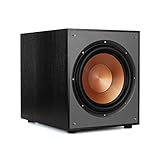
6. Klipsch R-120SW
$300–$400 · Best for: Medium living rooms on a budget
- Driver
- 12-inch copper-spun
- Amplifier
- 200 W RMS / 400 W peak
- Frequency response
- 29–120 Hz ±3 dB
- Enclosure
- Front-firing, ported
Why it wins: The R-120SW is one of the most popular budget subwoofers in home theater, and it is the natural partner for Klipsch speakers. The spec sheet lists a 12-inch copper-spun woofer, a 200 W RMS (400 W peak) amplifier and a frequency response of 29–120 Hz ±3 dB from a front-firing, ported cabinet.
Do the room maths and it makes sense: a 12-inch driver with that much power has the output for medium living rooms around 2,000 to 3,000 cubic feet. The front-firing design also makes placement easy, and its looks match Klipsch's Reference speakers.
The trade-off: that 29 Hz lower limit. The deepest notes in modern film soundtracks go lower, and sealed or larger ported subs from brands like SVS reach further down with tighter control. Owners also report it can sound boomy if pushed into a corner without room correction.
Who it suits: budget and mid-range Klipsch systems in medium rooms. If you have more to spend, Klipsch's SPL-120 is a step up, and the SVS SB-1000 Pro adds app-based EQ. In a large room, two R-120SWs often beat one bigger sub, because a second sub smooths out bass peaks and nulls between seats. See our best subwoofer for home theater guide for more options.
Pros
- 12-inch driver for the price of many 10-inch subs
- 200 W RMS amp with plenty of mid-bass punch
- Simple setup with LFE input
Cons
- Rolls off below 29 Hz
- No app or built-in room EQ
- Less refined than sealed rivals with music
4. Klipsch Speakers for Home Theater Side by Side
| Product | Score | Price | Type | Drivers | Impedance | Sold as | Buy |
|---|---|---|---|---|---|---|---|
| Klipsch RP-600M II Bookshelf Speakers Best Klipsch for Most Rooms | 86 | $500–$650 per pair | 2-way bookshelf, horn-loaded | 1-inch titanium LTS tweeter on 90x90 Hybrid Tractrix horn; 6.5-inch Cerametallic woofer | 8 ohms | Pair | Amazon → |
| Klipsch RP-8000F II Floorstanding Speaker Best Klipsch Towers for Big Rooms | 86 | $600–$800 each | Floorstanding, horn-loaded | 1-inch titanium LTS tweeter on 90x90 Hybrid Tractrix horn; dual 8-inch Cerametallic woofers | 8 ohms | Each | Amazon → |
| Klipsch RP-504C II Center Channel Speaker Best Klipsch Center Channel | 85 | $450–$650 each | Center channel, horn-loaded | 1-inch titanium LTS tweeter on Hybrid Tractrix horn; 5.25-inch Cerametallic woofers | 8 ohms | Each | Amazon → |
| Klipsch R-625FA Dolby Atmos Floorstanding Speaker Best Klipsch for Dolby Atmos | 79 | $400–$600 each | Floorstanding with built-in Dolby Atmos elevation module | 1-inch aluminum LTS tweeter on 90x90 Tractrix horn; dual 6.5-inch spun-copper IMG woofers; top-mounted up-firing Atmos module | 8 ohms | Each | Amazon → |
| Klipsch Reference Theater Pack 5.1 Best Klipsch for Small Rooms and Budgets | 72 | $500–$700 | — | — | — | — | Amazon → |
| Klipsch R-120SW Best Klipsch Subwoofer for the Money | 78 | $300–$400 | — | — | — | — | Amazon → |
5. Best Home Theater Receiver for Klipsch Speakers
The best home theater receiver for Klipsch speakers is not the most powerful one. It is the one with good room correction and the right number of channels, because Klipsch speakers need so little power.
The sensitivity maths. Speaker sensitivity tells you how loud a speaker plays from 1 watt at 1 meter. Klipsch's horn-loaded models are typically rated in the mid-90s dB; many mainstream speakers sit around 85 to 88 dB. Check the exact figure on each product page. Now run the numbers for a seat 10 feet (about 3 m) away, which loses about 9.5 dB versus 1 meter:
- A 95 dB speaker makes about 85.5 dB at your seat from 1 watt. To hit 105 dB peaks (cinema reference level), you need 19.5 dB more, or about 89 watts.
- An 87 dB speaker makes about 77.5 dB from 1 watt. The same 105 dB peak needs 27.5 dB more, or about 560 watts.
Every 3 dB doubles the power needed, so an 8 dB sensitivity gap means roughly six times the amplifier power. Most people never listen at full reference level, which means even an entry receiver has plenty of headroom with Klipsch.
Our receiver picks for Klipsch:
| Receiver | Channels | Room correction | Best for |
|---|---|---|---|
| Denon AVR-X1800H | 7.2 | Audyssey MultEQ XT | Most Klipsch 5.1 and 5.1.2 systems |
| Denon AVR-X2800H | 7.2 | Audyssey MultEQ XT | More power and features |
| Denon AVR-X3800H | 9.4 | Audyssey MultEQ XT32, Dirac Live upgrade | 5.1.4 systems and multiple subs |
| Onkyo TX-NR6100 | 7.2 | Dirac Live (via update) | Shares a parent company with Klipsch |
| Yamaha RX-V6A | 7.2 | YPAO | Yamaha app and styling fans |
Denon's AVR-X1800H is rated at 80 W per channel into 8 ohms, 20 Hz–20 kHz, at 0.08% THD with two channels driven. By the maths above, that is plenty for a mid-90s dB speaker in a living room. Owners often describe Denon's tuning as slightly warm, which balances the forward Klipsch treble, and Audyssey's room correction can tame the top end further. Klipsch speakers are rated at a nominal 8 ohms, so they are an easy impedance load for any mainstream AVR. Compare more options in our best home theater receiver and budget receiver guides.
6. Building the Best Klipsch Home Theater System
Match the front three. Your left, center and right speakers carry most of a film. Keep them in the same series (all Reference Premiere or all Reference) so the tweeters and woofers match and sound pans smoothly across the screen.
Pick fronts by room size.
| Room volume | Front speakers | Center | Sub |
|---|---|---|---|
| Under 2,000 cu ft | Reference Theater Pack or R-50M | Included or R-50C | 8-inch or R-120SW |
| 2,000–3,000 cu ft | RP-600M II | RP-504C II | R-120SW |
| Over 3,000 cu ft | RP-8000F II | RP-504C II | SPL-120 or two subs |
Add height channels last. Once the 5.1 base is right, go to 5.1.2 with the R-41SA on top of your fronts or in-ceiling models like the R-1650-C. A seven-channel receiver powers 5.1.2; a nine-channel model like the Denon AVR-X3800H powers 5.1.4.
Surrounds can be smaller. Surrounds carry less of the soundtrack. RP-600M IIs or even R-50Ms work well behind or beside the seats at about ear height.
Set the crossover at 80 Hz. Set all speakers to "small" and let the sub handle everything below 80 Hz, even with towers. It frees the receiver's amps and lets room correction manage the bass. For full layout advice, see our home theater setup guide.
7. What Klipsch Does Well
Efficiency. Klipsch speakers get loud on very little power, so even an entry receiver can drive them to cinema levels in a living room.
Dynamics. Horn tweeters respond quickly and stay clean at high volume. Explosions, gunshots and orchestral swells have real snap.
Dialogue. The horn focuses sound toward the seats and reduces reflections from walls, which helps voices stay clear in busy mixes.
Value at the low end. The Reference series and the R-120SW deliver a lot of volume per dollar.
8. Where Klipsch Falls Short
Bright treble for some ears. Horn tweeters can sound forward or harsh in hard, echoey rooms or with bright recordings. Rugs, curtains, toe-in and room correction help.
Rear ports need space. Most Reference and Reference Premiere speakers use rear-firing ports. Push them against a wall and the bass gets boomy.
Big centers. The RP-504C II is large and can be hard to fit under a TV.
Budget subs stop early. The R-120SW's 29 Hz lower limit is fine for the money, but sealed or bigger subs from SVS dig deeper with tighter control.
Hiss with sensitive receivers. Because Klipsch speakers are so efficient, you may hear faint amplifier hiss from the tweeters at idle with some receivers. It is rarely audible from the seat but worth knowing.
9. Klipsch vs Polk, SVS and Sony
Klipsch vs Polk: the classic choice. Polk uses soft-dome tweeters and sounds warmer and smoother; Klipsch sounds more dynamic and plays louder per watt. Polk's Signature Elite line is the most direct rival to Reference Premiere. Read our Polk Audio review.
Klipsch vs SVS: SVS Prime speakers like the Prime Tower have a more neutral sound, and SVS subwoofers dig deeper. Klipsch is more efficient and often cheaper. Many owners mix Klipsch speakers with an SVS sub, which works well.
Klipsch vs Sony: Sony's SS-CS line, like the SS-CS3, costs less but is less sensitive and less dynamic. Klipsch is the better step up. See our Sony home theater review.
Klipsch vs soundbars: louder and DTS:X-capable, but more boxes and cable. See soundbar vs home theater.
10. How We Ranked the Best Klipsch Speakers for Home Theater
We ranked the lineup by how well each speaker serves a real home theater system, using Klipsch's published specs, room-volume maths and owner-reported reliability. We have not bench-tested these speakers in a lab.
The RP-600M II ranks first because it suits the widest range of rooms and roles. The RP-8000F II follows as the best big-room choice. The RP-504C II earns its place because a matched center matters more than any other speaker for dialogue. The R-625FA ranks for adding Atmos without ceiling work, the Theater Pack for small rooms and budgets, and the R-120SW for value bass. For more brands, see our best home theater speakers roundup.
11. Who Should Skip Klipsch
- Listeners sensitive to bright treble, especially in hard, echoey rooms. Polk or SVS will suit you better.
- People who want everything wireless. Klipsch passive speakers need a receiver and speaker cable. Consider a wireless home theater system instead.
- Tiny rooms with speakers against the wall. Rear-ported Klipsch models need breathing room.
12. Common Mistakes to Avoid
Buying a big receiver for power alone
Klipsch speakers are efficient, so a mid-range receiver drives them easily. Spend on room correction, channel count and HDMI features instead of headline watts.
Mixing tweeter types across the front
A Klipsch center with another brand's left and right speakers can make voices change tone as they pan. Keep the front three in the same series.
Pushing rear-ported speakers against the wall
Most Klipsch models port out the back. Leave a gap behind them, or bass will boom. Room correction cannot fully fix a bad placement.
Skipping room correction
Audyssey, YPAO or Dirac Live can tame bright treble and boomy bass in your room. Run calibration after setup and again whenever you move speakers.
Setting towers to large
Even big Klipsch towers sound better with an 80 Hz crossover to the sub. It gives the receiver more headroom and lets the sub handle bass more evenly.
13. Frequently Asked Questions
What are the best Klipsch speakers for home theater?
For most rooms, the best Klipsch speakers for home theater are the RP-600M II bookshelf speakers with the RP-504C II center and an R-120SW sub. Large rooms should use RP-8000F II towers up front. On a tight budget, the Reference Theater Pack gives you a complete 5.1 speaker set in one box.
What is the best receiver for Klipsch speakers?
The Denon AVR-X1800H is the best receiver for most Klipsch speakers. Its rated 80 watts per channel is plenty for efficient Klipsch designs, it has seven channels for 5.1.2 Atmos, and Audyssey room correction helps tame bright horn treble. For 5.1.4 or multiple subs, step up to the AVR-X3800H.
Do Klipsch speakers need a powerful amp?
No. Klipsch speakers are highly sensitive, typically rated in the mid-90s dB, so they need far less power than average speakers for the same volume. A typical receiver rated around 80 watts per channel can drive them to cinema reference levels in a normal living room.
Are Klipsch speakers good for home theater?
Yes. Klipsch speakers are among the most popular for home theater because they play loud on modest power, sound dynamic with action films and keep dialogue clear. The trade-off is a bright, forward treble that some listeners dislike in echoey rooms. Room correction and soft furnishings help.
Are Klipsch speakers too bright?
Some listeners find them bright, especially in hard rooms with bare floors and walls. The horn tweeter is direct and detailed. Toeing the speakers in less, adding rugs and curtains, and running receiver room correction usually tame it. If you prefer a softer sound, Polk is a good alternative.
Is Klipsch better than Polk for home theater?
Neither is better outright. Klipsch is more efficient and dynamic, playing louder per watt with more punch. Polk sounds warmer and smoother with soft-dome tweeters. Choose Klipsch for big, lively movie sound; choose Polk for a relaxed sound in echoey rooms or for long listening sessions.
Every Klipsch Product We Track
See the full Klipsch brand page for spec sheets and scores on all 19 models.
Related Guides
AV Receivers
Best Home Theater Receiver
The best home theater receiver for 5.1, 7.2 and Dolby Atmos rooms, ranked on real channel counts, rated power, 4K/120 HDMI and room correction.
Bookshelf Speakers
Best Home Theater Speakers
The best home theater speakers for 2026: 8 packages, towers, bookshelf and center picks, plus the sensitivity and amp-power maths to build a matched 5.1.
Brand Reviews
Best Polk Speakers for Home Theater
The best Polk speakers for home theater, from Monitor XT to Signature Elite and Reserve, plus the best Polk Audio home theater system and subwoofer for you.
The Bottom Line
The best Klipsch speakers for home theater are the RP-600M II and RP-504C II for most rooms, RP-8000F II towers for large spaces, the R-625FA for Atmos without ceiling speakers, the Reference Theater Pack for small rooms, and the R-120SW for value bass. Pair them with a Denon AVR-X1800H, which has more than enough power for efficient Klipsch speakers plus the room correction to keep their lively treble in check. If you prefer a softer sound, compare Polk before you buy.
More in Brand Reviews
Brand Reviews
Best Bose Home Theater System
The best Bose home theater system for your room, how to build it in stages, and where Sonos, Samsung or Klipsch give you more sound for the same money.
Brand Reviews
Best Epson Projector for Home Theater
Which is the best Epson projector for home theater? Our 2026 Epson review ranks 6 models from the 880 to the LS9000, with lumens and throw maths for each.
Brand Reviews
Best Home Theater for Samsung Smart TV
The best home theater for Samsung smart TVs: HW-Q990F, HW-Q800F, Q-Symphony explained, receiver options and the best Samsung TV for a home theater build.
Brand Reviews
Best Sonos Home Theater Setup
The best Sonos home theater setup for your room and budget: Beam plus Sub 4, Arc Ultra plus Era 100s, or the full Arc Ultra build, with room maths for each.
Brand Reviews
Best Home Theater for Sony Bravia
The best home theater for Sony Bravia TVs: Bravia Theater bars, the Quad, receivers and SS-CS speakers, plus how Acoustic Center Sync works and who it suits.
Brand Reviews
Yamaha Home Theater Review
Yamaha home theater review: the best Yamaha receiver for your room, from RX-V4A to AVENTAGE RX-A4A, plus the YHT-5960U, subs, and Yamaha vs Denon.